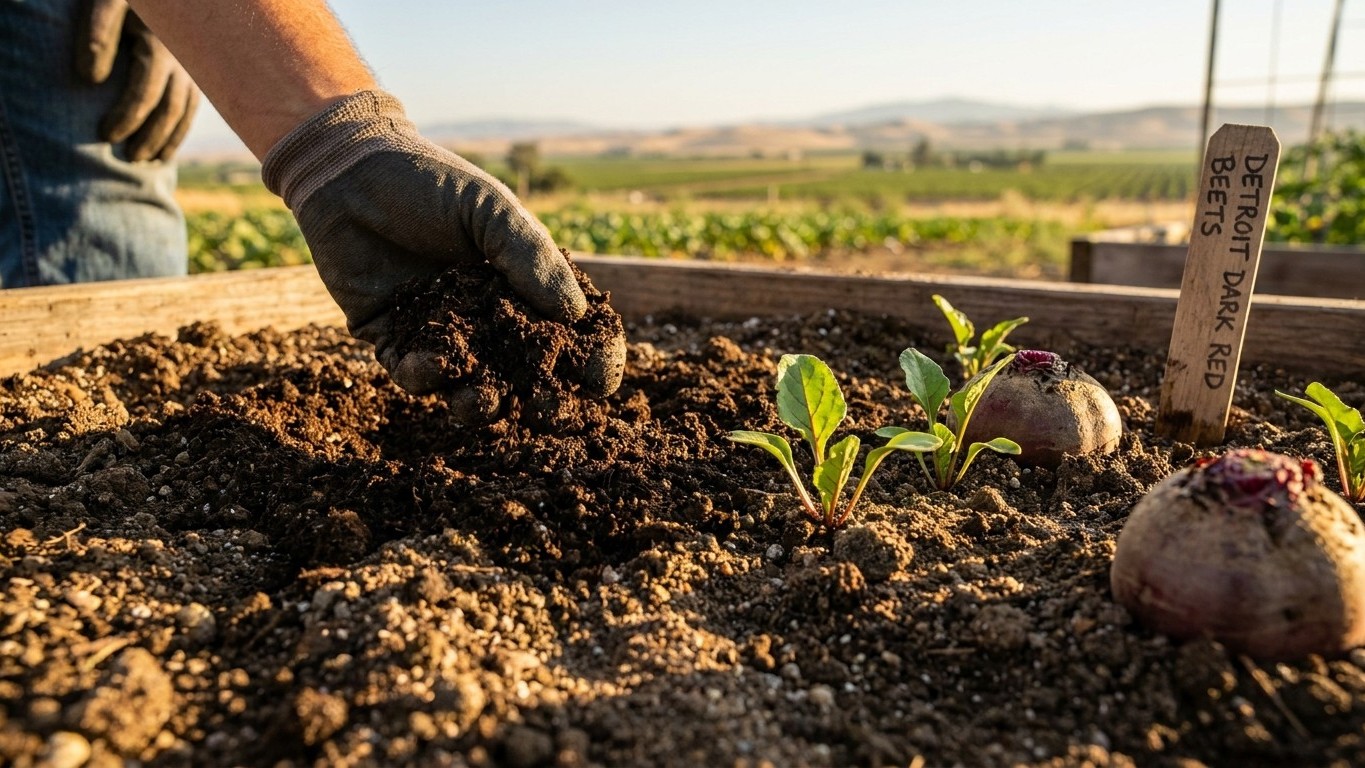

California doesn’t have one climate for beets, it has several, and the difference between the coast and the Central Valley matters more than any planting calendar. The state’s official soil, moderately well-drained loam with a slight acid tilt, sets a baseline. But the real decision point for beets is water in the first six weeks and heat once the root starts to size up. Get those two right and the soil forgives a lot.
The short answer
California’s official state soil is the San Joaquin series, an Alfisol, a forest-derived soil of moderate fertility that holds nutrients reasonably well. Sampled surface horizons run about 51 percent sand, 18 percent clay and 32 percent silt, a loam to silt loam texture, with a surface pH near 6.1 (slightly acid) and organic matter around 0.8 percent. Drainage is classed as moderately well drained. That combination is close to workable for beets: enough sand to keep the root from forking around clumps, enough silt and clay to hold some moisture between waterings, and a pH close to what beets prefer. The organic-matter figure, though, is modest, and Utah State University Extension’s guidance on beets calls for soil rich in organic matter, so a bed built on San Joaquin-type ground benefits from an added inch of composted material worked into the top of the row before sowing, no more — a starting point covered in more detail in this breakdown of Beet Soil in California.
What the soil doesn’t tell you is what the sky does. California’s frost record complicates any single answer for the state. At the reference climate station used for this page, no freeze occurs in an average year at all, a 30-year record with zero days at or below 32 F and a frost-free season listed as 365 days. That’s a coastal and Southern California pattern. Northern California, the Central Valley floor and the Sierra foothills do freeze in a normal year, sometimes hard, and a gardener there is working a different calendar entirely, a distinction worked through in detail in this guide on When to Sow Beets in California. The exact count of days a year the reference station tops 90 F isn’t published in the data behind this page, so it won’t be guessed at here. What the frost record does confirm is the shape of the problem in the milder parts of the state: it’s heat and dryness that push beets toward failure, not cold. Utah State University Extension is specific that water stress in the first six weeks causes premature flowering (bolting), and that heat above 85 F combined with water stress is what turns the root woody. Those are two separate failure paths, not one, and a warm coastal or valley spring can trigger either depending on when the irrigation lapses.
None of this describes any one backyard. California spans hundreds of mapped soil series, from heavy adobe clay in old floodplains to loose decomposed granite in the foothills to sandy river-bottom ground near the Sacramento and San Joaquin deltas. The San Joaquin series is a representative sample of the surface horizon as mapped, not a promise about what’s under a raised bed in Fresno or a rental yard in San Diego. Treat the figures above as a starting tendency, then confirm with a soil test before amending anything.
The six weeks that decide it here
Beets are sown directly in place, never transplanted, and the standard advice is to get seed in the ground 2 to 3 weeks before the last frost. In most of the country that phrase anchors a date. In much of California it anchors almost nothing, because the reference station behind this page shows no computable frost date at all in an average year. For a coastal or Southern California garden, that means the sowing window opens whenever soil temperature and daylight say spring has arrived, not whenever a frost calendar clears. For a Central Valley or Sierra foothill garden, where freezes still happen in a normal year, the older rule still applies and the six-week clock starts from that local last-frost date.
Either way, the six weeks right after sowing are the stretch that decides bolting risk, because that’s the window Utah State University Extension names for water stress triggering premature flowering. California’s spring, broadly, is a season of retreat: winter rain tapers off through March and April and is largely gone by the time early-summer heat sets in, a Mediterranean pattern of wet cool months sliding into dry warm ones. That means the risk in this state isn’t a wet spring drowning the seedbed, it’s a dry spring arriving early and catching a gardener who assumed the winter’s moisture would carry the row through April. A bed that looks damp on top from residual winter rain can still be dry an inch down, right where beet roots are forming, and that’s exactly the kind of stress Utah State University Extension flags as the bolting trigger.
The practical read for California: don’t rely on the calendar frost date the way a gardener in a colder state would, and don’t rely on winter’s leftover moisture either. Track actual soil moisture through those first six weeks, water on a schedule rather than by memory of recent rain, and treat late-winter dry spells, which California gets often, as the real threat window rather than any risk of a late freeze.
What goes wrong here
- Sowing by the frost calendar in a frost-free zone. In coastal and Southern California, waiting for a last-frost date that the record shows doesn’t reliably exist means sowing far later than necessary, pushing the beet’s six-week root-sizing window into hotter weather. Sow instead based on soil temperature and the local extension’s planting calendar, not a frost date this climate doesn’t really have.
- Assuming winter rain covers spring watering. California’s wet season front-loads moisture before the beet’s critical six weeks even begin, then drops off. The remedy is a monitored watering schedule starting at sowing, not a pause until the bed visibly dries.
- Letting heat and thirst overlap. Utah State University Extension is explicit that 85 F combined with water stress is what makes roots woody, a different failure from bolting. In the Central Valley and inland valleys, where summer heat arrives fast, the remedy is consistent deep watering through the entire growing period, not just the first six weeks, plus timing harvest before the hottest stretch rather than letting roots sit in the ground once the weather turns.
- Over-amending a modest-fertility soil. The state soil’s organic matter runs near 0.8 percent, low enough to tempt heavy compost additions. Utah State University Extension caps the recommendation at 1 inch of composted organic matter per 100 square feet; more than that risks excess nitrogen that favors leafy top growth over the root.
- Treating the Central Valley like the coast. A grower working San Joaquin-type ground in the valley still faces real winter freezes in a normal year, unlike the frost-free coastal reference station. Applying a coastal, frost-free sowing calendar to a Central Valley garden risks sowing into ground still cold enough to check germination.
Checking this against your own county
Everything above describes a representative state soil and a single reference climate station, not any particular yard. California’s actual growing conditions split sharply between coast, valley and mountain, and the only way to know which pattern applies to a specific address is a local check. The University of California Agriculture and Natural Resources system runs county-based Cooperative Extension offices across the state, reachable through ucanr.edu, and those offices carry local soil survey data, frost records for the actual county rather than a single reference station, and planting calendars built around each region’s real weather. A quick call or visit before sowing settles the frost question and the soil-texture question at once, for the specific ground being planted rather than the state average.
Common questions
Do beets need a cold spell to grow well in California?
No. Beets don’t require freezing temperatures at any stage. What they do need is a manageable temperature range during root formation, and the risk in most of California is too much heat, not too little cold, particularly once temperatures push past 85 F while the soil is also dry.
How many days from sowing to harvest for beets?
Standard guidance runs 60 to 80 days, counted from the day seed goes into the ground, since beets are sown directly rather than transplanted as seedlings. That window shifts earlier or later depending on soil temperature at sowing and how much heat stress the root faces along the way.
Is bolting the same problem as a woody root?
No, and treating them as one issue is a common mistake. Bolting, premature flowering, is triggered by water stress in the first six weeks after sowing. A woody root is a separate outcome caused by heat above 85 F combined with water stress later in the season. Consistent watering addresses both, but they come from different timing and different triggers.
Should I test my own soil instead of relying on the state soil profile?
Yes. The San Joaquin series figures describe a representative mapped surface horizon for the state, not any individual garden. California covers hundreds of distinct soil series, and a local extension office or a lab soil test will give an actual pH, texture and organic-matter reading for the ground being planted, rather than a statewide approximation.