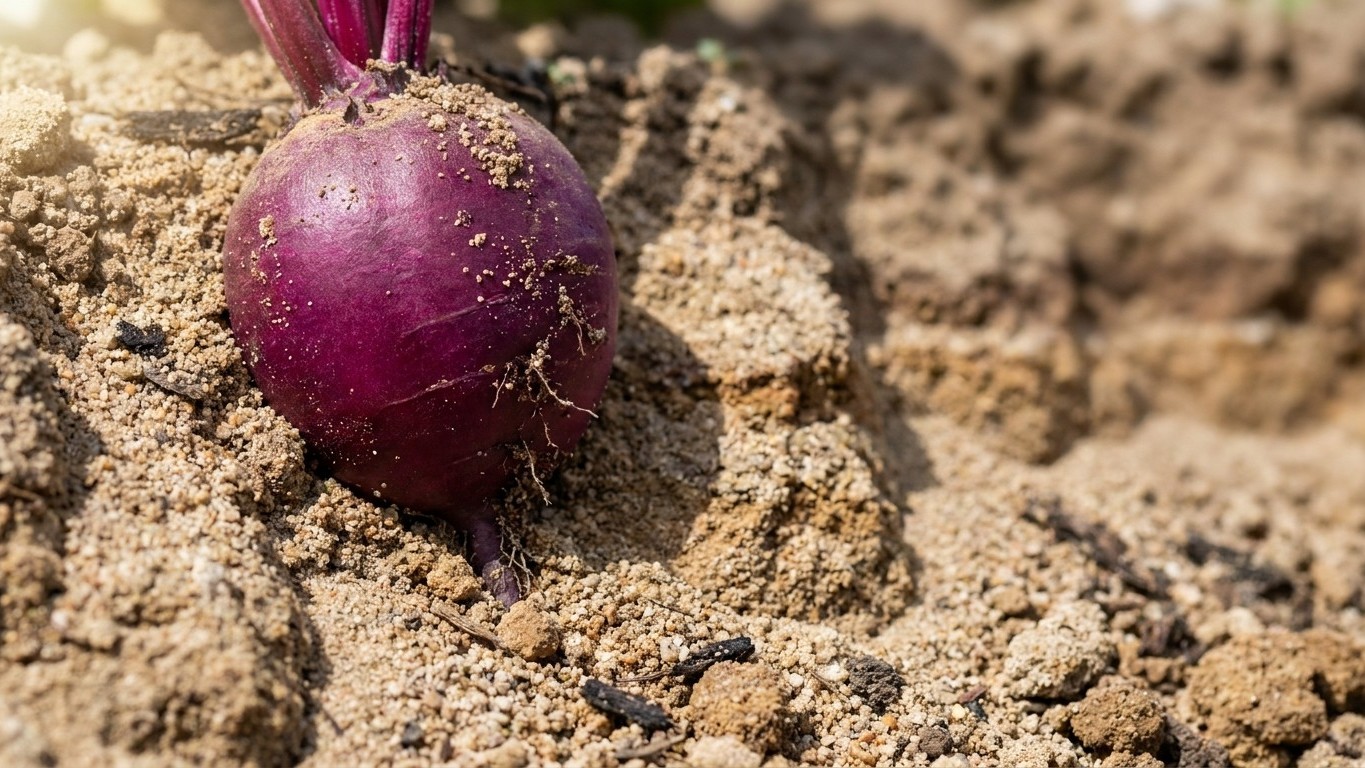

California’s state soil, the San Joaquin series, runs 51 percent sand, 18 percent clay and 32 percent silt with just 0.8 percent organic matter, moderately well drained. Beets want deep, sandy, well-drained ground loaded with organic matter, so this soil gets partway there but falls short on fertility. In the state’s frost-free coastal and southern zones, heat and water, not cold, decide whether the root turns woody.
The short answer
Start with the numbers. The San Joaquin series, an Alfisol, carries a surface pH near 6.1, slightly acid, and a texture of 51 percent sand, 18 percent clay and 32 percent silt, classing it as a loam with a fairly generous sand fraction. Organic matter sits at about 0.8 percent, and drainage is rated moderately well, not excessively drained and not poorly drained. California named this series its official state soil by state law, and USDA’s state soils program keeps the record.
What that texture means for a beet root
Utah State University Extension is blunt about what beets need: deep, sandy, well-drained soil rich in organic matter, amended with no more than 1 inch of composted organic matter per 100 square feet. The San Joaquin series gets the sand fraction roughly right and the drainage class is workable, but 0.8 percent organic matter is thin for a root crop that forges straight and smooth through loose, humus-rich ground. Clay at 18 percent isn’t high enough to choke a beet outright, but it can crust at the surface after a hard rain or a heavy irrigation, which matters more for a seedling pushing through than for the mature root below.
| Property | San Joaquin series (surface) | What beets prefer |
|---|---|---|
| Sand | 51 percent | High sand fraction |
| Clay | 18 percent | Low, to avoid forking and crusting |
| Silt | 32 percent | Moderate |
| Organic matter | about 0.8 percent | Higher, amended annually |
| Drainage | Moderately well drained | Well drained |
On the temperature side, the frost record for the Los Angeles station shows no computable freeze normal at all, zero days at or below 32 F across three decades, and a frost-free season listed at the full 365 days. That’s not a rounding artifact. Coastal and southern California, this station included, simply doesn’t freeze in an average year. The specific count of days each year that climb past 90 F isn’t part of the published record used here, so no number is given for it, but the growing constraint in this climate is heat paired with dry soil, not cold. Utah State’s guidance is that heat above 85 F combined with water stress is what turns a beet root woody, and that’s the mechanism to watch, not a frost date.
None of this describes every yard in the state. California carries hundreds of mapped soil series, and a garden a few miles from where the San Joaquin series was defined can sit on alluvial river-bottom soil, decomposed granite, or fill dirt trucked in during construction, each behaving nothing like the state soil. Treat these numbers as a baseline for what the region’s ground tends to do, then pull a real soil test before amending anything.
The six weeks that decide it here
Beets are sown directly in the ground, never transplanted, and the standard guidance is to put seed in 2 to 3 weeks before the last frost. In most of the country that phrase points to a calendar date. Along coastal and southern California it doesn’t, because there is no last frost in an average year to count backward from. That single fact changes how a gardener should read the six-week rule here: instead of timing sowing against a cold snap that won’t come, the real question is what the soil moisture looks like during the first six weeks after seed goes in the ground, because that window is what governs bolting.
What that window looks like in this climate
Utah State University Extension’s finding is specific: water stress during those first six weeks causes premature flowering, or bolting, in beets. That’s a different failure from the woodiness that comes later from heat plus dryness, and the two shouldn’t be lumped together as “just keep it watered.” Bolting is about the plant’s early signal that conditions are hostile enough to skip growing a root and jump straight to seed; woodiness is a texture problem in a root that’s already sizing up under heat stress. In this region’s frost-free zones, gardeners typically have latitude to sow across a long stretch of the cooler months rather than a narrow spring window, but whenever that six-week clock starts, the soil needs to stay evenly moist, not baked dry between waterings and not flooded either, since the San Joaquin series’ moderate drainage doesn’t forgive standing water for long.
Beets typically run somewhere between 60 and 80 days from seeding to harvest, and that count starts the day seed goes into soil, not from any later transplant date, since beets don’t transplant. That means the six-week bolting window covers roughly the first half to two-thirds of the crop’s life in the ground. Get the moisture wrong there and the plant’s decision is made long before the root has any size to show for it, no matter how the rest of the season goes.
What goes wrong here
- Thin organic matter limits root fill. At roughly 0.8 percent organic matter, San Joaquin-type soil doesn’t hold the crumb structure a beet root needs to size up smoothly. Work in up to 1 inch of composted organic matter per 100 square feet before sowing, per Utah State’s guidance, rather than dumping in more on the theory that extra is better.
- Surface crusting slows germination. The 18 percent clay fraction can cap over after irrigation, trapping beet seedlings, which are already slow and erratic to emerge, under a hard skin. Keep the top inch loose and check moisture daily until seedlings break through.
- Early dry spells trigger bolting. Because this region has no frost date to anchor sowing against, it’s easy to let irrigation slide during the first six weeks. That’s exactly when water stress pushes beets to flower early instead of building a root. Even, consistent moisture in that window matters more than any calendar date.
- Heat plus dry soil later makes roots woody. Once the root is sizing, temperatures above 85 F combined with water stress toughen its texture. Deep, less frequent watering and mulch to hold soil moisture during hot stretches help keep the root from turning fibrous.
- Assuming the state soil is the garden’s soil. The San Joaquin series is a representative surface profile mapped across many components, not a promise about any one backyard. A river-bottom lot, a hillside cut, or a yard filled during construction can carry completely different sand, clay and drainage numbers. A basic soil test settles what’s actually there.
Common questions
Does frost matter for beets in coastal and southern California?
Not in an average year. The Los Angeles-area climate record shows zero days at or below 32 F across three decades and a frost-free season listed at the full 365 days. Farther north, in the Central Valley and the Sierra, frost is a real factor, but it isn’t in this region, and the growing risks to plan for here are heat and dry soil instead.
What is California’s official state soil, and is it likely in my yard?
It’s the San Joaquin series, an Alfisol named the state soil by California law and tracked by USDA’s state soils program. It’s a useful baseline, but California maps hundreds of distinct soil series, so a given garden, especially one on river-bottom ground, a hillside, or disturbed fill, may bear little resemblance to it. A soil test is the only way to know for certain.
How much organic matter should I work into soil like this before planting beets?
Utah State University Extension recommends no more than 1 inch of composted organic matter per 100 square feet. Given that the San Joaquin series carries only about 0.8 percent organic matter naturally, that amendment matters, but more isn’t automatically better; sticking to the recommended amount avoids overloading the bed.
How long does it take beets to mature from seed in this climate?
Beets are sown directly in the ground and typically take somewhere between 60 and 80 days from seeding to harvest, never counted from a transplant since beets don’t transplant well. In frost-free zones, that window can fall across a wide stretch of the cooler months rather than a single tight spring slot, but the first six weeks after seeding remain the period when even soil moisture matters most.