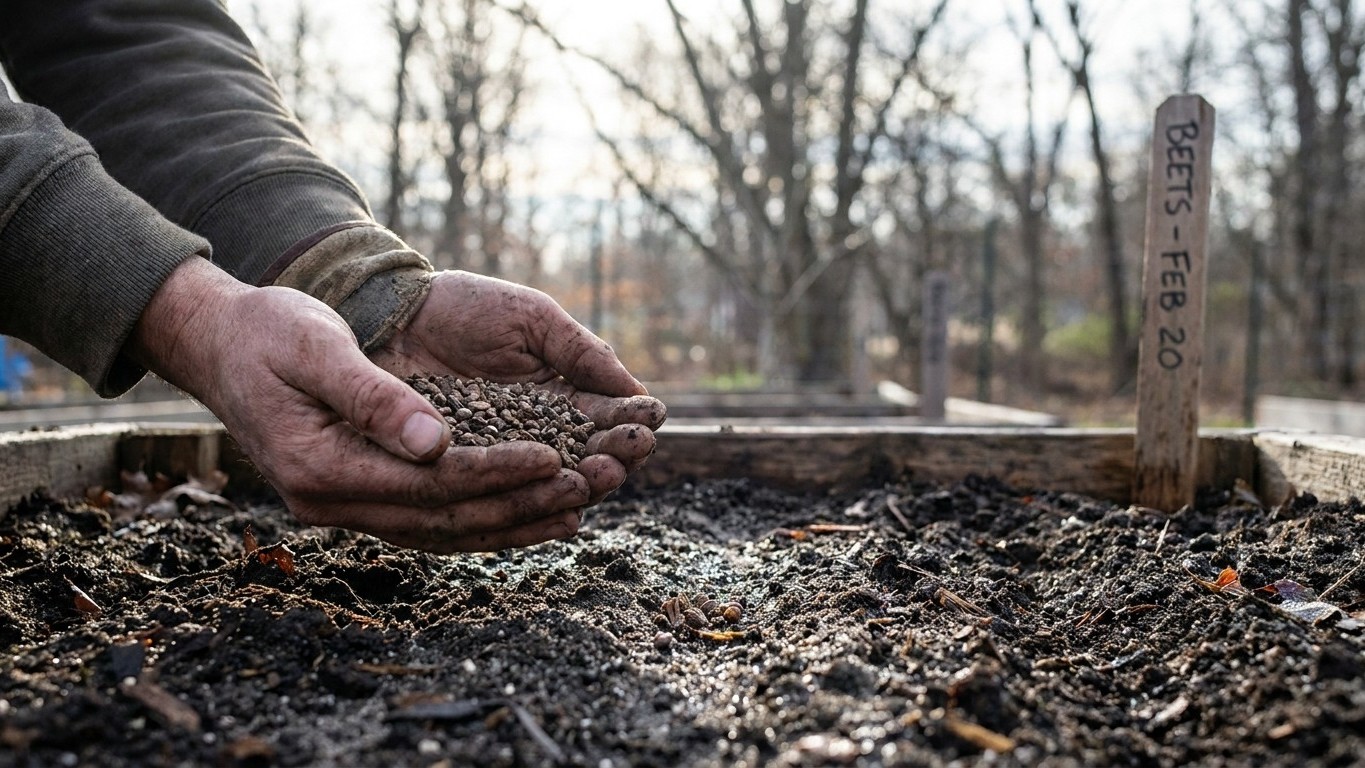

Across most of California, beet sowing is set by soil moisture and heat, not frost. Coastal and Southern California don’t get a killing freeze in an average year, so the sowing window opens with the cool season and closes when the ground starts drying and heating up. In the Central Valley and the Sierra, where freezes do occur, sow 2 to 3 weeks before the last one. The deciding factor everywhere is keeping the bed evenly moist for the first six weeks.
The short answer
California’s official state soil, the San Joaquin series, is an Alfisol: a forest-derived soil of moderate fertility with a surface pH around 6.1, slightly acid. Its texture runs 51 percent sand, 18 percent clay and 32 percent silt, a loam to silt loam that drains moderately well. That’s a reasonably workable starting texture for beets, which want deep, sandy, well-drained ground rich in organic matter, according to Utah State University Extension. The catch is the organic matter reading on this series: about 0.8 percent, on the low side. Utah State’s guidance is to work in no more than 1 inch of composted organic matter per 100 square feet, and on a soil like this, that amendment matters more than the sand-clay-silt ratio does.
The San Joaquin series is only moderately well drained, not sharply draining like a pure sandy loam. That middle-of-the-road drainage cuts both ways for beets: it holds enough moisture to get seedlings through germination without daily watering, but it can also sit wet enough after a heavy spring rain to slow root growth if the bed isn’t raised or worked deep.
On heat, the published climate record for the reference weather station behind this page doesn’t carry a count of days above 90 F, so that specific number isn’t published here. What the record does show is a frost-free year: zero days at or below 32 F over three decades, with a 365-day frost-free season. That’s a coastal or Southern California pattern. It flips the usual gardening math: the limiting factor for beets in these zones isn’t frost timing at all, it’s drought stress and, later in the season, heat combined with dry soil turning roots woody. In the Central Valley and the Sierra, real freezes still happen every winter, and treating the whole state as frost-free would be a mistake.
None of this is a diagnosis for one backyard. California spans hundreds of mapped soil series, and river-bottom ground, hill country, and anything a builder has graded or filled can behave nothing like the San Joaquin series. Use this as a baseline for what the region’s soil tends to do, then run an actual soil test before you plan amendments.
The six weeks that decide it here
Sowing 2 to 3 weeks before the last frost, where a frost date applies, puts the first six weeks of a beet’s life inside a fairly predictable stretch of California’s spring. That stretch is defined less by temperature swings than by a drying trend. California runs a Mediterranean rainfall pattern: wet winter, then a spring that steadily tapers off toward a dry summer. Rain that falls reliably in December and January becomes unreliable by March and often stops well before April in much of the state.
That timing matters directly for beets, because Utah State University Extension identifies water stress in the first 6 weeks after seeding as the trigger for premature flowering, or bolting. In California, the risk isn’t a single dry week, it’s the seasonal handoff: a gardener who sows expecting the winter rains to carry the crop can get caught when those rains cut off two or three weeks earlier than the seedlings needed them to. The back half of that six-week window, once the rainy season has ended but before a gardener has settled into a regular irrigation routine, is where bolting risk concentrates here.
That’s a separate problem from woodiness. Woodiness shows up later, once roots are sizing up, and it comes from heat above 85 F combined with water stress at that later stage, according to the same Utah State guidance. A beet bed can dodge bolting by staying moist through its first six weeks and still turn woody in July if the inland heat arrives before harvest and irrigation lapses. Treating these as the same fix, just “keep it watered,” misses that one failure is about a shortfall early and the other about heat plus dryness later. Both call for consistent moisture, but they happen on different clocks.
What goes wrong here
- Bolting from the spring dry-down. Sowing on a schedule built around winter rain, then losing that rain two or three weeks early, stresses seedlings in the exact window that triggers premature flowering. Remedy: irrigate on a fixed schedule through the first six weeks after seeding regardless of what the sky is doing, rather than relying on rainfall to carry the crop.
- Woody roots from inland heat. Once daytime temperatures push past 85 F, any accompanying dry spell thickens and toughens the root. This hits Central Valley and inland gardens hardest, less so the frost-free coastal strip. Remedy: keep the bed watered through hot stretches and plan the sowing date so roots size up and get harvested before the hottest weeks set in.
- Low organic matter slowing root development. At roughly 0.8 percent organic matter, soil resembling the San Joaquin series doesn’t hold nutrients or moisture as well as beets prefer. Remedy: work in up to 1 inch of composted organic matter per 100 square feet before sowing, not after.
- Heavier clay ground elsewhere in the state compacting around the root. The state soil runs only 18 percent clay, but many California garden soils, especially in valley bottoms, carry far more. Compacted clay deforms beet roots and slows drainage. Remedy: double-dig or raise the bed at least 8 to 10 inches and mix in coarse organic matter to open the structure.
- Applying a coastal frost-free calendar inland. A gardener who reads that California is largely frost-free and sows accordingly in the Central Valley or Sierra foothills can lose a crop to a freeze that the coast never sees. Remedy: check your own region’s freeze history rather than the statewide average before setting a sowing date.
Common questions
How long do beets take to mature in California?
60 to 80 days from seeding to harvest, per Utah State University Extension. That count starts at direct seeding, not at a transplant date, since beets are sown in place rather than started indoors and moved out.
Can I sow beets year-round on the California coast?
The frost-free record for coastal and Southern California removes the freeze constraint, but it doesn’t remove heat and drought. Beets still face bolting risk if the first six weeks run dry and woodiness risk if roots size up during a hot, dry stretch, so the cooler, wetter months remain the safer window even where frost is a non-issue.
Which beet variety should I plant in California?
Utah State University Extension names five varieties in its guidance but doesn’t attach season, color or use data to any single one of them, so no variety-specific recommendation can be made here without going beyond what’s published.
Do I need to test my own soil before sowing?
Yes. The San Joaquin series figures on this page describe the state’s official representative soil, not any individual garden. With hundreds of mapped soil series across California, and with graded, filled or river-bottom ground behaving differently again, a soil test is the only way to know your own texture, pH and drainage before amending.