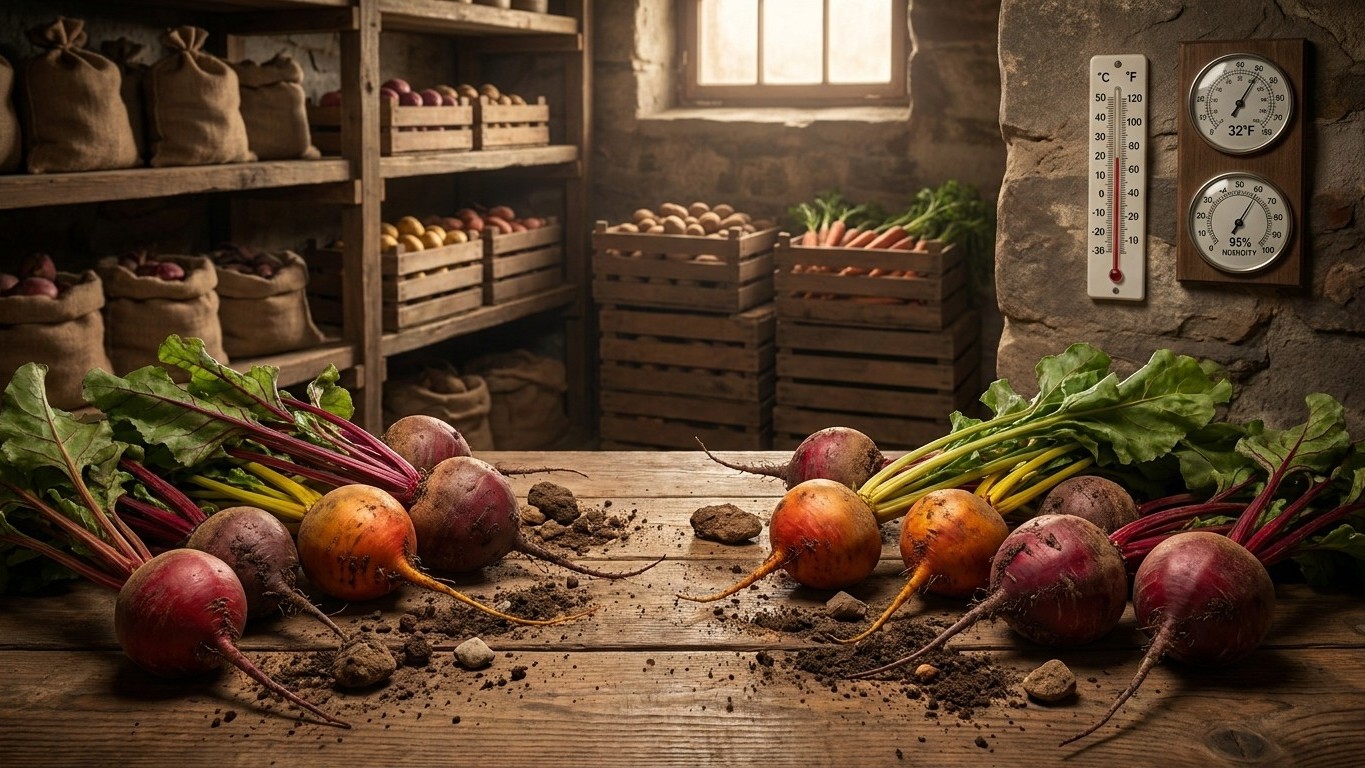

Beets reach harvest maturity 60 to 80 days from seeding, and once pulled, they hold longest in storage set to 32 F and 95 percent relative humidity, where Utah State University Extension says they’ll keep for two to four months. That’s the whole equation: a maturity window tied to when you sowed the seed, and a storage environment that has almost nothing to do with your kitchen fridge’s default settings.
The short answer
Utah State University Extension puts beet root maturity at 60 to 80 days from seeding, depending on variety. That’s a real spread, not a rounding error, and it matters because beets go straight into the ground as seed. There’s no transplant date to shift the calendar, no six-week head start in a tray under lights. The clock starts the day the seed goes into soil, full stop.
For storage, the same source gives a single, specific target: 32 F and 95 percent relative humidity. Hit both numbers and beets last two to four months. Miss either one and the shelf life drops fast. A typical refrigerator crisper drawer runs cooler than the rest of the fridge but rarely holds 95 percent humidity unless the drawer is sealed and the beets are kept moist or bagged with some ventilation. A root cellar, if you have one, gets you closer to both targets at once, since basements and cellars naturally hold higher humidity than a kitchen appliance built to keep produce dry so it doesn’t rot in the open air.
The two-to-four-month range isn’t arbitrary variability, either. It reflects the fact that storage life depends on more than just temperature and humidity, things like how much surface damage the roots had when they went into storage, how quickly they were cooled after harvest, and how consistently the storage environment held its targets over weeks rather than just on day one. A batch that spent a few hours in a warm garage before reaching cold storage won’t perform the same as one moved straight from soil to 32 F.
Utah State University Extension names five varieties commonly grown in home gardens: Detroit Dark Red, Red Ace, Early Wonder, Green Leaf, and Golden. The source doesn’t attach maturity days, storage performance, or flavor notes to any of them individually, so there’s no basis here for saying one holds longer than another or ripens faster. Treat the list as a starting point for what’s available, not a ranking.
What this means practically: mark your seeding date, count forward 60 to 80 days depending on the variety you planted, and have a cold, humid storage spot ready before you pull the first root.
What actually decides it
Two separate problems can ruin a beet crop, and gardeners often lump them together as “watering issues.” They’re not the same failure, and they don’t happen at the same point in the plant’s life.
Early water stress bolts the plant
When beet seedlings hit a dry spell early on, especially right after thinning, the plant reads that stress as a signal to skip ahead to reproduction. It sends up a flower stalk instead of putting energy into the root. Once a beet bolts, the root turns fibrous and the plant’s priorities shift permanently toward seed production. There’s no reversing it by watering more later. This is a timing failure at the seedling stage, tied to inconsistent moisture during establishment, not to heat or to how long the plant has been in the ground.
Late-season heat makes roots woody
A completely different failure shows up later, once roots are sizing up. Sustained heat during root development pushes the plant to lay down more fibrous tissue, and the texture turns tough and stringy even when the beet looks normal-sized from above ground. This isn’t about a single dry stretch. It’s a slower, cumulative response to warm conditions during the bulking phase, and it happens independently of whether the seedling bolted earlier. A beet that never bolted can still turn woody if it matures during a stretch of hot weather.
Keeping these two mechanisms separate matters because the fix for one doesn’t touch the other. Consistent moisture at the seedling stage prevents bolting. Getting roots to maturity before the hottest stretch of the season, or accepting some texture tradeoff if that’s not possible, is the only lever for the woodiness problem. “Just keep it watered” addresses the first failure and does nothing for the second.
Row spacing also plays into how evenly a bed holds moisture. Utah State University Extension recommends thinning seedlings to 3 inches apart within the row, with rows set 12 to 18 inches apart. Crowded rows compete for the same moisture pocket in the soil, which can make the early bolting risk worse in a bed that wasn’t thinned on schedule.
How to do it
- Sow beet seed directly in the garden bed. Beets don’t transplant well, so there’s no seedling stage to raise indoors first. The 60- to 80-day maturity clock starts on this date.
- Thin seedlings once they’re up and growing. Space plants to 3 inches apart within the row, and keep rows 12 to 18 inches apart, per Utah State University Extension guidance. Thinning reduces competition for water right at the stage when moisture stress can trigger bolting.
- Keep soil moisture consistent through establishment. This is the window where a dry stretch does the most damage, since stressed seedlings are the ones most likely to bolt instead of forming a usable root.
- Track days from seeding, not from any other milestone. Depending on the variety planted, roots reach maturity somewhere in the 60- to 80-day range. Note your seeding date on a calendar or garden log so you’re not guessing later in the season.
- Harvest by pulling roots once they’ve reached size and the days-from-seeding window has passed. Handle roots gently to avoid nicks and bruises, since damaged skin gives storage rot a way in.
- Cool the roots as soon as possible after pulling. The faster beets reach storage temperature, the less time they spend losing moisture and quality at ambient warmth.
- Move roots into storage held at 32 F and 95 percent relative humidity. These are the two figures Utah State University Extension ties to two to four months of storage life, and both need to be met together, not just one or the other.
- Check stored roots periodically. Even at the right temperature and humidity, individual roots can soften or spoil, and pulling those out early protects the rest of the batch.
What goes wrong
- Seedlings bolt before forming a root. This traces back to a dry spell during establishment, often right after thinning when roots are shallow and can’t reach reserve moisture. The remedy is consistent watering through the seedling stage, since once a plant bolts there’s no bringing the root back.
- Roots turn woody despite looking full-sized. This is a separate failure from bolting, caused by sustained heat during the root-bulking phase rather than by a single dry stretch. There’s no late fix once the texture has set; the practical response is timing seeding so maturity falls before the hottest part of the season where possible.
- Crowded rows produce small, uneven roots. Skipping the thinning step, or thinning too late, leaves plants competing for the same moisture and nutrients. Thin to 3 inches apart in the row as soon as seedlings are large enough to handle, matching the spacing Utah State University Extension recommends.
- Stored beets shrivel or rot within weeks instead of lasting months. This usually means the storage spot is missing one of the two required conditions, either running warmer than 32 F or drier than 95 percent relative humidity. A standard refrigerator crisper often falls short on humidity unless the roots are kept in a ventilated bag with a bit of added moisture; a root cellar or similarly humid cold space gets closer to both targets.
- Harvested roots go into storage still bearing field heat. Beets pulled on a warm day and left in a garage or on a porch before storage lose quality faster than roots cooled promptly. Move roots to the cold, humid storage environment as soon as practical after harvest.
Common questions
How long does it take beets to be ready to harvest?
Utah State University Extension puts root maturity at 60 to 80 days from seeding, depending on the variety planted. Since beets are sown directly in the garden, that count starts on your seeding date, not on any later milestone.
What temperature and humidity should beets be stored at?
Utah State University Extension recommends 32 F and 95 percent relative humidity for stored beets, a combination that supports two to four months of storage life.
Why did my beets bolt instead of forming roots?
Bolting is typically triggered by water stress early in the seedling stage. Once a beet plant bolts and sends up a flower stalk, the root stays fibrous and undersized, and there’s no way to reverse that shift by watering afterward.
Why are my beet roots tough and woody even though they grew to full size?
Woodiness comes from sustained heat during the root’s bulking phase, a different mechanism than the early water stress that causes bolting. A beet can avoid bolting entirely and still turn woody if it matures during a stretch of hot weather.