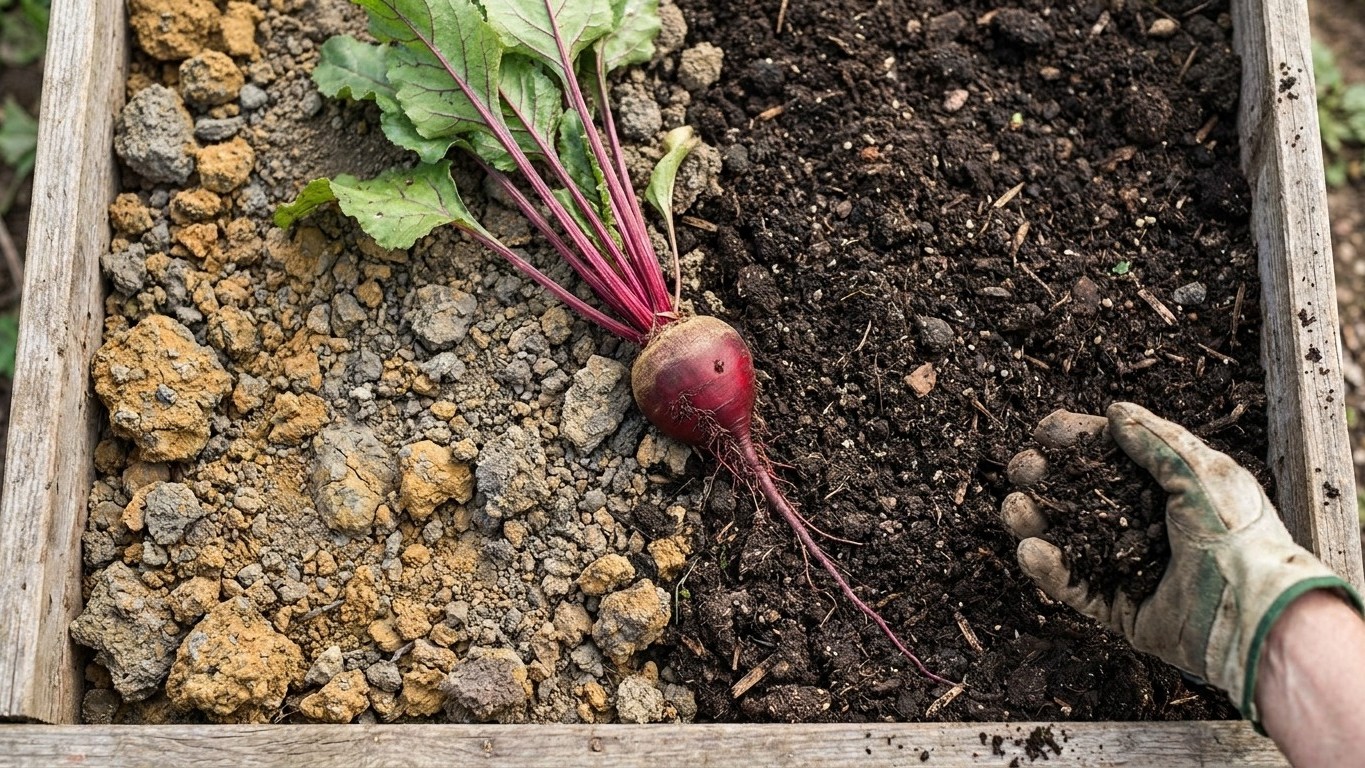

Beets want soil they can push through without a fight: fertile, well-drained, deep, and sandy, carrying plenty of organic matter, according to Utah State University Extension‘s guide to Growing Beets in the garden. Heavy clay needs compost worked in before the root can size up properly. But that compost has a ceiling, and most gardeners blow right past it.
The short answer
Utah State University Extension puts it plainly: beets need “fertile, well-drained, deep, sandy soils rich in organic matter.” That phrase is doing four jobs at once, and each word matters for a different reason. Fertile means the plant has nitrogen and potassium available without a fight. Well-drained means the root doesn’t sit in water and rot or split. Deep means nothing blocks the taproot from pushing straight down. Sandy means the texture is loose enough for a swelling root to expand without deforming around rocks or compacted clumps.
Most home gardens don’t start with that soil. They start with clay, or with a mix that’s heavier and tighter than beets prefer. The Extension guidance addresses that directly: heavy soils need amending with compost before the root can develop the way it’s supposed to. Compost loosens the structure, adds organic matter, and improves drainage all at once, which is why it’s the go-to fix rather than sand alone or a fertilizer swap.
Here’s where the guidance gets specific in a way that surprises people: there’s a stated limit on how much compost to add. Utah State University Extension recommends no more than 1 inch of composted organic matter per 100 square feet. That’s a cap, not a suggestion to hit if convenient. Gardeners who assume more organic matter is automatically better tend to overshoot it, layering on compost season after season until the bed is closer to potting mix than garden soil.
That matters for beets specifically because the crop’s root architecture is sensitive to texture extremes on both ends. Too heavy and unamended, the root can’t push through or expand, and you get stunted, misshapen beets. Too loose and over-enriched with compost, and the balance of nutrients shifts, drainage can change in unpredictable ways, and the fine texture the plant actually needs gets diluted by an excess it doesn’t call for. The 1-inch-per-100-square-foot figure isn’t arbitrary. It’s the line between fixing a heavy soil problem and creating a new one.
So the short answer has two parts, and neither works without the other: amend heavy soil with compost because beets need loose, fertile, deep ground, and stop at roughly an inch per 100 square feet because that’s the point past which more compost stops helping the root and starts working against it.
What actually decides it
Getting the soil right is only half the equation. Two separate problems get lumped together by gardeners as “watering issues,” and treating them as one mistake means you’ll keep making both. They happen at different points in the plant’s life, for different physiological reasons, and the fix for one doesn’t touch the other.
Root architecture and soil texture
A beet root doesn’t grow like a carrot, boring straight down through whatever’s in front of it. It swells, pushing outward as it develops, which means the soil around it has to give. In compacted or heavy clay, that swelling gets resisted unevenly. Roots come out forked, flattened on one side, or stunted at a fraction of their potential size. This is exactly why the Extension guidance calls for depth and looseness before anything else. Amending with compost isn’t cosmetic. It changes whether the root can physically expand into a round or tapered shape instead of fighting compacted ground the whole way down.
Early water stress and bolting
Beets that experience dry stress early in their development, while they’re still small seedlings establishing a root system, respond by bolting. The plant reads the stress as a signal that its life is at risk, so it shifts energy toward producing a seed stalk instead of continuing to build the root you actually want to harvest. Once a beet has bolted, the root stays small and woody and the plant’s energy goes into flowering rather than storage. This is a distinct failure from anything that happens later in the season, and it’s triggered specifically by inconsistent moisture during establishment, not by heat, not by soil texture, and not by nutrient levels.
Late-season heat and woodiness
A completely different problem shows up later, once the root has already sized up: heat during the later stages of growth toughens the root’s texture, making it woody and fibrous rather than tender. This isn’t the same mechanism as bolting. The plant isn’t redirecting its energy toward a seed stalk. It’s the root tissue itself responding to sustained high temperatures by developing tougher, more lignified cell structure. A beet can avoid bolting entirely, grow a full root, and still end up woody if it matures during a stretch of intense late-season heat. Treating both problems as one generic “watering issue” misses that they happen at different growth stages for different physiological reasons, and a fix aimed at one won’t touch the other.
How to do it
- Assess the existing soil first. Dig down and check whether you’re working with something close to the sandy, deep, well-drained profile beets prefer, or whether you’re dealing with heavy clay that will need amending before planting.
- Amend heavy soil with compost, not sand alone. If the soil is heavy, work in composted organic matter to loosen the texture and improve drainage, following the guidance that this is the recommended fix for soils that aren’t naturally suited to root crops.
- Cap the compost at 1 inch per 100 square feet. Measure the amendment rather than eyeballing it. This is the ceiling Utah State University Extension specifies, and it applies per application, not as a one-time lifetime total for the bed.
- Work the compost in deeply. Since beets need deep soil for the taproot to develop without obstruction, mix the amendment into the ground rather than leaving it as a surface layer that only benefits the top few inches.
- Sow the seed directly in place. Beets are a direct-seeded crop, not started elsewhere and transplanted, so the amended bed needs to be ready before seeding, not adjusted afterward.
- Keep moisture consistent through germination and early establishment. This is the window where water stress triggers bolting, so even, reliable moisture at this stage protects the root’s development before it has a chance to divert energy toward a seed stalk.
- Monitor conditions as the root matures. Once the root has sized up, watch for prolonged heat stretches, since that’s the separate mechanism that produces woody texture regardless of how well the earlier watering was managed.
What goes wrong
- Compost added without a limit. Gardeners assume more organic matter always helps and keep layering compost in season after season. The fix is measuring to the 1-inch-per-100-square-foot ceiling each time rather than adding compost by feel.
- Heavy clay left unamended. Planting directly into unimproved clay produces stunted or misshapen roots because the soil resists the root’s natural expansion. The fix is amending with compost before seeding, not after roots are already struggling.
- Inconsistent watering during germination. Letting the bed dry out while seedlings are establishing triggers bolting, and once a beet bolts, the root stops developing normally. The fix is steady moisture specifically during this early window, not just “watering when convenient.”
- Assuming a late-season woody root means underwatering. Woodiness from heat stress is a different failure from bolting and isn’t fixed by watering more at that late stage. The fix is recognizing it as a heat-driven texture change in mature roots, separate from the early moisture issue.
- Skipping the depth check before amending. Compost worked only into the top inch or two doesn’t give the taproot the deep, loose profile it needs. The fix is mixing the amendment down through the bed, not just top-dressing.
Common questions
Does the compost limit apply once per season or once total?
Utah State University Extension specifies no more than 1 inch of composted organic matter per 100 square feet as the recommended rate. The guidance doesn’t distinguish a separate lifetime total, so treat it as the ceiling to observe each time compost is applied.
Can beets grow in soil that isn’t sandy at all?
The Extension guidance describes sandy soil as what beets prefer, but it also directly addresses heavy soils, recommending compost amendment specifically because many gardens don’t start with an ideal sandy profile. Amending is the stated path for heavier ground, not a substitute for starting over with different soil.
Is bolting the same thing as a woody root?
No. Bolting happens early, triggered by water stress during establishment, and results in the plant shifting energy toward a seed stalk instead of the root. Woodiness happens later, driven by heat during the root’s maturation, and is a texture change in tissue that has already developed. They come from different causes at different growth stages.
Do specific beet varieties need different soil?
Utah State University Extension’s guide lists several beet varieties suited to the garden but doesn’t attach specific soil, season, or color data to any single one. The soil recommendations, fertile, well-drained, deep, sandy, and rich in organic matter, along with the compost ceiling, apply as general guidance rather than varying by variety.