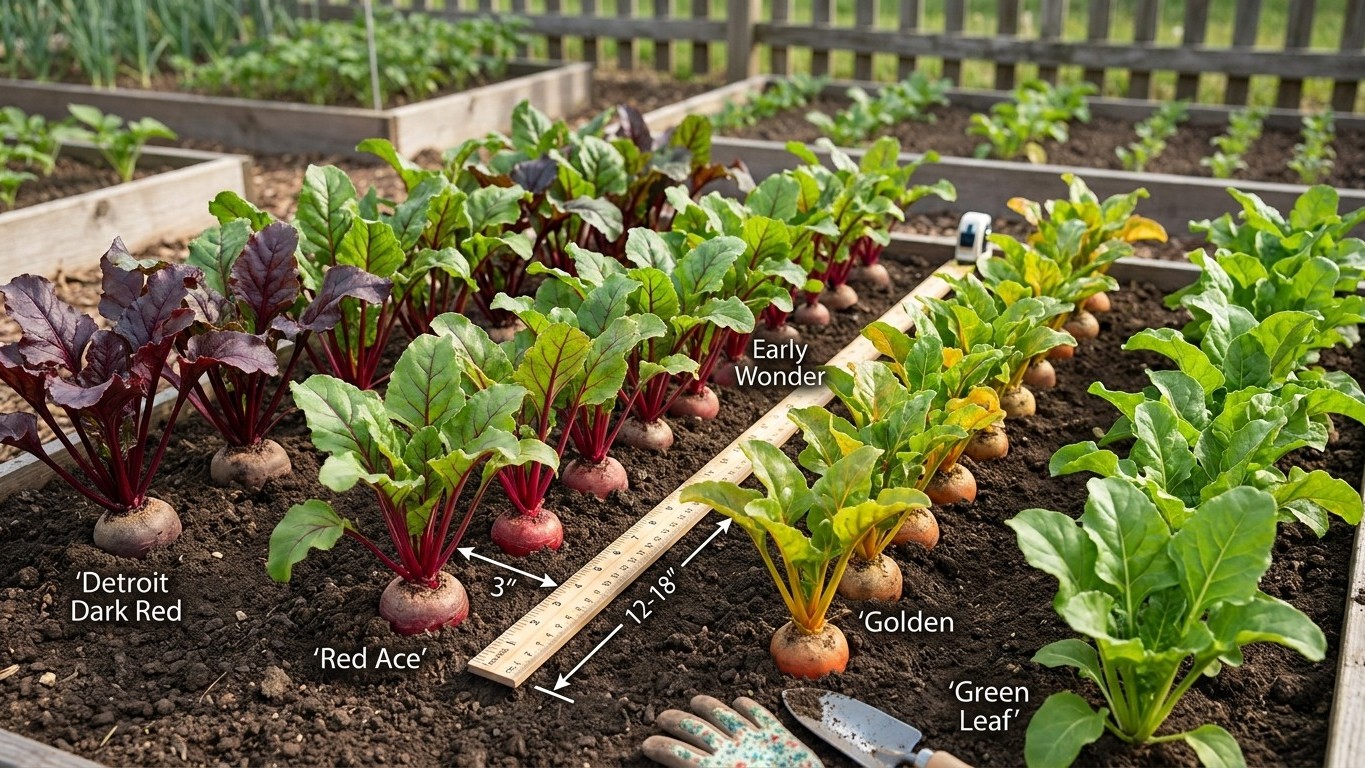

Utah State University Extension’s “Beets in the Garden” guide names five beet varieties, Detroit Dark Red, Red Ace, Early Wonder, Green Leaf, and Golden, but it doesn’t attach a single figure to any of them. No days-to-maturity comparison, no color note, no storage advantage. What the guide does quantify is spacing, harvest timing, and storage conditions that apply to beets in general, not to one name over another.
The short answer
If you’re hoping the Extension ranked these five varieties by speed, flavor, or storage life, it didn’t. Utah State University Extension lists Detroit Dark Red, Red Ace, Early Wonder, Green Leaf, and Golden as options for the home garden, full stop. There’s no accompanying table, no note that one matures faster than another, no claim that one holds up better in the root cellar. The list reads like a menu with no descriptions, just names.
That’s not an oversight so much as a reflection of what the guide is actually built to tell you. It’s a spacing-and-timing document, not a variety trial report. So while the title question, which variety does the Extension favor, has no answer in the source, three other numbers are spelled out clearly and apply regardless of which of the five names you plant.
Thin seedlings to 3 inches apart in the row, with rows spaced 12 to 18 inches apart. Expect roots to reach maturity 60 to 80 days from seeding, depending on variety, a range that acknowledges some spread without specifying which variety lands where in it. And once harvested, store roots at 32 F and 95 percent relative humidity, conditions under which they’ll keep for 2 to 4 months.
Beets are direct-seeded. There’s no transplant date to track, no seedling tray to graduate from. The clock on that 60 to 80 day window starts the moment seed goes into the ground, which matters because gardeners used to transplanting tomatoes or peppers sometimes assume every maturity count starts at transplant. Here, it doesn’t. There isn’t one.
So the practical answer to “which variety should I choose” is: pick based on seed availability, personal preference, or what your local nursery stocks, because the Extension gives you no data-driven reason to favor one of the five over another. What it gives you instead is a set of management numbers, spacing, the maturity window, and storage temperature and humidity, that determine whether your beets turn out well far more than the name on the seed packet does.
What actually decides it
Since the source doesn’t differentiate the five named varieties, the outcome in your garden comes down to two separate mechanisms that have nothing to do with which beet you planted. They happen at different points in the season, for different reasons, and treating them as the same problem, “just keep it watered,” misses what’s actually going on in each case.
Early water stress triggers bolting
Beet seedlings that dry out in their first weeks respond by shifting into reproductive mode early. Instead of putting energy into the root, the plant sends up a seed stalk, a process called bolting. Once that happens, root development effectively stops and you’re left with a skinny, woody taproot topped by a flowering stem. This is a young-plant problem. It happens when soil moisture is inconsistent right after germination or during the seedling stage, well before the plant is anywhere near the 60 to 80 day maturity window.
Later heat makes the root woody
Woodiness is a different failure with a different timeline. This one shows up near or after the root should have been harvested, when sustained heat toughens the tissue and makes it fibrous rather than tender. It’s not caused by a dry spell in week two, it’s caused by a root sitting in hot soil too long, often because harvest was delayed past the point the root had reached a usable size. Bolting is a failure of the young plant reacting to stress. Woodiness is a failure of timing at the other end, leaving a mature root exposed to heat it should never have experienced.
Because the Extension doesn’t publish variety-specific data, there’s no published reason to think Golden resists bolting better than Red Ace, or that Detroit Dark Red tolerates late heat better than Green Leaf. What decides your results is whether you kept moisture even in the first few weeks and whether you pulled roots within the maturity window rather than letting them sit.
How to do it
- Choose a variety from the five the Extension names, Detroit Dark Red, Red Ace, Early Wonder, Green Leaf, or Golden, based on seed availability or preference, since the source doesn’t rank them against each other.
- Sow seed directly in the garden bed. Beets aren’t transplanted, so there’s no seedling stage indoors to manage separately.
- Once seedlings emerge, thin them to 3 inches apart in the row, with rows spaced 12 to 18 inches apart, giving each root room to size up without crowding.
- Keep the soil evenly moist from seeding through the seedling stage. This is the window where dry stress can push the plant toward early bolting instead of root growth.
- Track days from the original seeding date, not from any later point, since the maturity window of 60 to 80 days runs from when seed went into the ground.
- Watch roots as they approach that window and harvest promptly rather than letting them sit in the ground through a stretch of sustained heat, which is when woodiness sets in.
- Move harvested roots into storage at 32 F and 95 percent relative humidity, where they’ll hold for 2 to 4 months.
What goes wrong
- Seedlings bolt before forming a root: a dry stretch in the first weeks after germination pushes the plant to send up a seed stalk instead of building a root. Keep soil consistently moist from the moment seed is sown through the seedling stage to avoid triggering this early.
- Roots turn woody near harvest: leaving mature or near-mature roots in hot soil past the point they should have been pulled toughens the tissue. Harvest within the 60 to 80 day window from seeding rather than delaying once roots have sized up.
- Roots come out small or misshapen: skipping the thinning step, or thinning too late, leaves roots competing for space and crowding each other. Thin to 3 inches apart in the row while seedlings are still small, with rows 12 to 18 inches apart.
- Stored beets shrivel or sprout early: holding roots above 32 F or in air drier than 95 percent relative humidity shortens their storage life well below the 2 to 4 month range. Match both the temperature and the humidity target, not just one of them.
- Assuming one named variety has a trait the source doesn’t confirm: nothing in the guide says Golden is milder, that Green Leaf matures faster, or that Detroit Dark Red stores longer. Treat the five names as unranked options rather than picking based on an assumed advantage.
Common questions
Which beet variety does Utah State University Extension recommend?
None specifically. The guide names Detroit Dark Red, Red Ace, Early Wonder, Green Leaf, and Golden as options but gives no data ranking one above another.
How long do beets take to mature?
60 to 80 days from seeding, depending on variety, according to Utah State University Extension. The source doesn’t break that range down by which of the five named varieties falls where within it.
Do beets need to be transplanted like tomatoes or peppers?
No. Beets are sown directly in place, and the 60 to 80 day maturity count runs from the seeding date, since there’s no transplant step in the process.
What’s the right way to store harvested beets?
Store roots at 32 F and 95 percent relative humidity. Under those conditions, Utah State University Extension notes they’ll keep for 2 to 4 months.