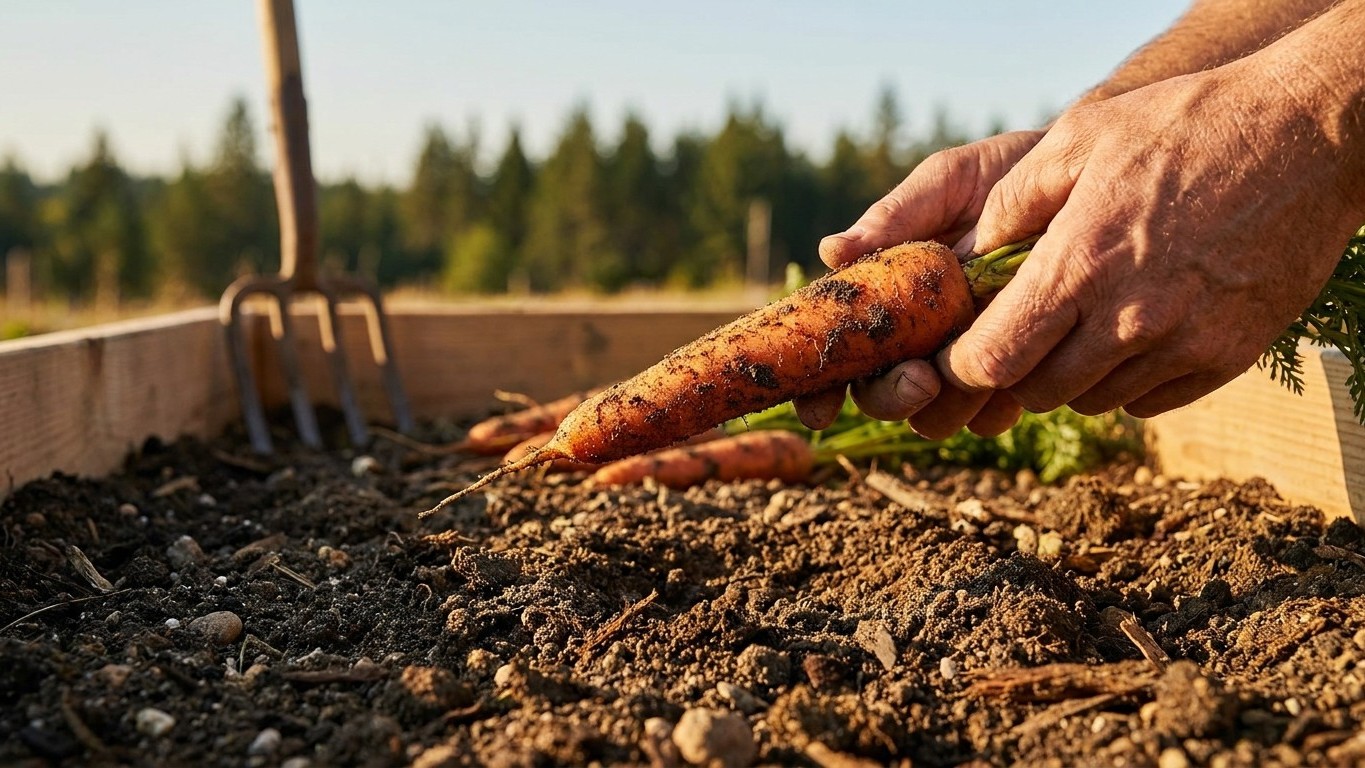

Maine’s official state soil, the Chesuncook series, is sandy, acid and moderately well drained under a coating of forest litter. That mix leans favorable for carrots, but it’s a statewide average, not a reading from your own raised bed. The real answer sits in your own dirt: dig eight inches down, check for rocks and clay, and watch how fast water disappears after a rain. Get that right, and a straight, unforked carrot is within reach almost anywhere in the state.
The short answer
Maine’s designated state soil, named by state law and tracked by the USDA’s State Soils program, is the Chesuncook series. It’s a Spodosol, the kind of sandy, strongly leached ground that forms under conifer stands, and its surface horizon runs 35 percent sand, 12 percent clay and 53 percent silt. Drainage is classed as moderately well drained. Surface pH sits around 5.1, which is strongly acid. On paper, that’s a texture carrots can work with: sand and silt dominate over clay, and roots generally push through that kind of ground without much resistance. Getting the timing right matters just as much as the soil texture; see When to Sow Carrots in Maine for guidance on planting windows suited to this climate.
But two numbers on this soil profile need a caveat before anyone reaches for a trowel. Organic matter in the surface horizon averages about 53.0 percent, which is nowhere near what a cultivated vegetable bed looks like. A number that high means the surface being measured is a natural forest floor layer, peat, muck, or leaf litter, not tilled garden soil. And that pH of 5.1 describes the Chesuncook series as mapped under trees, not the bed you’ve been amending with compost and maybe lime for years. Neither figure should be read as “my soil’s pH” or “my soil’s organic matter.”
Will Carrots Fork in Maine Soil? Texture-wise, a soil that’s roughly a third sand and just over a tenth clay tends to stay loose enough that a taproot can drive straight down without splitting around an obstruction. Forking shows up when the ground is heavier than that, dense clay, compacted subsoil, or a bed full of stones the root has to detour around. If a soil test or a simple dig shows clay content well above what Chesuncook carries, or if the bed is stony, the fix isn’t a different carrot variety. It’s plenty of compost worked in deep, double digging to break up the layer where clay or hardpan sits, or building a raised bed filled with a loose, sifted mix so the root never meets resistance in the first place.
None of this settles the question for any one garden. Maine spans hundreds of mapped soil series, from river-bottom silt to hillside ledge to fill dirt trucked in during a driveway job. The Chesuncook profile is a starting point for what the region’s ground tends to do, not a diagnosis of the dirt under your carrots.
The test that settles it in your own garden
The state average won’t tell you what’s eight inches under your carrot bed. A short hands-on check will.
- Dig a test hole. Go down at least eight to ten inches in the spot you plan to sow. Carrots need that much clear depth to grow straight; a shovel that hits a hard layer, a rock shelf, or dense clay before then tells you exactly where the trouble will start.
- Look at what comes out. Spread the soil on a tarp and count the stones and pebbles by eye. Every stone in that zone is a potential fork point, since the root will grow around it rather than through it.
- Feel the texture. Take a handful of moist soil and rub it between your fingers. Gritty means sand-heavy and likely to drain fast. Slick and sticky that holds a ribbon shape means clay-heavy, the texture most associated with forked, twisted roots. Silky and smooth without stickiness usually means silt, which drains and roots better than clay but can still compact.
- Watch the drainage. Fill the same hole with water and time how long it takes to disappear. Water that lingers for hours points to poor drainage and a compaction problem worth fixing before sowing. Water that vanishes almost immediately suggests a sandy soil that will need more organic matter to hold moisture evenly.
None of these steps hands you a lab-grade number, and no figure here should replace an actual soil test if you want pH or nutrient levels in writing. What the dig-and-feel test does give you is the practical picture: depth, stones, texture and drainage, the four things that decide whether a carrot grows straight or forks.
When to sow here
Carrots go into the ground as seed, straight into their final bed. There’s no transplanting step to count from, so every date here runs off the seeding date itself.
- Start from your last spring frost window. For coastal Portland, NOAA’s 1991-2020 climate normals put that window between April 22 and May 1. That’s the mildest stretch of the state; inland and northern Maine run their frost dates substantially later in spring, so a grower in Aroostook County or the western mountains needs to push the whole schedule back.
- Sow two to three weeks before that last frost date. Carrot seed tolerates cool soil better than most people expect, so working backward from the Portland window means the earliest sowing falls somewhere in the first half of April along the coast, with inland gardens waiting longer based on their own local frost record.
- Check soil temperature before you sow, not just the calendar. The ground needs to have warmed to at least 40 F. Below that, seed sits and rots more than it sprouts, no matter what the date says.
- Aim for the germination sweet spot. Carrot seed comes up best in soil between 55 and 65 F. Soil that’s only just cleared the 40 F minimum will still germinate, just slower and more unevenly, so a grower who can wait for warmer soil within that early window usually sees a cleaner stand.
- Count the growing season forward from seeding. Since there’s no transplant date in this crop, the full run to harvest, commonly cited in the 70 to 100 day range depending on variety, starts on the day seed goes into the ground, not on any later date.
The arithmetic, in plain terms: find your local last-frost date, back up two to three weeks, but don’t sow until the soil itself has cleared 40 F. Those two conditions don’t always land on the same day, and in a cold, wet Maine spring, the soil-temperature rule usually wins.
What goes wrong here
- Forking in heavy, compacted ground. A bed with more clay than the loose, sandy-silt texture carrots prefer will split a taproot around every dense pocket it hits. The remedy is working in generous compost and double digging to loosen the profile a full spade’s depth down, or skipping the fight altogether and building a raised bed filled with a loose mix.
- Poor germination during a hot, dry spell. Carrot seed struggles once soil temperature climbs well past the 55-65 F sweet spot, and a sudden warm stretch right after sowing can leave a thin, patchy stand. Keeping the seedbed consistently moist with light, frequent watering during germination, and timing sowing for cooler weather rather than a warm snap, keeps the stand even.
- Split roots from uneven watering. Carrots that dry out and then get soaked, a common pattern after a stretch of neglect followed by heavy rain, tend to crack along the root as it swells unevenly. Steady, even moisture through the growing season, rather than occasional deep soakings, prevents the swings that cause splitting.
- Stones or debris left in the bed. Even a soil with decent texture overall can carry enough small rocks to deflect a taproot. Sifting the top eight to ten inches of a bed before sowing removes the obstacles a shovel test might have missed.
Checking this against your own county
Everything above describes tendencies, not a reading of your specific plot. Maine’s land-grant extension service, the University of Maine Cooperative Extension, keeps county-level staff and published guidance built around local soils and frost patterns rather than a single statewide average. Their office can point you toward a soil test through the university’s lab, county-specific frost guidance, and variety recommendations suited to your part of the state. Find them at extension.umaine.edu before you finalize a sowing date or decide whether your bed needs a raised frame.
Common questions
Does Maine’s state soil mean my garden is automatically good for carrots?
No. The Chesuncook series describes a representative soil profile mapped under forest cover, not a cultivated bed. Its texture leans favorable, but the state spans hundreds of other soil series, and your yard could easily differ.
Can I use the 5.1 pH figure for the Chesuncook series as my garden’s pH?
No. That figure comes from the surface horizon of an uncultivated, forested soil profile. A worked vegetable bed, especially one that’s been limed or amended over the years, will read differently. A soil test is the only way to know your actual number.
Should I count carrot growing days from when I sow or from a later date?
From seeding. Carrots are sown directly into the garden and never transplanted, so the full days-to-harvest figure for any variety runs from the day the seed goes in the ground.
What’s the single biggest fix for forked carrots in Maine gardens?
Working generous compost into the bed and loosening the soil a full spade’s depth through double digging, according to Utah State University Extension guidance on carrot growing. Where the ground stays heavy or rocky no matter what, a raised bed filled with a loose mix solves the problem outright.