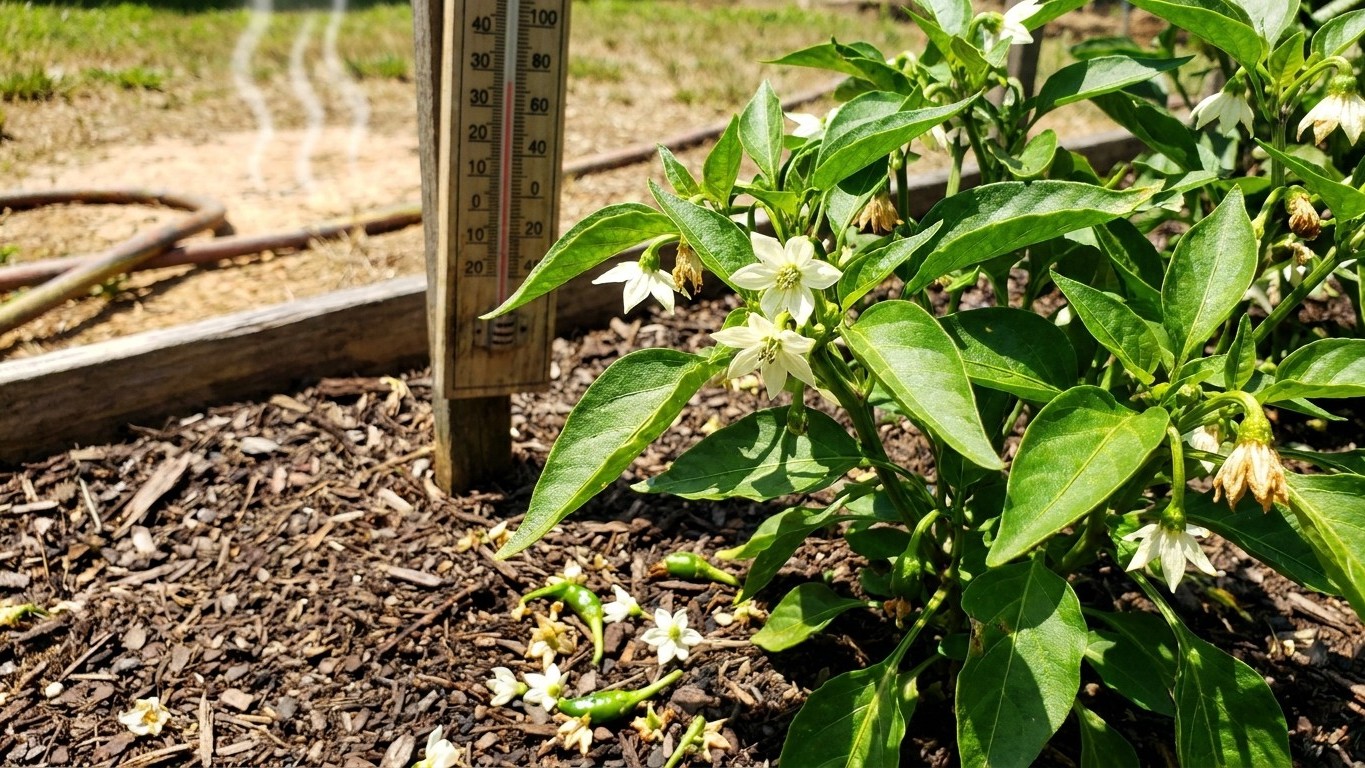

Manitoba peppers usually Fail to Set Fruit because of cold, not heat. The reference station at Winnipeg records zero days a year at or above 90°F, so scorching afternoons rarely knock blossoms off the plant here. The bigger threat comes from the other direction: nights that drop below 55°F, especially in early June and again in late August, when pollen turns sterile and flowers drop before they ever swell into a pepper.
The short answer
Start with the number that defines summer here: 0.0 days a year at or above 90°F, measured at the Winnipeg reference station under the 1981-2010 Canadian Climate Normals. That is not a rounded figure or an estimate. It means the classic “too hot to set fruit” problem that plagues pepper growers in warmer states almost never shows up in Manitoba gardens. Daytime heat stress on pollen, the kind that causes blossoms to abort in a Texas or Kansas July, is close to a non-issue on the Canadian Prairies.
That reassuring number only tells half the story. Pepper fruit set fails at both ends of the temperature scale, and the cold end is where Manitoba growers run into trouble. Nights below 55°F interfere with pollen viability just as surely as extreme heat does, and a short Prairie growing season means those cool nights show up on both sides of summer, not just in a brief spring or fall window.
Why the cold end matters more here
This site tracks daytime highs above 90°F for every territory, because that figure is measured, published, and comparable from state to state. It does not track summer night minimum temperatures, and for good reason: those numbers vary block to block depending on low-lying ground, tree cover, and distance from open water, in ways a single reference station cannot capture. A garden in a river valley can run several degrees cooler overnight than one on higher ground a few miles away, and no latitude-based assumption can substitute for that.
What this means practically: don’t guess at your night temperatures from where Manitoba sits on the map. Keep a simple min-max thermometer in the pepper bed through June and again in late August, the two stretches most likely to dip under 55°F here. If you see repeated mornings in the low 50s while flowers are open, that is very likely your fruit-set problem, more than any heat the summer ever throws at the plants.
When to start seed here
Utah State University Extension lays out the rule simply: pepper transplants need 8 to 10 weeks indoors, and they should go into the ground only after the soil itself reaches 60°F, and only once the frost risk has passed. In Manitoba, that arithmetic has to run through a frost date that behaves differently than a calendar might suggest.
Working backward from frost
- Start with the mean last-spring-frost date. Environment and Climate Change Canada’s 1981-2010 Climate Normals put the mean last spring frost at Winnipeg Richardson International Airport on May 23. That is an average, not a guarantee. In one year out of two, frost arrives after that date, so treat May 23 as the midpoint of a risk window rather than a safe planting day.
- Add time for soil to catch up to air. Soil warms more slowly than the air above it, so a frost-free week doesn’t necessarily mean 60°F soil. Most Manitoba gardeners find soil doesn’t reach that mark until a week or two past the mean frost date, pushing realistic transplant timing into early to mid June for many yards.
- Confirm with a soil thermometer instead of a calendar. A simple probe thermometer pushed 4 inches into the bed removes the guesswork. Wait for consistent 60°F readings, not just a warm afternoon, before setting transplants out.
- Count back 8 to 10 weeks for indoor sowing. If the transplant target lands in the first half of June, seed should go into trays roughly 8 to 10 weeks earlier, which places the indoor start in the first half of April for most Manitoba gardens. Growers in a county with a later frost history should push that window back accordingly.
This is arithmetic worth redoing every spring rather than trusting to memory. A single station’s mean frost date won’t match a low-lying yard or a northern district that historically lags the Winnipeg reference point by a week or more, so local frost records, where a gardener has kept them, beat a regional average every time.
What goes wrong here
- Blossom drop from a cool night. Flowers open, then fall off within a day or two, with no pepper ever forming. This is the Manitoba pattern more often than heat-driven drop, since nights below 55°F during flowering interrupt pollen viability. The fix isn’t chemical: hold off transplanting until nights are reliably milder, and consider row cover on cool evenings once plants are flowering outdoors.
- Blossom drop from a rare hot spell. Even with zero average days above 90°F, an occasional hot afternoon can still push local conditions past what open blossoms tolerate, particularly against a south-facing wall or in a sheltered raised bed that traps heat. Light afternoon shade cloth on the one or two hottest days of the year is usually enough to prevent drop without hurting overall yield.
- Sunscald on exposed fruit. Where foliage is thin, sun-facing peppers can develop pale, papery patches on the skin. This shows up more on plants that have lost leaves to wind, hail, or over-aggressive pruning. Leaving foliage intact and avoiding heavy pruning through the fruiting weeks keeps the developing peppers shaded by their own canopy.
- Blossom-end rot on the fruit itself. A dark, sunken patch at the blossom end signals a calcium delivery problem, usually tied to uneven watering rather than a soil calcium shortage. Even moisture through a raised bed or container, rather than a soak-then-dry-out cycle, is the more reliable fix than any fertilizer application.
Common questions
Do Manitoba summers ever get hot enough to hurt pepper fruit set?
Rarely, based on the record. The Winnipeg reference station shows 0.0 days a year at or above 90°F under the 1981-2010 Canadian Climate Normals, so sustained heat stress on pepper blossoms is uncommon here compared with warmer states. An occasional hot afternoon can still cause isolated drop, but it isn’t the dominant pattern.
Is May 23 a safe date to transplant peppers outdoors?
No. May 23 is the mean last spring frost date at Winnipeg Richardson International Airport, meaning frost arrives after that date in about half of all years. Treat it as the center of a risk window, confirm soil has reached 60°F, and watch a local forecast before moving transplants outside.
How do I know if my nights are too cool for fruit set?
This site doesn’t publish summer night minimum temperatures, since they vary too much within a single region to be useful as a general figure. Keep a simple min-max thermometer in the garden through the flowering weeks; repeated mornings below 55°F point to cold-driven blossom drop rather than any soil or fertilizer issue.
When should I start pepper seed indoors for a Manitoba garden?
Work backward from your expected transplant date, which typically falls one to two weeks after the mean May 23 frost date once soil reaches 60°F. Counting back 8 to 10 weeks from that point, as Utah State University Extension recommends, generally places indoor seed-starting in the first half of April for most Manitoba gardens.