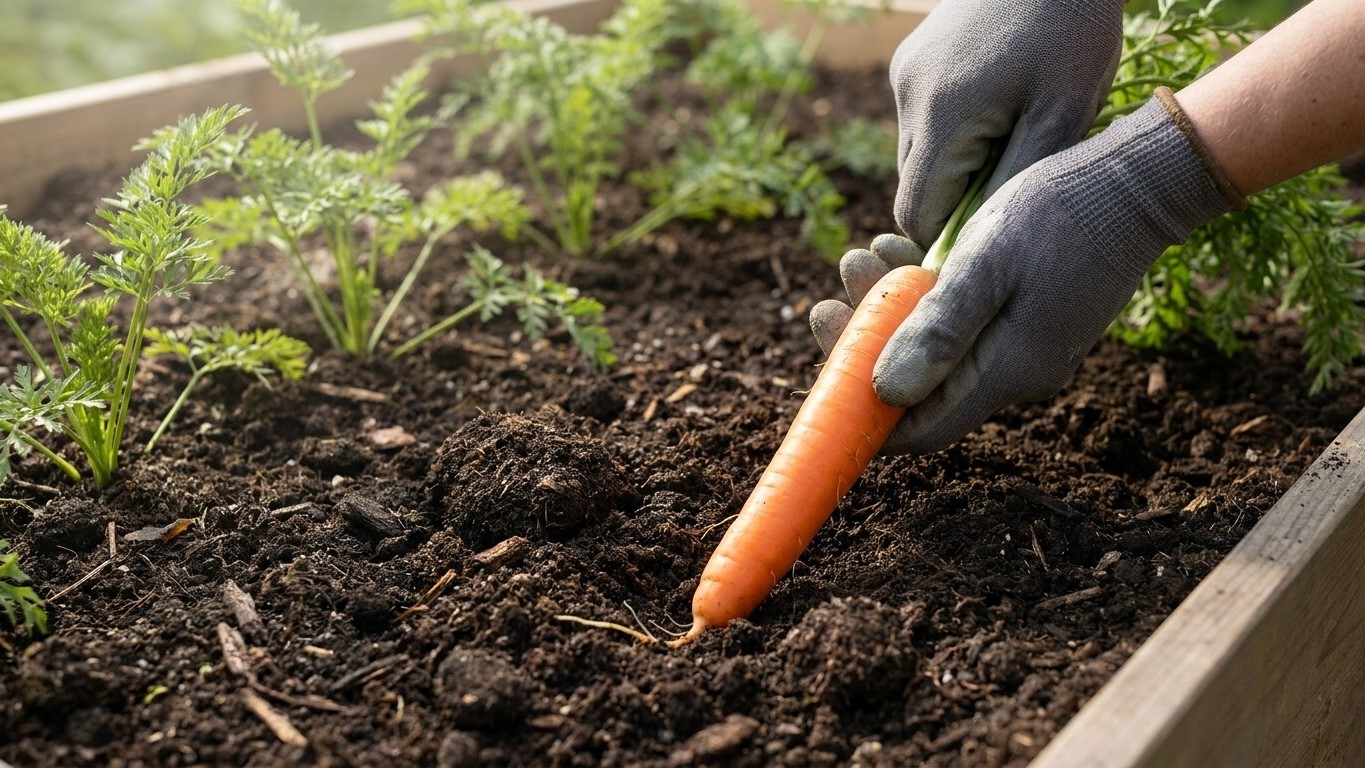

Will Carrots Fork in New Brunswick Soil? New Brunswick’s farmland soil, taken as a whole, drains well and carries a modest share of clay, so a carrot sown into typical ground here has decent odds of coming out straight rather than forked. What works against it more is chemistry: the province’s soil runs strongly acid, and organic matter sits under 4 percent. Getting a straight, sweet carrot means matching your bed to what your own soil actually is, not to a provincial average, and timing the seed to a frost window built around a mean date rather than a guarantee — see When to Sow Carrots in New Brunswick for that timing.
The short answer
Across the mapped agricultural surface of New Brunswick, the most common soil order is Podzol, the acid, leached soil that forms under conifer forest, where centuries of rain have washed the bases out of the topsoil. It covers about 46 percent of the mapped surface, with Gleysolic soils the next most common. The median surface reading comes out strongly acid, around pH 4.7. Texture runs 47 percent sand, 16 percent clay and 37 percent silt, which puts it in loam territory rather than heavy clay, and it’s classed as well drained. Organic matter sits around 3.4 percent, estimated from measured organic carbon.
Set that against what Utah State University Extension says a carrot actually wants: deep, sandy, well-drained soil rich in organic matter. Heavy or rocky ground is what makes the root fork, and the fix is plenty of compost worked in, plus double digging the bed, or building a raised bed filled with a loose mix if the ground underneath won’t cooperate. At 16 percent clay and classed well drained, the provincial texture doesn’t hand carrots the heavy, waterlogged conditions that cause the worst forking. The organic matter figure is the softer spot; 3.4 percent is on the lean side for a crop that wants soil described as “rich” in it, so compost still pays even where clay is low.
None of this is a reading of your own backyard. The figure comes from 418 mapped soil components across the province’s surveyed agricultural regions, and it’s a median, not a universal number. A province this size spans hundreds of distinct soil series, and land along a river valley, a drained bog, or a lot that’s been scraped and filled for a house will look nothing like the provincial middle. Treat the podzol profile as a starting point for what the ground here tends to do, acid and well drained, and nothing more specific than that until you’ve had a look at your own dirt.
The test that settles it in your own garden
The provincial median tells you what New Brunswick soil leans toward. It doesn’t tell you what’s under your own carrot bed. That takes a few minutes with a shovel, not a lab.
- Dig a hole where you plan to sow, going down as far as a full shovel blade will reach, and look at what comes up. Note where the darker topsoil ends and a paler, denser subsoil begins, and how many stones turn up in the pile.
- Take a handful of moist soil from that hole and squeeze it. If it holds a tight ball and smears into a ribbon between your fingers, you’re dealing with clay-heavy ground, the kind that tends to fork a carrot root. If it barely holds together and falls apart, that’s a sandier, looser soil closer to what carrots prefer.
- Look for stones and hardpan as you dig. A root that hits a rock or a compacted layer will split around it rather than growing straight down, whatever the texture reads like on paper.
- Fill the hole with water and watch what happens over the next while. Ground that drains at a steady, visible pace is behaving like the well-drained soil the province’s own median describes. Water that just sits there, barely dropping, points to a drainage problem no seed packet can fix on its own.
- Weigh what you found against the podzol profile above. Loam and steady drainage, close enough to the provincial pattern, means you can likely sow straight into the ground with compost worked in. Heavy clay, standing water, or a stony subsoil means double digging or a raised bed is the more reliable route.
When to sow here
Carrots go into the ground as seed and stay there through harvest. There’s no transplanting with this crop, so every count below runs from the sowing date, not from any date you’d set out a seedling.
- Start from the mean last spring frost for the region, which sits around May 23 based on the long-term normals for the Moncton station. Count back 2 to 3 weeks from that date, and the sowing window lands roughly in the first half of May.
- Treat that date as a midpoint, not a promise. A mean last frost date means that in about half the years on record, frost actually arrived later than May 23. Sowing on the calendar alone can still put seed into ground that freezes again.
- Check the soil itself before you drop seed. It needs to have reached at least 40 F, the floor carrots tolerate for germination, whatever the date on the calendar says.
- Expect slow, uneven sprouting if the soil is only just at that 40 F floor. Carrots germinate best between 55 and 65 F, and cold, early-May soil sitting well under that range can stretch germination out over several weeks rather than the faster pace warmer soil allows.
- Consider a second sowing later in the month, once the soil has warmed further toward that 55 to 65 F sweet spot, for a faster and more even germination than the earliest planting typically manages.
What goes wrong here
Most carrot failures in New Brunswick gardens trace back to one of the same handful of causes, and each one has a workaround that doesn’t require a different variety.
- Forking in heavy, compacted ground. A root that meets clay, a stone, or a hardpan layer splits instead of growing straight down. The fix is the same one Utah State University Extension gives for any heavy soil: dig deep, work in generous compost, or skip the ground entirely and sow into a raised bed filled with a loose mix.
- Poor, patchy germination during a hot spell. Once soil surface temperatures push past the 55 to 65 F germination sweet spot, the top inch can dry and crust between waterings, and seedlings that do sprout come up unevenly. Keeping the surface consistently damp, mulching lightly, or shading the bed during a stretch of hot weather helps seed come up more evenly.
- Splitting roots from uneven watering. A dry stretch followed by a heavy soak swells the root faster than the skin can stretch, and it cracks. A steady watering schedule, with mulch to even out moisture between waterings, keeps growth more consistent.
- Stunted, pale roots in strongly acid ground. With a provincial median around pH 4.7, some New Brunswick soil runs acid enough to lock up nutrients carrots need. A soil test that comes back strongly acid is the signal to work in lime ahead of sowing, rather than assuming the variety or the fertilizer is at fault.
Checking this against your own county
Everything above describes a provincial median built from soil samples across New Brunswick’s agricultural regions, not a reading of any one county’s dirt. Kings, Carleton, Charlotte, Sunbury and every other county in the province sit on their own mix of soil series, and some will drain and sit at a very different pH from the podzol profile described here.
For a closer look at soil conditions where you actually garden, Agriculture and Agri-Food Canada maintains resources at agriculture.canada.ca. The provincial department’s own site currently blocks automated checks, so the federal department is the more reliable link to point to here. A local test, or a look at county-level soil mapping through that federal resource, will tell you far more about your own forking risk and pH than any provincial median can.
Common questions
Does New Brunswick soil naturally suit carrots?
The provincial median leans loam and well drained, which is reasonably friendly to a straight-growing root. The catch is chemistry: a median pH around 4.7 is strongly acid, and organic matter around 3.4 percent is lean for a crop that wants soil rich in it, so amendment still matters even where the texture is on your side.
When exactly should I sow carrot seed in New Brunswick?
Aim for roughly 2 to 3 weeks before the mean last frost date of May 23, which lands sowing in the first half of May, but check that soil has reached at least 40 F first, and don’t treat the frost date as a hard guarantee since it’s a midpoint, not a safe cutoff.
Why did my carrots come out forked?
Forking almost always traces back to heavy, compacted, or stony ground that the root can’t push through cleanly. Working in plenty of compost and double digging the bed, or moving to a raised bed with a loose fill, addresses it directly.
Where can I check my own soil beyond this article?
Agriculture and Agri-Food Canada, at agriculture.canada.ca, is the federal resource to start with for soil information relevant to your county, since the provincial soil profile here is a starting point rather than a reading of any specific plot.