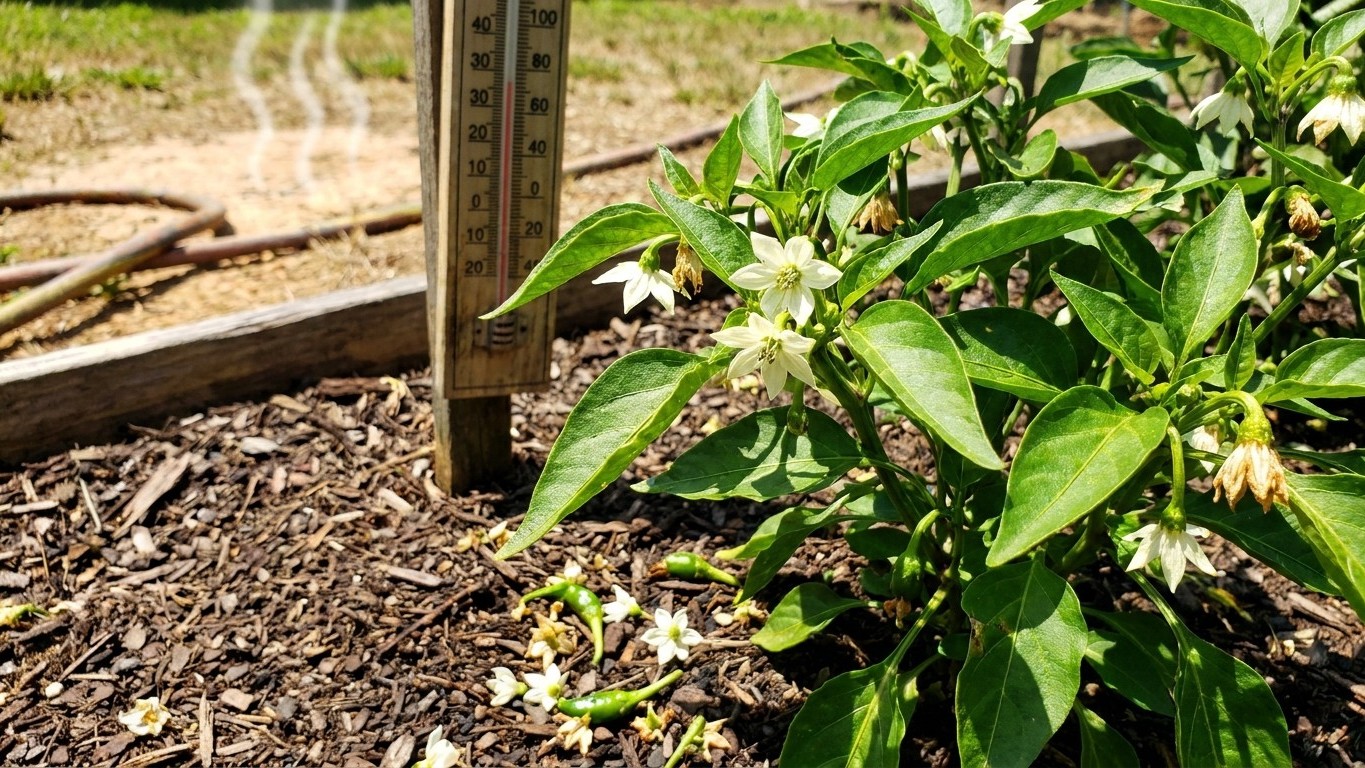

Peppers in Utah often set flowers just fine but never turn those flowers into fruit. The reason is usually temperature, not soil or fertilizer. Utah’s dry, high-elevation climate pushes summer days well past the point where pepper flowers hold, and the same open skies that heat things up during the day let temperatures fall fast once the sun goes down. Getting fruit set right here means tracking both edges of that range, not just one.
The short answer
Start with the heat side, because it’s the one this region measures well. The reference station in Salt Lake City averages 52.1 days a year at or above 90°F, based on NOAA’s 1991-2020 Climate Normals. That’s not a handful of scorching afternoons in late July. It’s roughly seven full weeks scattered across the growing season where daytime highs cross the threshold that Utah State University Extension identifies as one of the two points where pepper fruit set breaks down. When a plant sits at or above that mark for stretches at a time, flowers can open, look healthy, and still drop without ever forming a pod. The plant isn’t sick. It’s protecting itself, shedding blossoms rather than spending energy on fruit it may not be able to support in heat stress.
The other edge of the range gets less attention, but it matters just as much. Utah State University Extension is clear that pepper fruit set also fails when nights fall below 55°F, and in a state with this much elevation variation, that threshold can show up even during months that otherwise feel like full summer. A mountain valley or a high bench lot can drop into the low 50s on a clear night while a low-elevation garden twenty miles away stays warm enough for fruit to hold. This site tracks the 90°F day count for Utah, but it does not carry summer night minimum data for individual areas within the state. That gap matters. Don’t guess at your nighttime lows based on how far north or south you are, and don’t assume a warm afternoon means a warm night. Elevation, local terrain, and how open your site is to the sky at night all shift that number more than latitude does. If pepper flowers keep dropping in a summer that doesn’t feel unusually hot, a thermometer left outside overnight for a week will tell you more than any general climate description can.
Put those two boundaries together and the picture is straightforward: Utah pepper growers are working with a narrower fruit-setting window than the length of the frost-free season suggests. The season may run long enough on paper, but the number of days inside the 55°F to 90°F band where flowers reliably become fruit is smaller than a quick glance at the calendar implies. Watching both ends, not just the hot one, is what separates a pepper patch that fruits steadily from one that flowers all summer and produces little.
When to start seed here
Working out a seed-starting date for peppers in Utah means counting backward from two fixed points: when it’s safe to move plants outside, and how many weeks a pepper transplant needs indoors before that happens. Utah State University Extension recommends starting peppers 8 to 10 weeks before transplanting, and transplanting only after frost has passed and the soil has warmed to 60°F. Here’s how that arithmetic works for most of the state.
- Find your last spring frost window. For the reference station used in Utah’s NOAA climate data (station USW00024127), the 32°F freeze probability window falls between April 12 and April 29. That’s a range, not a single date, and it reflects a mild valley location. Higher elevations across much of Utah run colder and later; southern Utah tends to warm up earlier. Check local frost records for your county rather than assuming the reference station’s window applies directly to your yard.
- Wait for the soil, not just the calendar. Even after the air is frost-free, soil can lag behind by days or weeks depending on how much sun the bed gets and whether it’s covered with mulch or exposed. Peppers need soil at 60°F before transplanting; a simple soil thermometer pushed a few inches into the bed on a few mornings in a row will confirm when that threshold is actually met, rather than guessing from air temperature alone.
- Count back 8 to 10 weeks from your transplant date. If your frost-free, 60°F-soil date lands in early May for a lower valley location, seed starting indoors should begin somewhere in late February to early March. If your area runs colder and that safe date slides into late May or early June, push the indoor seed start back to match, always counting 8 to 10 full weeks before the day you expect to move plants outside.
- Build in a buffer for a slow spring. Because the frost window spans more than two weeks even at a single reference station, and because soil warming can lag frost dates by days, it’s worth treating the earliest end of your seed-starting window as the target and the later end as a fallback rather than starting everything at the last possible moment.
Redoing this math with your own county’s frost data, rather than relying on state-wide averages, is the single biggest adjustment most Utah gardeners can make to get transplants into the ground at the right time.
What goes wrong here
- Blossom drop in a heat spell or a cool night. This is the direct result of the two thresholds above: flowers opening during a run of 90°F-plus days, or during a clear night that falls under 55°F, will often fall off the plant without setting fruit. There’s no product that fixes this in the moment. The remedy is timing and siting: use light afternoon shade cloth during the hottest stretches, and choose planting spots that hold a bit more warmth on cool nights, such as against a south-facing wall or fence, rather than in an open, exposed bed.
- Sunscald where the sun is strong. Utah’s clear skies and high elevation mean stronger direct sun exposure than many gardeners are used to, and pepper fruit exposed after leaf loss or thin foliage can develop pale, sunken patches on the side facing the sun. The remedy is keeping the plant’s canopy full through steady watering and avoiding heavy pruning during peak summer, since leaf cover is what actually shades the fruit.
- Blossom-end rot on developing fruit. This shows up as a dark, leathery patch on the bottom of the pepper and is tied to inconsistent water delivery rather than a lack of calcium in the soil itself; uneven watering interrupts the plant’s ability to move calcium into the fruit. The remedy is even, consistent soil moisture through mulching and a regular watering schedule, especially during the hot stretches when soil dries out fastest.
Common questions
Why do my pepper plants flower but never set fruit in Utah?
The most common cause is temperature outside the range peppers need to hold their blossoms. Utah State University Extension identifies both ends of that range: nights below 55°F and days at or above 90°F. Utah’s Salt Lake City reference station averages 52.1 such days a year, and many areas of the state also see cool nights even in summer months. Track both conditions at your own site rather than assuming one or the other is the culprit.
Does elevation change when I should start pepper seeds in Utah?
Yes. The published frost window (April 12 to April 29) comes from a mild valley reference station. Higher elevations across most of the state see later, colder springs, while southern Utah tends to warm earlier. Count backward 8 to 10 weeks from your own area’s frost-free, 60°F-soil date rather than using the reference station’s window directly.
Can I fix blossom-end rot with a calcium supplement?
Blossom-end rot is usually a watering consistency problem, not a soil calcium shortage. Even, regular watering and mulch to hold soil moisture address the root cause more reliably than adding calcium products to the soil.
Is there a published night-temperature threshold I can check for my specific Utah county?
Not on this site. Summer night minimum temperatures aren’t tracked here by territory, only the count of days at or above 90°F. If cool nights are dropping your fruit set, monitor your own site with an outdoor thermometer rather than estimating from elevation or latitude alone.