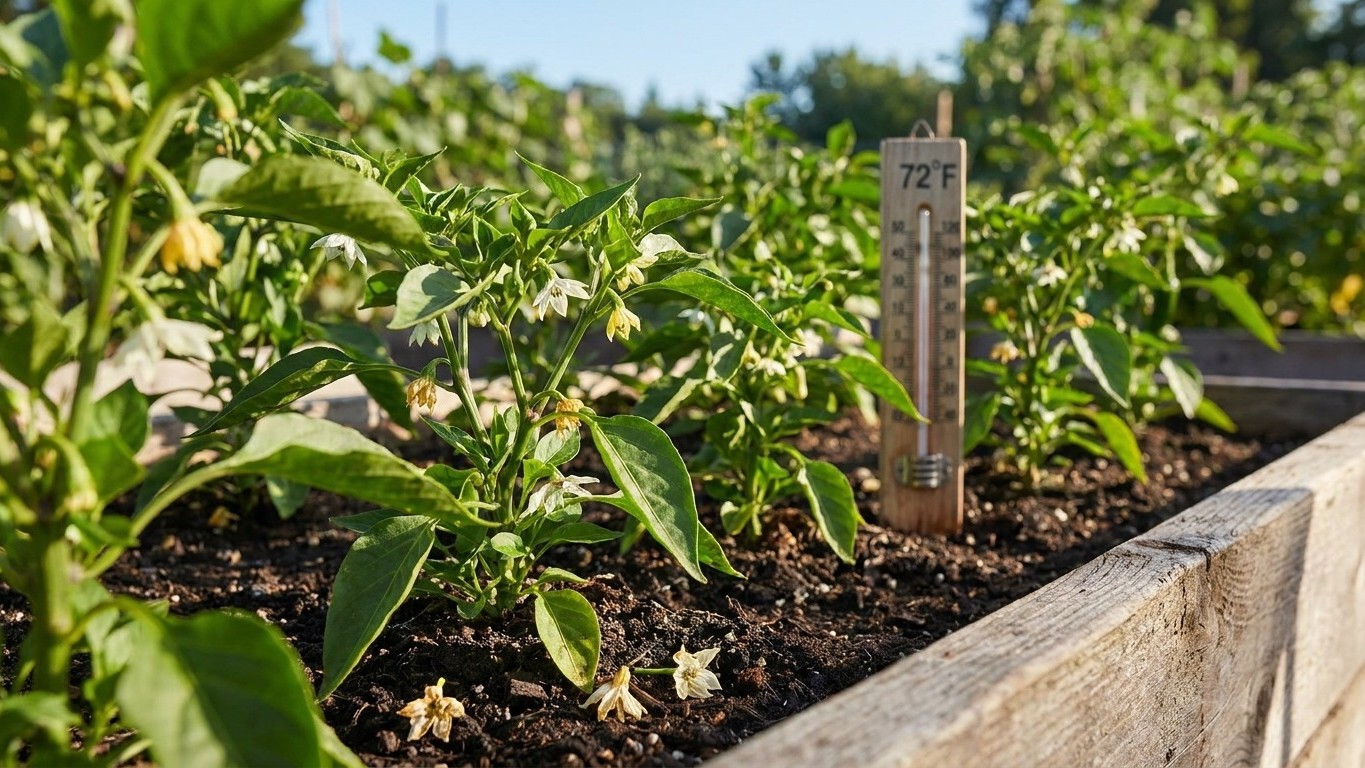

In Alabama, start pepper seed indoors roughly 8 to 10 weeks before your local transplant date, which falls once the soil hits 60 F and the frost danger has passed. Near the Huntsville reference station, that frost window runs from March 19 to April 3, so seed-starting typically lands in mid-January through early February. Your county’s actual dates depend on your own soil warm-up and microclimate.
The short answer
Near the Huntsville reference station, Alabama averages 58.5 days a year at or above 90 F, based on NOAA NCEI Climate Normals for 1991-2020. That’s a heavy stretch of summer heat, and it matters more for peppers than most gardeners expect. Pepper plants don’t just tolerate high heat poorly, they stop setting fruit altogether once daytime temperatures climb past 90 F for any real stretch. The flowers can still open, but the plant drops them rather than commit resources to a fruit that’s unlikely to mature in that stress. You’ll see healthy, green, blooming plants that simply aren’t producing, and the calendar is the reason.
That’s one end of the failure window. The other end is just as real and gets ignored far more often: pepper fruit set also fails when nights drop below 55 F. Cool spring nights in Alabama can linger well past the last frost date, especially in valleys, low-lying yards, and anywhere cold air pools overnight. A plant set out too early into a stretch of 50-degree nights will sit and sulk, flowers dropping just as surely as they would in a heat wave, even though the daytime weather looks perfectly springlike.
Here’s the catch for Alabama gardeners specifically: this site tracks days at or above 90 F by territory, because that data is measured and published at the county and station level. Summer and spring night minimums are not tracked here, and they vary far more locally than daytime highs do. Two yards ten miles apart can have a five- or six-degree difference in overnight low depending on elevation, tree cover, and how close they sit to a creek or low spot.
That means the hot-end risk for your county is something you can quantify against the 58.5-day figure above and plan around with shade cloth or timing. The cool-end risk is something no dataset can hand you. You have to watch your own thermometer, or better, put a min-max thermometer in the exact spot where your pepper bed will go, for two weeks before you plan to transplant. Don’t guess at your overnight lows from your latitude or from how cold your winter felt. Neither one predicts a 55-degree threshold in April with any real accuracy, and guessing wrong costs you a full flush of blossoms.
When to start seed here
The math behind a seed-starting date isn’t complicated, but it only works if you do it in the right order. Work backward from your transplant date, not forward from some fixed January calendar date, because your actual planting-out day depends on conditions in your own yard, not a fixed number on a page.
- Find your last spring frost window. Near the Huntsville reference station, NOAA’s 1991-2020 normals put the 32 F freeze probability window between March 19 and April 3. That’s airport-station data, and suburban or rural yards often see their last frost one to two weeks later than an airport reports, sometimes more at elevation. Check your own county’s extension records if you’re outside the immediate Huntsville area.
- Confirm soil temperature, not just air temperature. Peppers need soil at 60 F before transplanting, according to Utah State University Extension. A calendar date can pass while soil is still cold under mulch or in shaded beds, so a simple soil thermometer pushed a few inches down beats guessing from the air temperature alone.
- Set your transplant date at the later of those two markers. If your frost-free date and your 60 F soil date don’t land on the same week, plant out when both conditions are satisfied, not just one.
- Count back 8 to 10 weeks from that transplant date. That’s your seed-starting date indoors. If your transplant date lands in early April, for example, 8 to 10 weeks back puts seed-starting in late January to early February.
- Build in a buffer for uneven germination. Pepper seed is slower and less predictable to germinate than tomato seed. Starting at the early end of that 8-to-10-week window gives you room if a tray comes up patchy or slow.
Redo this arithmetic with your own county’s frost data rather than borrowing the Huntsville dates outright. A county an hour north or south, or one with more elevation change, can run a real week or two off the reference station’s numbers in either direction.
What goes wrong here
- Blossom drop from a hot spell. Once daytime highs push past 90 F for several days running, plants abort blossoms rather than push fruit through the stress. Alabama’s 58.5 average days a year at that threshold means this isn’t a rare event, it’s a predictable part of most summers. The remedy is timing plantings so early fruit set happens before the worst heat arrives, and using light shade cloth over plants during the hottest stretch of a heat wave to lower the load on the plant without cutting off pollination.
- Blossom drop from a cool night. The flip side: nights under 55 F cause the same dropped-blossom symptom, usually in early spring right after transplanting. Since this site doesn’t track summer night minimums, the fix is to watch your own overnight temperatures with a thermometer at bed level before committing tender transplants outside, and to hold plants a little longer under cover if a cold snap is forecast even after the average frost date has passed.
- Sunscald on exposed fruit. Alabama’s strong summer sun can scald pepper fruit that’s left uncovered by foliage, showing up as a pale, papery, sunken patch on the side facing the afternoon sun. Avoid heavy pruning that opens up the plant’s canopy during the hottest months, and let the natural leaf cover shade the fruit rather than stripping it back for looks.
- Blossom-end rot from uneven watering. Peppers pull calcium through water, and a summer of feast-or-famine watering, heavy rain followed by a dry stretch, interrupts that uptake and leaves a dark, sunken spot on the fruit’s bottom end. Consistent watering on a set schedule, plus mulch to even out soil moisture swings, does more to prevent it than any calcium spray applied after the fact.
Common questions
Can I skip seed-starting and buy transplants instead?
Yes, and many Alabama gardeners do, especially given how narrow the good-weather window can be between the last frost and the first serious heat. Buying transplants sidesteps the 8-to-10-week indoor clock entirely. You still need to wait for 60 F soil and a frost-free window before setting them out, and you still need to watch your own overnight temperatures for that under-55 F risk before committing them to the ground.
Does the 58.5 days-above-90 figure apply to my whole county?
That number comes from the Huntsville reference station’s 1991-2020 NOAA climate normals, and it’s a good regional signal for north Alabama, but heat load can run higher in low-lying or urban areas and somewhat lower at elevation or near larger bodies of water. Treat it as a planning baseline, not a guarantee for your exact address.
What if my soil hits 60 F earlier than my frost-free date?
Go with the later of the two. Warm soil without frost protection still risks a late cold snap killing a tender pepper transplant, and Utah State University Extension’s guidance ties transplanting to both conditions being met, not just one.
How do I know if dropped blossoms are from heat or cold, not disease?
Check the timing against the weather. Blossom drop tied to a run of 90 F-plus days or a stretch of nights under 55 F usually resolves on its own once temperatures moderate, with no lesions, spots, or wilting on the leaves. Disease-related flower loss typically comes with other visible symptoms on the foliage or stems, which heat and cold stress alone do not produce.