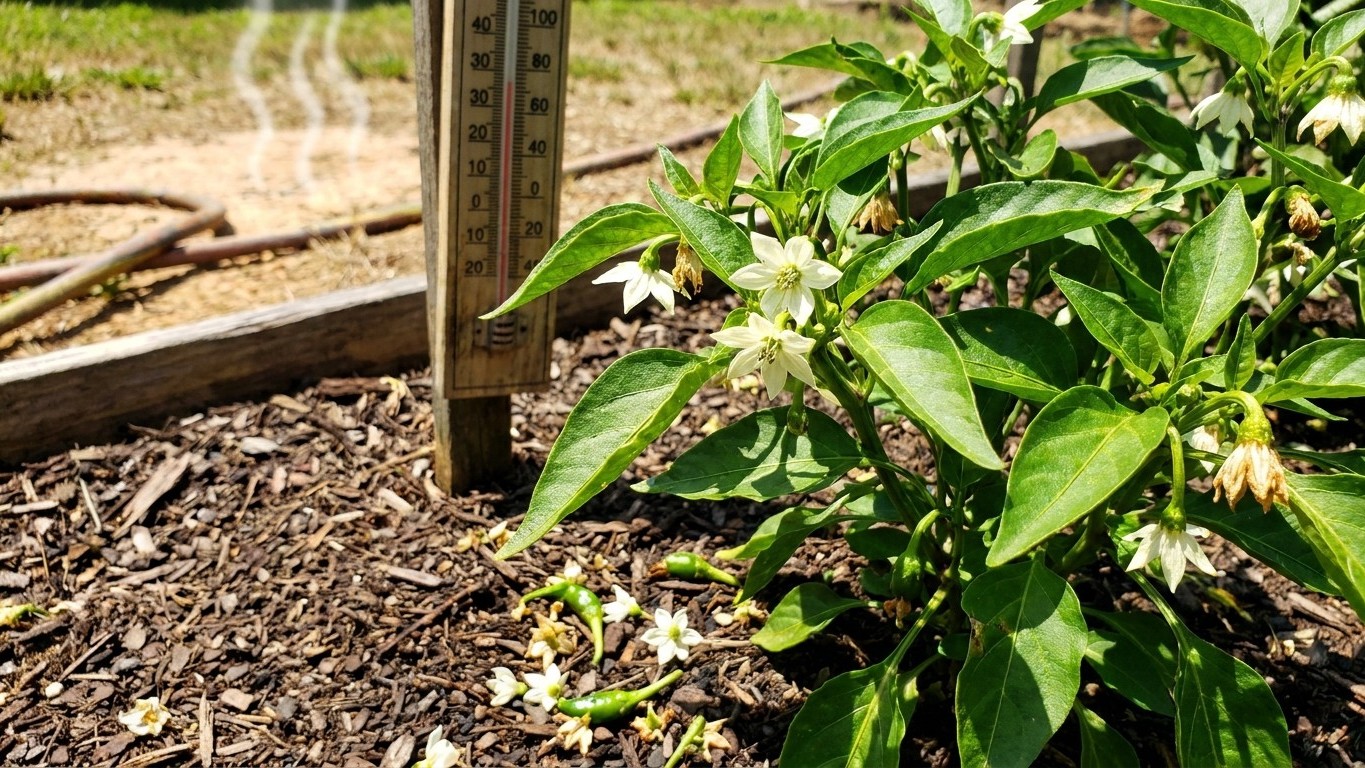

Pepper flowers set plenty of buds across California gardens, but a lot of them drop before ripening into fruit. The reference station in Los Angeles logs an average of 2.4 days a year at 90 F or hotter, which is enough heat stress during flowering to stall pollen and empty a plant’s blossoms. Cool nights cause the same failure from the other direction. Either extreme shuts down fruit set.
The short answer
The heat side
The Los Angeles reference station averages just 2.4 days a year at 90 F or above, according to NOAA NCEI Climate Normals covering 1991 to 2020. That number sounds small, and across a whole year it is. But pepper flowering doesn’t happen across a whole year. It happens in a window of a few weeks, and if even one or two of those 2.4 hot days land during that window, pollen can turn sterile and the flowers drop without setting fruit. A single afternoon spike is often all it takes. Growers along the immediate coast, where the marine layer keeps summer afternoons mild, may see fewer of those hot days than growers a few miles inland in the same county, where the same air mass can run noticeably warmer once it clears the fog belt.
The cool side
Fruit set fails at the other end too. Pepper plants need nights that stay above 55 F to hold their blossoms and shed pollen properly, according to Utah State University Extension. This site tracks days at or above 90 F for each California territory, but it does not carry summer night minimum temperatures. That’s a gap the gardener has to fill locally, not by guessing from a map. A coastal garden and an inland garden at the same latitude can post very different overnight lows once the marine layer, elevation, and local terrain get factored in, so latitude alone tells you nothing reliable about how cold your nights run in June or July. Watch your own thermometer through the flowering weeks, especially in gardens near the coast where marine air can keep nights cool even after a warm day, or in valley and foothill gardens where clear skies let heat radiate out fast after sunset.
When to start seed here
Counting backward from transplant
Utah State University Extension recommends starting pepper seed 8 to 10 weeks before transplanting outdoors, and moving transplants out once soil temperature reaches 60 F and frost risk has passed. Working that timeline backward for a California garden looks like this:
- Find the date your garden soil typically reaches 60 F. Use a soil thermometer at planting depth rather than guessing from air temperature, since soil warms more slowly, especially in shaded or heavily mulched beds.
- Confirm frost risk is over before that soil-temperature date arrives. In coastal and southern California, that’s rarely a limiting factor at all (more on that below).
- Count back 8 weeks from your soil-ready transplant date for the earliest reasonable seed-start indoors, and 10 weeks back for the latest reasonable window, giving yourself a two-week range rather than a single fixed day.
- Adjust that window if your indoor setup runs cooler or your seedlings tend to grow slowly; peppers are notoriously slow to germinate and can need the full 10 weeks to reach a sturdy transplant size.
Frost varies across California
Coastal and southern California is effectively frost-free. NOAA NCEI’s 1991-2020 Climate Normals list no computable freeze normal for the Los Angeles reference station, and NOAA RCC ACIS daily records show zero days at or below 32 F across 30 years there, with the frost-free season listed at the full 365 days. For a gardener in that part of the state, soil temperature and heat, not frost, are what set the planting calendar. That is not true for the whole state. Northern California, the Central Valley, and the Sierra do experience freezing winters, and gardeners in those regions need to check their own local frost dates rather than assume the coastal pattern applies to them.
What goes wrong here
- Blossom drop from a heat spell. Even a short run of days at or above 90 F during flowering can cause pepper blossoms to drop without setting fruit, since pollen loses viability in extreme heat. Provide light shade cloth, in the 30 to 40 percent range, over plants during the hottest afternoons of the flowering window, and hold off on heavy pruning that strips away the leaf canopy protecting the plant.
- Blossom drop from a cool night. Nights that dip below 55 F during flowering cause the same failure from the opposite direction. Track your own overnight lows through bloom season rather than assuming a “warm state” means warm nights everywhere, and delay setting out transplants until both soil and night temperatures are reliably in range.
- Sunscald on exposed fruit. California’s strong summer sun can scald fruit that loses its leaf cover, often after heat stress causes wilting or leaf drop. Keep the plant’s foliage full through the season and avoid over-pruning, adding light shade cloth if a heat spell has already thinned the canopy.
- Blossom-end rot from uneven watering. Hot, dry stretches combined with inconsistent irrigation, sometimes made worse by local water restrictions, lead to calcium uptake problems that show up as a dark, sunken patch on the fruit’s blossom end. Water deeply and on a steady schedule, and mulch around the base of the plant to slow soil moisture swings between waterings.
Common questions
Does California ever get frost that affects pepper transplants?
It depends on where in the state you garden. Coastal and southern California, represented by the Los Angeles reference station, shows zero days at or below 32 F across 30 years of NOAA RCC ACIS records, with a 365-day frost-free season. Northern California, the Central Valley, and the Sierra do get freezing weather and need their own local frost date, since the coastal pattern doesn’t apply there.
How many days does the reference station typically see above 90 F?
NOAA NCEI’s 1991-2020 Climate Normals put the Los Angeles reference station’s average at 2.4 days a year at 90 F or higher. That’s a low number over a full year, but it matters most if those days happen to fall during your pepper plants’ flowering window.
Can I set pepper transplants out before the soil reaches 60 F?
Utah State University Extension’s guidance ties transplant timing to soil reaching 60 F, not to a calendar date. Setting plants out into colder soil tends to stall growth and delay flowering rather than speed the season along, so it’s worth checking soil temperature directly before moving transplants outdoors.
What’s the difference between blossom drop and blossom-end rot?
Blossom drop happens before fruit ever forms, when flowers fall off the plant due to heat above 90 F or nights below 55 F during flowering. Blossom-end rot happens after fruit has already set, showing up as a dark, sunken spot on the fruit itself, usually tied to uneven watering rather than temperature extremes.