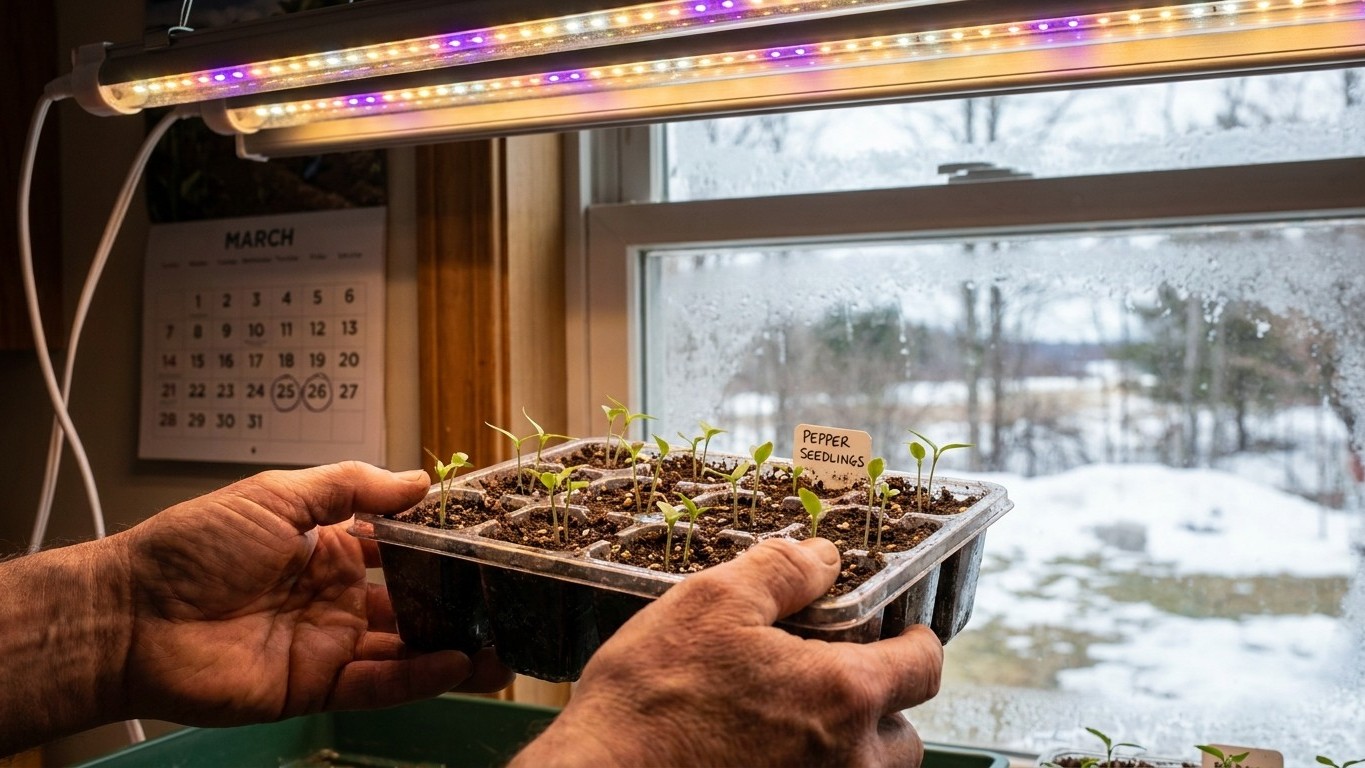

In Alberta, start pepper seed indoors about 8 to 10 weeks before you plan to transplant outdoors, which means the last week of March through mid-April for most of the province. That timing lines up with an average last frost near May 21 and the wait for soil to warm past 60°F, both of which push transplant day into late May or June rather than earlier.
The short answer
Start with the heat side of the equation, because it’s the one piece of good news Alberta gardeners get. The reference station at Calgary shows an average of 0.0 days a year at or above 90°F, based on Environment and Climate Change Canada’s Canadian Climate Normals for 1981 to 2010. That number matters because pepper fruit set collapses once daytime highs climb past 90°F: flowers drop, pollen goes sterile, and a plant that looked loaded with blossoms suddenly sets nothing. In Alberta, that failure mode is close to a non-issue. You are not fighting heat stress on your peppers the way a gardener in Texas or Arizona would be.
The other end of the fruit-set window is where Alberta growers actually need to pay attention. Peppers also stop setting fruit when nights drop below 55°F, even if the days are comfortable and the plants look healthy. This is a real risk in a province where June nights can still dip into the 40s in some years, especially in the foothills or northern districts. The catch is that this site does not carry summer night-minimum data for Alberta or any other territory. There is no substitute figure to offer here, and guessing one from latitude or from how cold the winters run would be misleading, since night temperatures in a Chinook-influenced climate like Alberta’s don’t follow a simple north-south gradient anyway.
What that means in practice: you have to watch your own nights once plants are outside. A cheap min-max thermometer left in the garden bed for a week in late May or early June will tell you more about your actual risk than any provincial average ever could. If you’re seeing nights consistently at or below 55°F after transplant, that’s the signal to hold off setting plants out, or to use row cover overnight until the pattern breaks. The hot-end risk is essentially closed for Alberta. The cool-end risk is open, and it’s on you to measure it where you garden.
When to start seed here
Working out a seed-starting date is really just backward arithmetic from two anchor points: when it’s safe to put transplants outside, and how many weeks a pepper seedling needs indoors before it’s ready for that move. Here’s how the count works for Alberta, step by step, so you can redo it for your own county or even your own yard.
- Start with the average last frost. For the Calgary International Airport station, Environment and Climate Change Canada’s 1981-2010 normals put the mean last spring frost at May 21. That’s a mean date, not a guarantee: in one year out of two, frost actually arrives later than that. Treat it as the middle of a window, not a line you can plant right up against.
- Add the soil-temperature requirement. Frost-free air doesn’t mean warm soil. Pepper transplants need soil at 60°F before they go in the ground, according to Utah State University Extension. Soil in Alberta typically lags behind the air by a couple of weeks after the last frost, so the safe transplant window usually falls sometime in late May to mid-June, depending on your local ground conditions that year.
- Pick a working transplant date. Say your soil reaches 60°F in the first week of June, a reasonable estimate for much of southern and central Alberta in an average year. That becomes your target transplant date. If you garden farther north or at higher elevation, push that date back by however many days your local frost and soil warming typically lag behind Calgary.
- Count back 8 to 10 weeks. Utah State University Extension recommends starting pepper seed indoors 8 to 10 weeks before transplant. Counting back from an early-June transplant target lands seed starting somewhere between late March and mid-April.
- Adjust for your own records, not the calendar alone. If your garden has run a week or two behind or ahead of the Calgary average in past years, shift the whole sequence by that same margin. The arithmetic stays the same; only the starting anchor moves.
The point of doing the math this way, rather than just picking a date off a seed packet, is that it forces you to check the two things that actually decide success: your real soil temperature and your real frost risk, not a generic calendar rule.
What goes wrong here
Alberta’s climate creates a specific set of pepper problems, some tied to cool spells, some tied to strong sun at altitude, and one that has nothing to do with temperature at all.
- Blossom drop from a cool night. Because Alberta’s days-above-90°F count sits at 0.0, heat-driven blossom drop is rare here. The bigger threat is the cool end: nights below 55°F can cause flowers to drop even when the plant looks otherwise fine. Since this site doesn’t track summer night minima, the remedy starts with your own thermometer. If overnight temperatures are running cool after transplant, cover plants with row cover or cloches in the evening and remove the cover once the sun is up, to buy the plant a warmer microclimate until the pattern passes.
- Sunscald on exposed fruit. Alberta’s high elevation and clear-sky days mean UV exposure can be intense even when air temperatures stay moderate. Fruit that develops on the sunny side of a lightly leafed plant can blister or develop pale, papery patches. The fix is simple: avoid heavy pruning that strips foliage, and let the plant’s own leaf canopy shade the fruit rather than exposing it directly to midday sun.
- Blossom-end rot from uneven watering. This shows up as a dark, sunken patch on the bottom of the fruit and it’s driven by inconsistent soil moisture, not by a lack of fertilizer, despite the common assumption. Chinook winds can dry garden soil out fast in Alberta, and the following week’s rain can then swing moisture the other way. Mulching around the base of the plant and watering on a steady schedule, rather than letting soil cycle between dry and soaked, is the most reliable way to prevent it.
Common questions
Can I transplant peppers before the average last frost date in Alberta?
It’s risky. The May 21 figure from Environment and Climate Change Canada is a mean, and in half of all years frost arrives after that date. Peppers are frost-tender, so transplanting ahead of that average without a hard local forecast in hand invites losing the whole planting to a late cold snap.
Do I need to worry about heat stress on peppers in Alberta?
Not much, based on the numbers. With an average of 0.0 days a year at or above 90°F at the Calgary reference station, the heat-driven form of blossom drop that plagues hotter climates is essentially not a factor in most Alberta gardens.
Why are my pepper flowers dropping even though the days feel warm?
Cool nights are the likely cause. Pepper fruit set fails when nights drop below 55°F, even if daytime temperatures are pleasant. Since local night-minimum data isn’t tracked on this site, check your own garden with a thermometer rather than assuming the days tell the whole story.
How long before transplant should I start pepper seed indoors?
Utah State University Extension recommends 8 to 10 weeks indoors before transplanting, with transplant timed to after frost and once soil has reached 60°F. Count back from your expected transplant date using those two figures to land on your seed-starting date.