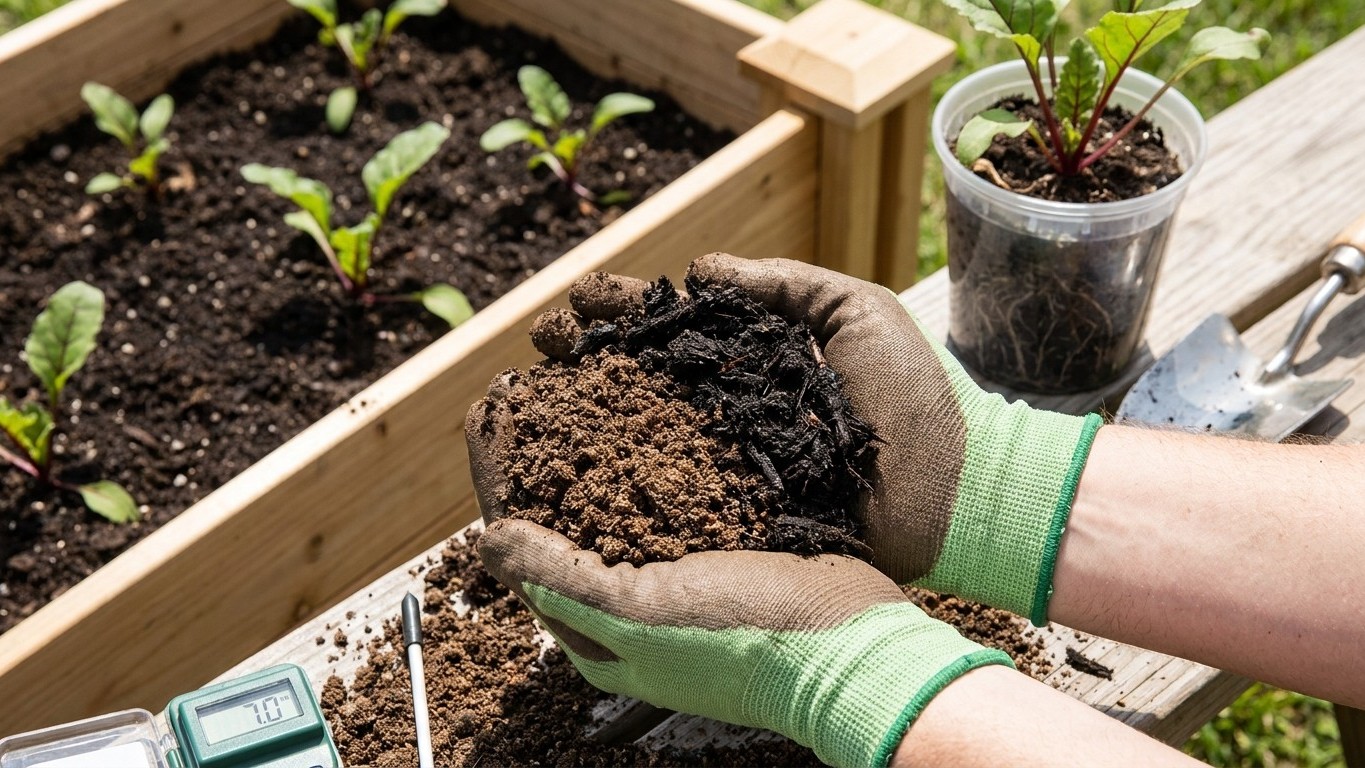

Beet Soil in Pennsylvania runs strongly acid and only middling in organic matter, which means most beet beds here need a pH correction and a compost top-up before seed goes in the ground. When to Sow Beets in Pennsylvania comes down to sowing two to three weeks ahead of the last spring frost, which lands anywhere from late March in Philadelphia to a month later in the northern tier, and keep that root evenly watered through its first six weeks. Skip that step and you get a plant that bolts before it roots.
The short answer
The soil that USDA lists as representative of Pennsylvania is the Hazleton series, a young Inceptisol that hasn’t had time to build strong subsurface layers. Its surface horizon runs 46 percent sand, 12 percent clay and 42 percent silt, which puts it in loam-to-silt territory, and it drains well. Organic matter sits around 3.0 percent, and surface pH averages about 4.6, which is strongly acid. That last number matters more than the texture does. Beets tolerate a fairly wide range of ground as long as it’s deep and drains freely, and Hazleton’s texture and drainage class both fit that description reasonably well. The pH doesn’t. Beets grow best closer to neutral, and a bed sitting at 4.6 will lock up boron and other micronutrients the root needs to size up evenly, which shows up as internal black spotting or lopsided roots even when watering and spacing are done right.
Utah State University Extension’s guidance for the crop calls for deep, sandy, well-drained ground rich in organic matter, amended with no more than 1 inch of composted material per 100 square feet. Hazleton’s 3.0 percent organic matter is workable but on the modest side of “rich,” so that inch of compost is doing real work in a Pennsylvania bed, not just topping off soil that’s already generous. A day-count for how often the state’s reference city climbs past 90°F isn’t part of the sourced record for this page, so it won’t be guessed at here. What is on record is the mechanism: Utah State’s research ties heat above 85°F combined with water stress directly to woody roots. Pennsylvania summers do produce stretches in that range, which means the heat side of the equation is live here even without a published day tally to quote.
None of this is a soil test for any one yard. Pennsylvania spans hundreds of mapped soil series, from river-bottom silt to rocky hillside ground to anything a builder has cut, filled or compacted, and a garden a few miles from a Hazleton-mapped area can behave completely differently. Treat the numbers above as a description of what the region’s ground tends to do, not a stand-in for a soil test pulled from an actual bed.
The six weeks that decide it here
Beets are direct-sown, never transplanted, and the 60 to 80 days on a seed packet count from the day seed goes into the ground, not from any later step. Sowing two to three weeks before the last frost date puts that first six-week stretch, the window when water stress does the most damage, squarely inside a known part of the Pennsylvania calendar. NOAA’s 1991-2020 climate normals put the last spring freeze at Philadelphia’s reference station between March 29 and April 6. That’s the mild edge of the state. The northern tier and the Alleghenies run two to four weeks behind that date, so a gardener in those regions is sowing, and running that critical six-week window, later in the spring than someone near Philadelphia.
Pennsylvania spring is not a steady ramp toward summer. It’s common for the state to see a run of raw, wet days followed abruptly by a dry, windy stretch, sometimes within the same week, and a late frost can still show up after a run of unseasonably warm afternoons. That swing matters more for beets than a simple “wet spring” or “dry spring” label would suggest, because it’s the sudden dry patch tucked inside an otherwise damp season that catches a gardener off guard. A bed that looked adequately moist on Monday can be dry an inch down by Friday if wind and sun move in, and beets don’t forgive that gap the way a tougher root crop might.
The bolting risk in Pennsylvania sits specifically in that early, swing-prone stretch, not later in the season once plants are established. A beet stressed for water in its first weeks reads that stress as a signal to flower rather than build a root, and once a plant bolts there’s no reversing it. That’s a distinct failure from the woodiness that shows up later under summer heat, and treating both as “just keep it watered” misses the point that one is a spring-timing problem and the other is a mid-summer one.
What goes wrong here
- Bolting from an early dry spell. A gap in watering during those first six weeks after sowing, especially during one of Pennsylvania’s abrupt dry snaps inside an otherwise wet spring, pushes beets to flower instead of forming a root. Keep the seedbed consistently moist, not soaked, from germination through the first true leaves, and don’t let a few sunny, windy days go unchecked just because the week before was rainy.
- Woody roots from summer heat layered on water stress. Once temperatures push past 85°F, any accompanying dryness turns the root fibrous and tough, a separate problem from spring bolting and one that shows up in already-established plants. Mulch to hold soil moisture through the hottest stretch and don’t let beds dry out between waterings once summer heat sets in.
- Locked-up micronutrients from strongly acid ground. Hazleton-type soil at a surface pH near 4.6 is well outside the range beets prefer, and acid soil restricts boron uptake in particular, producing internal black spots or uneven roots even when watering is handled well. A lime application based on an actual soil test, not a guess, brings the bed closer to neutral before seed goes in.
- Thin, low-organic-matter ground that can’t hold moisture evenly. At roughly 3.0 percent organic matter, a Hazleton-type bed dries out and rewets faster than the “rich” soil beets prefer, which compounds both the bolting risk and the woodiness risk above. Work in up to 1 inch of composted organic matter per 100 square feet before sowing, and no more than that, since over-amending can throw off the texture beets need for straight root growth.
- Crusting over silty ground after a hard rain. With silt at 42 percent of the surface horizon, a heavy spring downpour can cap the surface and block tender beet seedlings from pushing through. A light mulch or a shallow scratch of the surface after a hard rain keeps the crust from sealing over newly sown rows.
Checking this against your own county
Everything above describes what Pennsylvania’s representative soil tends to do, not what’s actually in any one garden bed. The only way to know an actual pH, texture and organic matter number is a soil test pulled from the bed in question, and the fastest route to that is Penn State Extension, the state’s land-grant extension service. County offices there can point to a soil-testing lab, interpret the results against beet-specific targets, and flag anything particular to that county’s mapped soils, whether that’s a river-bottom series that holds water longer than Hazleton does or a hillside series that’s rockier and faster-draining than the state average.
Common questions
Do I need to test my soil pH before planting beets in Pennsylvania?
If the ground anywhere close to Hazleton-type soil, sitting around pH 4.6, is a reasonable starting assumption for much of the state, but it’s still an assumption. A soil test through Penn State Extension gives an actual number for the bed in question, and beets do better closer to neutral than at that acid baseline.
How soon after sowing can beets bolt in Pennsylvania?
The risk window is the first six weeks after seed goes into the ground, which for most of the state overlaps the stretch right after the last spring frost. Water stress during that period, particularly during one of the state’s sudden dry snaps, is what triggers early flowering rather than root formation.
Is bolting the same problem as a woody beet root?
No. Bolting comes from water stress in the first six weeks after sowing and ends the plant’s chance of forming a usable root. Woodiness comes later, when temperatures above 85°F combine with dry soil in an already-growing plant. They call for the same fix, consistent moisture, but at two different points in the season.
How much compost should I add to a Pennsylvania beet bed?
Utah State University Extension’s figure is up to 1 inch of composted organic matter per 100 square feet, worked in before sowing. Given that Hazleton-type soil runs around 3.0 percent organic matter, on the low side of what beets prefer, that amendment is doing meaningful work in a typical Pennsylvania bed rather than just topping off soil that’s already rich.