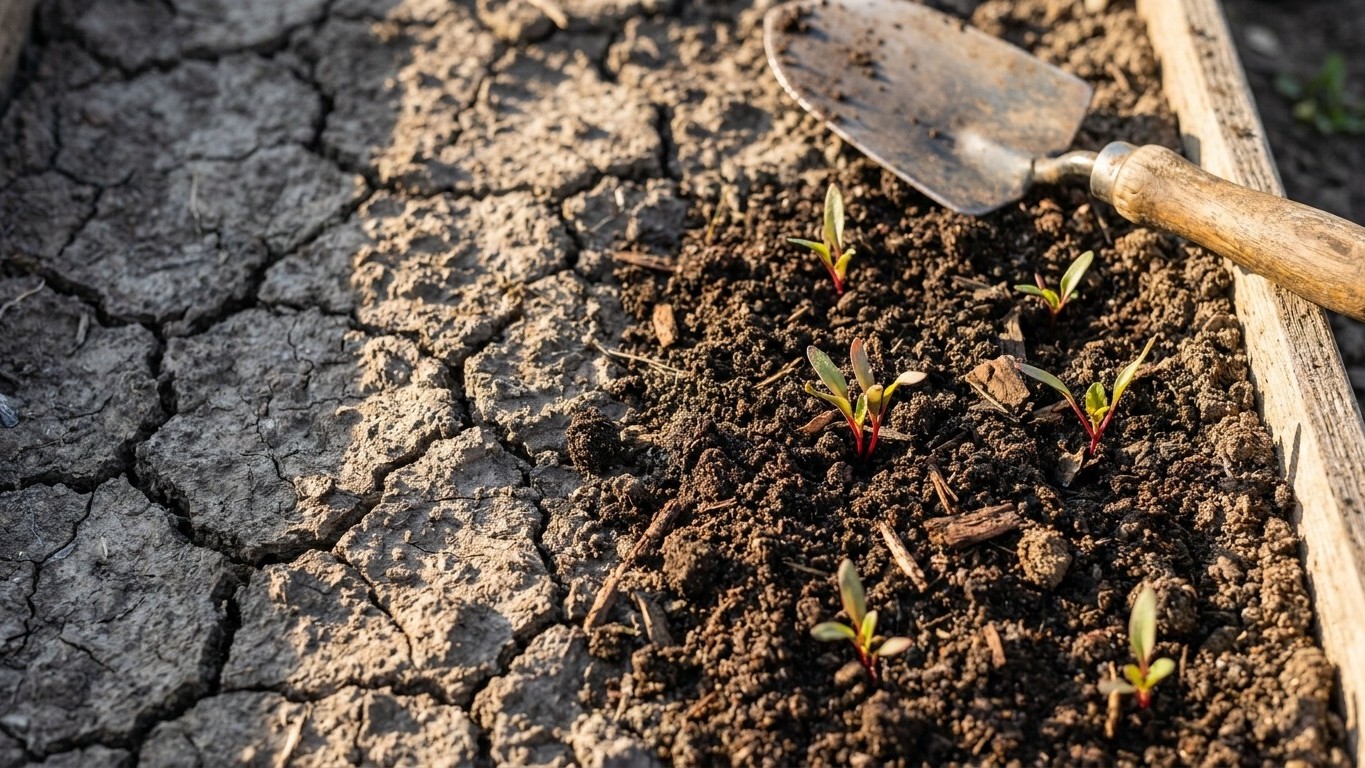

Texas beets face two separate threats: a heavy alkaline clay that swings between concrete-hard and sticky glue, and a spring window that can turn hot before six weeks of growth are done. Understanding Beet Soil in Texas is the first step before sowing seed directly in the ground, 2 to 3 weeks before the last frost, which for the Houston area falls between February 4 and March 1. Keep the bed steadily moist through those first six weeks to head off bolting, and know that heat above 85 F paired with dry soil is what turns a beet root woody.
The short answer
The soil USDA lists as representative of Texas is the Houston Black series, a Vertisol, the kind of clay that cracks wide open in a dry spell and turns to glue the moment it rains. Its surface horizon runs about 20 percent sand, 54 percent clay and 26 percent silt, with organic matter around 3.0 percent and a surface pH near 7.9, solidly alkaline. Drainage is rated moderately well drained, which sounds better than it behaves once that much clay is holding the water.
Beets want the opposite of that profile. Utah State University Extension describes the ideal beet bed as deep, sandy and well drained, rich in organic matter, the kind of ground a beet root can push through without resistance. A bed that’s 54 percent clay does the reverse: it compacts around the taproot, sheds water unevenly, and crusts hard on the surface after a rain, which is exactly the surface a fine beet seed struggles to break through. None of that makes beets impossible in Texas clay, but it does mean the standard advice, “amend with organic matter”, isn’t optional here. It’s the difference between a straight, tapered root and one that forks around a wall of compacted clay.
Heat is the second variable, and it works on a different clock than the soil does. Utah State’s research is specific on this point: heat above 85 F combined with water stress is what makes a beet root turn woody and fibrous, not heat alone. Along the Gulf Coast, that 85 F mark arrives early in the growing season and doesn’t let up, which puts real pressure on getting a beet crop through its root-bulking weeks before the heat and any dry spell overlap. Sow late, or let the soil dry out once temperatures climb, and the two failures stack on top of each other.
None of this describes every garden in the state. Texas spans hundreds of mapped soil series, and a yard in the Hill Country, a river-bottom garden, or a lot that’s been graded and filled by a builder can look nothing like the Houston Black series. Treat these numbers as a starting point for what the region’s clay tends to do, not a reading of your own bed.
The six weeks that decide it here
When to Sow Beets in Texas comes down to sowing 2 to 3 weeks before the last frost, which puts a beet’s first six weeks squarely into late winter and early spring along the Gulf Coast, working from that February 4 to March 1 last-frost window for the Houston station. That stretch of the year rarely settles into one pattern. A cold front can drop the temperature ten or fifteen degrees and dump a hard rain in an afternoon, then be followed by a stretch of dry, breezy days as south winds push evaporation back up. It’s a season that swings rather than holds steady, and a beet seedling doesn’t get a vote in which version it gets.
That swing matters more on this soil than it would on sand. The same clay that cracks open in a dry week closes back up and turns waterlogged after the next front comes through, so a young beet root can go from thirsty to sitting in saturated ground within days. Utah State’s finding on bolting is specific: water stress in the first six weeks is what pushes a beet plant toward premature flowering, and that six-week window is exactly the stretch the Houston sowing calendar lands on. A dry snap in week two or three, before the root system is deep enough to ride it out, is the kind of stress that shows up as a flower stalk weeks later rather than a beet.
The practical takeaway isn’t to chase the weather forecast every day. It’s to treat the first six weeks as a period where the soil moisture needs to stay level regardless of what the sky is doing, wetting the bed ahead of a dry, windy stretch and making sure a heavy clay bed can actually drain after a front comes through rather than sitting saturated for a week. Bolting risk here isn’t a single bad day. It’s the accumulated effect of a spring that doesn’t sit still, landing on a soil that doesn’t buffer moisture swings well to begin with.
What goes wrong here
- Bolting from the wet-dry swing. The Vertisol cracks open in a dry week and seals shut after rain, so a young beet’s roots see both extremes inside the same six-week window that Utah State ties to bolting. Water on a set schedule through that stretch, rather than reacting to whichever front just passed, so the bed never gets the chance to dry to cracking before the next rain arrives.
- Woody roots from heat arriving on schedule. Once daytime highs push past 85 F, any lapse in soil moisture is what triggers the fibrous, woody texture Utah State describes, and that mark comes early in a Texas spring. Get seed in as close to the front of the recommended window as the frost date allows, so root bulking finishes before the heat and any watering lapse can overlap.
- Poor germination from a crusted surface. A clay surface that’s 54 percent clay dries into a hard crust after rain, and a fine beet seed can’t always push through it. Cover the seed with a thin layer of compost or fine mulch and keep the surface consistently damp until the seedlings break through, rather than letting it dry and reseal between waterings.
- Waterlogged roots after a heavy front. Moderately well drained sounds fine on paper, but a Vertisol that’s swollen shut after rain can hold water around a taproot longer than a beet tolerates. Raise the bed a few inches, or ridge the row, so roots sit above the saturated layer rather than in it.
- Micronutrient lockout at pH 7.9. Alkaline soil in this range can limit how available certain micronutrients are to a growing root, showing up as pale or uneven leaf color rather than an obvious deficiency. Work in composted organic matter, capped at 1 inch per 100 square feet per Utah State’s guidance, which nudges the soil chemistry gradually rather than trying to force the pH down in one pass.
Checking this against your own county
The Houston Black series is the soil USDA lists to represent Texas, not a description of any one backyard. A garden forty miles inland, on a different soil series, can drain faster, run less alkaline, or hold far less clay, and the only way to know is a soil test pulled from that actual bed rather than a regional average.
Texas A&M AgriLife Extension runs county offices across the state and can point to a soil testing lab, give a local reading on how this spring is shaping up, and confirm which frost dates apply to a specific county rather than the Houston station used here. Their statewide site is agrilifeextension.tamu.edu, and the county office is the fastest way to swap a state-level starting point for a number that actually describes the ground a beet seed is going into.
Common questions
Can beets grow in Texas clay without amending it first?
They can come up, but a bed that’s roughly half clay by weight compacts around the taproot and drains unevenly, which tends to produce forked or stunted roots. Working in composted organic matter, up to 1 inch per 100 square feet, gets the texture closer to what Utah State Extension lists as ideal for beets.
Is the February to March window the right one for all of Texas?
No. That February 4 to March 1 last-frost range comes from a single Houston-area weather station. Texas covers four USDA hardiness zones, and the Panhandle’s last frost falls well after Houston’s while South Texas can clear frost earlier, so a county-level check is worth doing before locking in a sowing date.
What’s the difference between a beet bolting and a beet turning woody?
Bolting is the plant sending up a flower stalk instead of putting energy into the root, and Utah State ties that to water stress in the first six weeks after sowing. Woodiness is a separate problem that shows up later, when heat above 85 F combines with a dry spell during root bulking. One ruins the harvest early, the other ruins the texture near the end.
Does the soil’s alkaline pH need to be fixed before planting?
Not necessarily fixed, but it’s worth knowing. A surface pH near 7.9 can limit how available some micronutrients are to beet roots. Composted organic matter nudges pH gradually over time; a soil test through a county extension office is the only way to know whether a particular bed needs more correction than that.