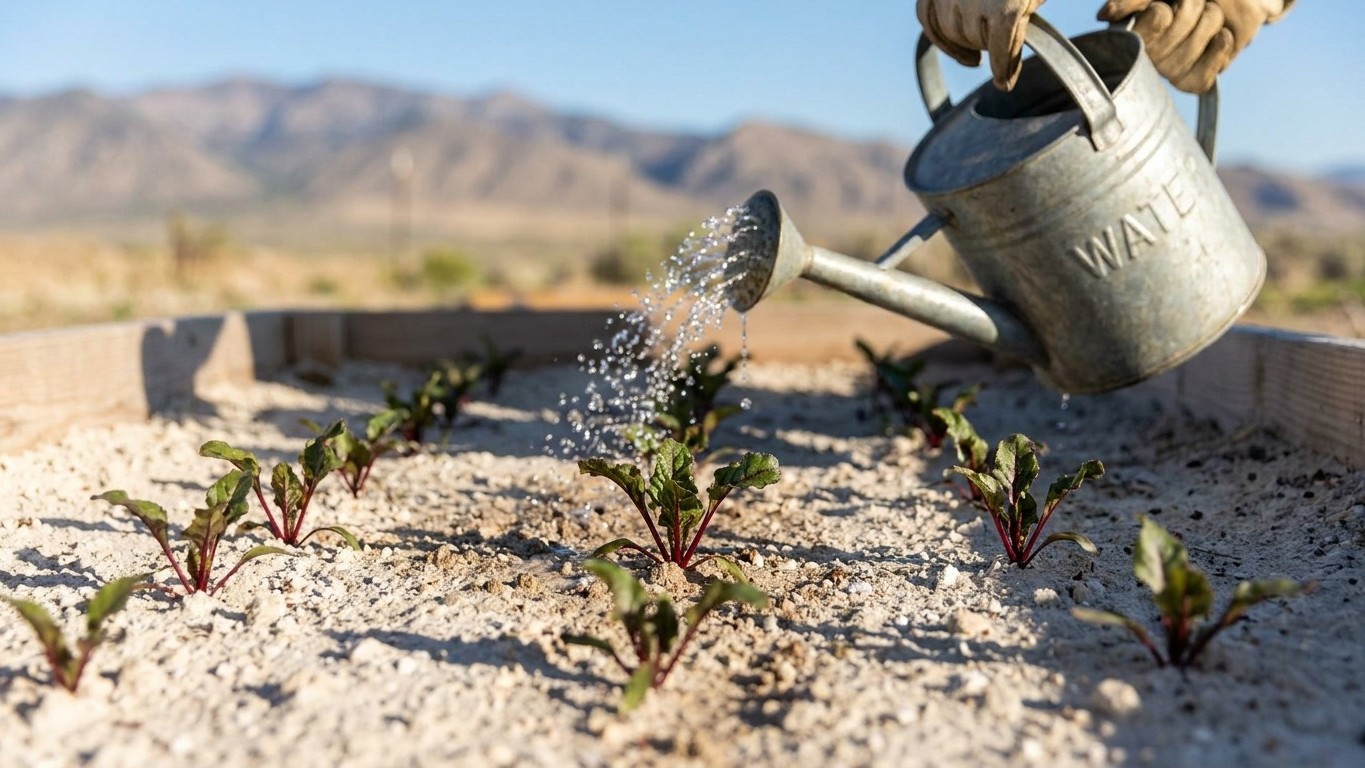

Beets grow fine in Utah if you work around two separate problems: soil that’s alkaline, sandy and quick to dry out, and a narrow spring window that sits right before the state’s summer heat turns a root woody. When to Sow Beets in Utah comes down to sowing seed directly into the bed 2 to 3 weeks before the last frost, keeping that bed evenly moist for the first six weeks, and not letting temperatures above 85 F catch a thirsty plant later on. Get those two things right and the rest of the crop takes care of itself.
The short answer
USDA lists the Mivida series as representative of Utah’s soil. It’s an Aridisol, the kind of soil that forms under a dry climate and tends to run alkaline and carry salts. The surface horizon comes in at roughly pH 8.1, with 72 percent sand, 9 percent clay and 19 percent silt, organic matter around 1.5 percent, and a well-drained classification. For a beet, that combination reads two ways at once. The sand and the well-drained rating mean water moves through fast, which is good news against rot but bad news against drought stress. The low organic matter means the soil has little buffering capacity to hold onto moisture or nutrients between waterings, and the alkaline, salt-prone chemistry can slow germination and thin out a seedling stand before the plant ever gets a chance to size up a root.
None of that is a life sentence for the crop. Utah State University Extension’s guide to Beets in the Garden is built around exactly this kind of ground: deep, sandy, well-drained soil rich in organic matter is what the plant wants, amended with no more than 1 inch of composted organic matter per 100 square feet. That’s a modest correction, not a soil overhaul, and it’s the single move that does the most to close the gap between the native Mivida profile and what Beet Soil in Utah actually prefers.
The heat side of the equation matters just as much. The exact count of days a year the reference station spends above 90 F isn’t part of the data behind this page, so it won’t be printed here as a number. What is documented is the mechanism: USU Extension is explicit that heat above 85 F combined with water stress is what makes a beet root turn woody and fibrous. In an Aridisol landscape with low organic matter and fast drainage, that combination of hot air and dry soil isn’t a rare event, it’s the default state of a Utah summer once the season turns.
One caveat worth repeating before anything else: Utah spans hundreds of soil series, and Mivida is the one USDA uses to represent the state, not a survey of every backyard in it. River bottoms, foothill ground, and any lot a builder has cut and filled will differ from this profile, sometimes completely. Treat the numbers above as a starting point for what the region’s ground tends to do, then confirm your own dirt before making decisions off someone else’s soil report.
The six weeks that decide it here
NOAA’s 1991-2020 climate normals put the last spring freeze for the reference station somewhere between April 12 and April 29. Sowing 2 to 3 weeks ahead of that date, which is the standard timing for direct-seeded beets, lands the seed in the ground sometime in late March to mid-April depending on where in that window the local frost date falls. That timing detail matters, because those first six weeks after sowing, not after transplanting since beets go straight into the bed as seed, are the window USU Extension flags as the period when water stress does its damage. Miss the watering during that stretch and the plant doesn’t just slow down, it often responds by bolting, throwing up a flower stalk instead of building the root anyone actually wants to eat.
What does a Utah spring in that window typically look like? The state’s own representative soil answers part of that question before a single weather record does. An Aridisol forms specifically under a dry climate, which is USDA’s shorthand for the region getting less moisture than the ground loses to evaporation across most of the year. Layer that onto a sandy surface texture that runs 72 percent sand and holds only about 1.5 percent organic matter, and the practical result is a bed that can look damp on top after a spring storm and be dry two inches down within a day or two. That’s the mechanism behind the bolting risk in this state: not a single bad week, but a soil built to shed moisture sitting under a climate built to dry it out further, both working against a plant that needs steady moisture for its first six weeks and nothing else.
The fix isn’t complicated, but it is a scheduling problem as much as a watering one. Because the six-week clock starts at the sowing date, not at some fixed calendar day, a gardener who sows right at the early edge of the 2-to-3-week pre-frost window is running that critical period through cooler, often wetter weeks than someone who waits and sows closer to the frost date itself. Either approach can work. What doesn’t work is treating the watering schedule as an afterthought once the seed is in, since by the time wilting shows up above ground, the bolting response may already be triggered below it.
What goes wrong here
- Bolting from a dry stretch in the first six weeks. The sandy, low-organic-matter surface drains fast and holds little reserve moisture, so a missed watering during this window is often enough to trigger premature flowering. Remedy: water on a fixed schedule through that period rather than waiting for visible wilt, and mulch the surface to slow evaporation from the exposed sand.
- Woody, fibrous roots from heat later in the season. This is a separate failure from bolting: USU Extension ties it to temperatures above 85 F hitting a plant that’s also short on water at that stage. Remedy: keep watering consistent as the season warms, and time sowing so the root has bulked up before the hottest stretch arrives.
- Thin, uneven germination in alkaline, salt-prone ground. The Aridisol’s pH near 8.1 and its tendency to carry salts can slow seed germination and knock out part of a stand before it starts. Remedy: run a soil test ahead of planting and water the bed thoroughly before sowing to help move salts down and away from the seed zone.
- Nutrients and moisture running through the bed instead of staying in it. With organic matter around just 1.5 percent, native soil in this profile has little capacity to hold what’s applied to it. Remedy: work in composted organic matter, capped at 1 inch per 100 square feet per USU Extension’s guidance, rather than assuming more is better.
- Fast drainage undoing deep, infrequent watering. A well-drained, 72-percent-sand surface lets water pass through before roots can use much of it. Remedy: shift to more frequent, lighter watering rather than the deep-soak schedule that works on heavier soils elsewhere.
Checking this against your own county
Everything above describes the soil USDA uses to represent Utah as a whole and a set of general climate mechanics, not a reading of any one garden. Before changing a watering schedule or ordering a truckload of compost, get an actual test of the dirt in question. Utah State University Extension runs county offices across the state and can point a gardener toward soil testing and localized planting guidance for their specific address, which matters more than any state-level average once frost dates, elevation and soil type start to shift from one valley to the next. A garden forty minutes from the reference station used for the frost dates on this page can have a meaningfully different last-frost window, and USU’s county staff are the ones positioned to say what that difference actually is.
Common questions
How many days after sowing until beets are ready to harvest in Utah?
Beets are direct-seeded, not transplanted, so the maturity clock starts the day the seed goes into the ground rather than at a later planting-out date. USU Extension’s guidance centers on that seeding date as the reference point for tracking a crop toward harvest, so any timeline should be counted from sowing, not from when seedlings first appear above ground.
Is bolting the same problem as a woody root?
No, and treating them as one problem is the most common mistake. Bolting comes from water stress in the first six weeks after sowing and shows up as a flower stalk instead of a root. Woodiness comes later, when heat above 85 F combines with a shortage of water while the root is sizing up. Same underlying cause, water, at two different stages, with two different results.
Does Utah’s alkaline soil mean beets won’t grow at all?
No. The state’s representative soil runs alkaline, with a surface pH near 8.1, but that’s a starting condition to manage, not a barrier to the crop. USU Extension’s soil recommendation, adding organic matter and confirming drainage, applies directly to this kind of ground and is the standard adjustment rather than a special case.
Should I water beets on a set schedule or wait until the soil looks dry?
Given how fast the state’s representative sandy soil sheds moisture, waiting for visible dryness on the surface risks letting the root zone dry out first, especially during the six-week window right after sowing. A fixed watering schedule through that period, adjusted after an actual soil test, is a more reliable approach than judging by the look of the top inch of soil.