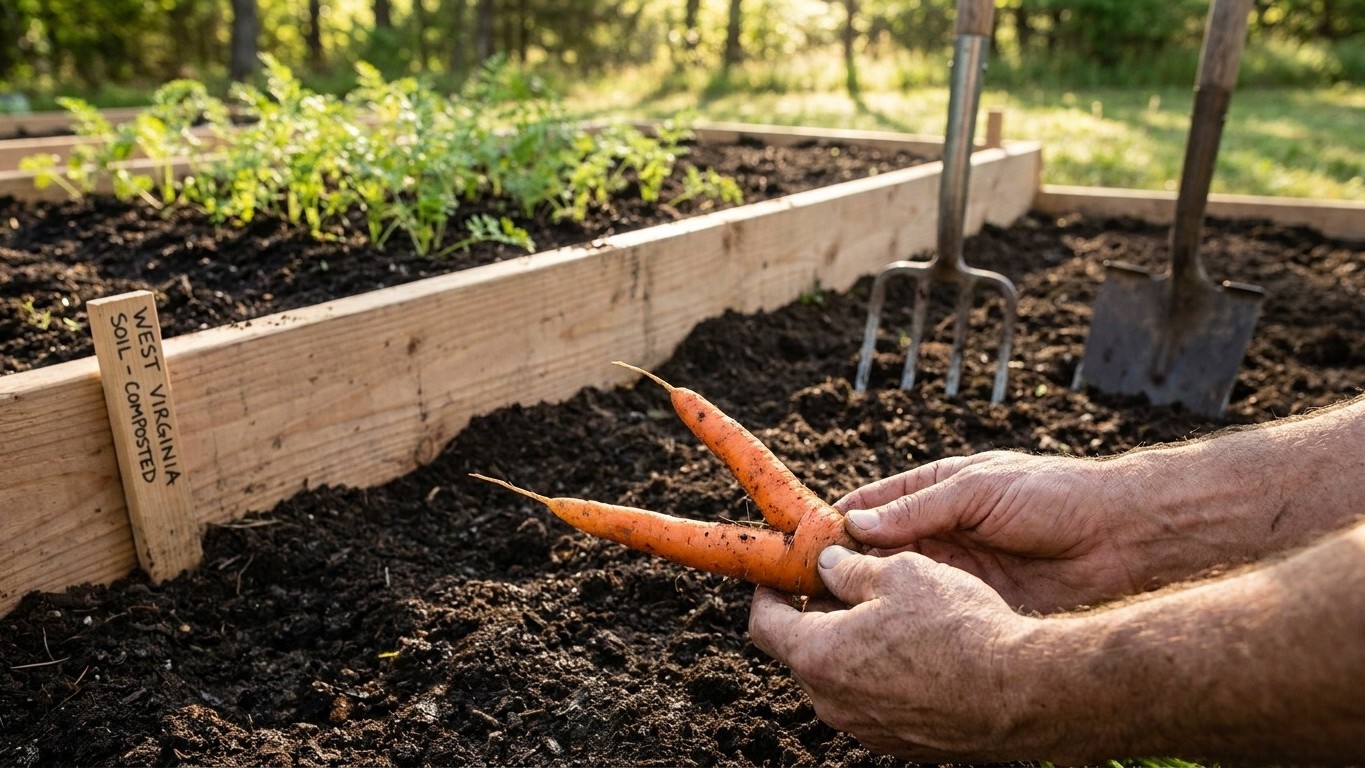

West Virginia’s official state soil is a strongly acid, silt-heavy loam that drains only moderately well, and carrots planted straight into it will often fork rather than run straight down. That’s not a verdict on your yard specifically, but a compost-rich raised bed or a well-worked, double-dug row is the standard fix. When to Sow Carrots in West Virginia generally means sowing two to three weeks ahead of your local last frost, and germination goes best once the soil itself has warmed.
The short answer
The soil West Virginia law recognizes as its official state soil is the Monongahela series, an Ultisol, the category of old, heavily weathered and leached soils that dominate much of the Appalachian region. Recorded surface values for this series run 27 percent sand, 18 percent clay and 54 percent silt, with organic matter around 3.0 percent and a surface pH near 5.0, which is strongly acid. Drainage is classed as moderately well drained, meaning water moves through it, but not quickly.
For a carrot root, that texture profile is a mixed signal. Silt-dominant ground like this tends to compact and crust more than a sandy loam, and any compaction layer or buried stone a carrot’s tip meets on its way down is what causes forking, the root splitting into two or more legs instead of growing as one clean taproot. Will Carrots Fork in West Virginia Soil? is a question the Monongahela profile alone can’t fully answer, since a pH near 5.0 is also on the acid side of what most vegetable roots prefer, though the exact tolerance for carrots isn’t something this soil record settles.
None of that means carrots won’t grow here. It means the ground needs help before the seed goes in. Working several inches of compost into the top foot of soil loosens silt that would otherwise pack down around a growing root, and double digging, turning the soil a full spade deep and breaking up the layer beneath it, removes the hardpan that a shallow tilling would leave in place. Where the native ground is especially heavy or full of rock, building a raised bed with purchased or blended loam sidesteps the problem entirely, since the carrot never has to fight its way through the Monongahela profile at all.
Treat all of this as a starting point, not a diagnosis. West Virginia’s terrain runs from river bottoms to steep hill country to flat valley floor, and the state is mapped into hundreds of distinct soil series, each with its own texture, drainage and pH. A garden ten miles from the next one over can sit on completely different ground, especially where a builder has cut, filled or graded the topsoil away. The Monongahest profile tells you what the region’s ground tends to do; it doesn’t tell you what your own bed will do until you check it yourself.
The test that settles it in your own garden
- Dig a test hole where you plan to sow, at least a foot deep. Note whether you hit solid clay, a rock layer or a hardpan before reaching that depth, since anything blocking a straight foot of loose soil is a likely forking point.
- Check for stones and debris as you dig. Carrots fork around obstructions, so a handful of gravel or old construction fill in the root zone matters more than almost anything else you’ll find.
- Feel the texture of a handful of moist soil from that hole. Roll it between your fingers: gritty and loose suggests sand, sticky and moldable suggests clay, and a smooth, slightly slick feel that won’t hold a ribbon shape suggests silt closer to the Monongahela profile.
- Watch the drainage by filling the hole with water and timing how long it takes to disappear. Water that lingers for hours points to compaction or a clay-heavy layer that will need loosening before roots can push through it.
- Send a sample for a lab soil test through your local extension office if you want an actual pH and nutrient reading, since nothing short of a lab result gives you a real number to work from.
When to sow here
- Find your last spring frost date. For the Charleston area, NOAA’s climate normals put it somewhere between April 9 and April 23, depending on the year’s pattern. That’s a river valley station, and higher ground elsewhere in the state tends to see frost linger later into spring and arrive earlier in fall.
- Count back two to three weeks from that date. If your last frost lands on April 9, that puts sowing in the middle of March. If it lands on April 23, the same count back lands you in the first days of April. Carrots are sown as seed directly into the ground, never started indoors and transplanted, so this backward count from frost is the only calendar math that applies.
- Check soil temperature before you sow, not just the calendar date. Carrot seed needs the ground at a minimum of 40 F to germinate at all, and it does best once soil warms into the 55 to 65 F range. A soil thermometer pushed a couple of inches down tells you more than any date on a seed packet.
- Expect a slow start if you sow at the cold end of that window. Seed sown when soil is barely at 40 F will sit and germinate slowly compared to seed sown once the ground has warmed closer to 55 F, so a patient early sowing and a slightly later, faster-germinating one often finish closer together than the calendar suggests.
- Count maturity from the seeding date, always. Since carrots aren’t transplanted, the full span from seed in the ground to harvest is what matters, and that stretch runs long enough that an early sowing gives you real room before fall frost closes the season.
What goes wrong here
- Forking in heavy ground. The Monongahela profile’s high silt content and moderate drainage set up exactly the compaction that splits a taproot in two. The fix is compost worked deep into the bed, a full double dig before sowing, or building up a raised bed with looser, purchased soil so the root never meets the native layer at all.
- Poor germination during a hot, dry spell. Carrot seed is small and sits shallow, so it dries out fast once temperatures spike, and a crust can form over silt-heavy soil that a thin seedling can’t push through. Keeping the top inch of soil consistently moist with light, frequent watering until seedlings show is the practical answer, along with a thin scatter of straw or a board laid over the row until sprouting starts.
- Splitting from uneven watering later in the season. A dry stretch followed by a heavy soak makes a root swell faster than its skin can stretch, and it cracks. A steady watering routine, rather than feast-or-famine soaking after a rain-free week, keeps that from happening as roots size up toward harvest.
- Stunted or curled roots in shallow, undug beds. Skipping the deep loosening step and sowing straight into unworked ground gives a carrot nowhere to go but sideways. This one isn’t a soil chemistry problem, it’s a preparation problem, and it shows up even in beds that tested fine for texture and drainage.
Checking this against your own county
Everything above describes the state’s representative soil and one river valley’s frost record, not your specific garden. West Virginia University’s Extension Service, reachable through extension.wvu.edu, maintains county offices across the state that can run an actual soil test, give you a local frost date closer to your elevation, and tell you whether your county’s ground leans closer to the Monongahela profile or something entirely different. That’s the step that turns a state-level starting point into an actual planting plan.
Common questions
Does the whole state have the same soil as the Monongahela series? No. That series is the officially recognized state soil, chosen to represent a common Appalachian pattern, but West Virginia includes hundreds of mapped soil series, and river bottoms, hillsides and disturbed urban lots can all differ sharply from it.
Can I sow carrots earlier than the two-to-three-week window before frost? Only if soil temperature has already reached the 40 F minimum. Sowing into colder ground doesn’t speed things up, it just leaves seed sitting without germinating.
Is raised-bed soil a permanent fix for forking? It removes the native compaction and stone problem as long as the bed’s fill stays loose and is refreshed with compost between seasons; letting a raised bed compact down over several years reintroduces the same risk.
Why do carrots split even when they’re not forked? Splitting is a watering issue, not a soil-structure issue, and it happens even in well-prepared beds if watering swings between drought and heavy soaking as the roots size up.