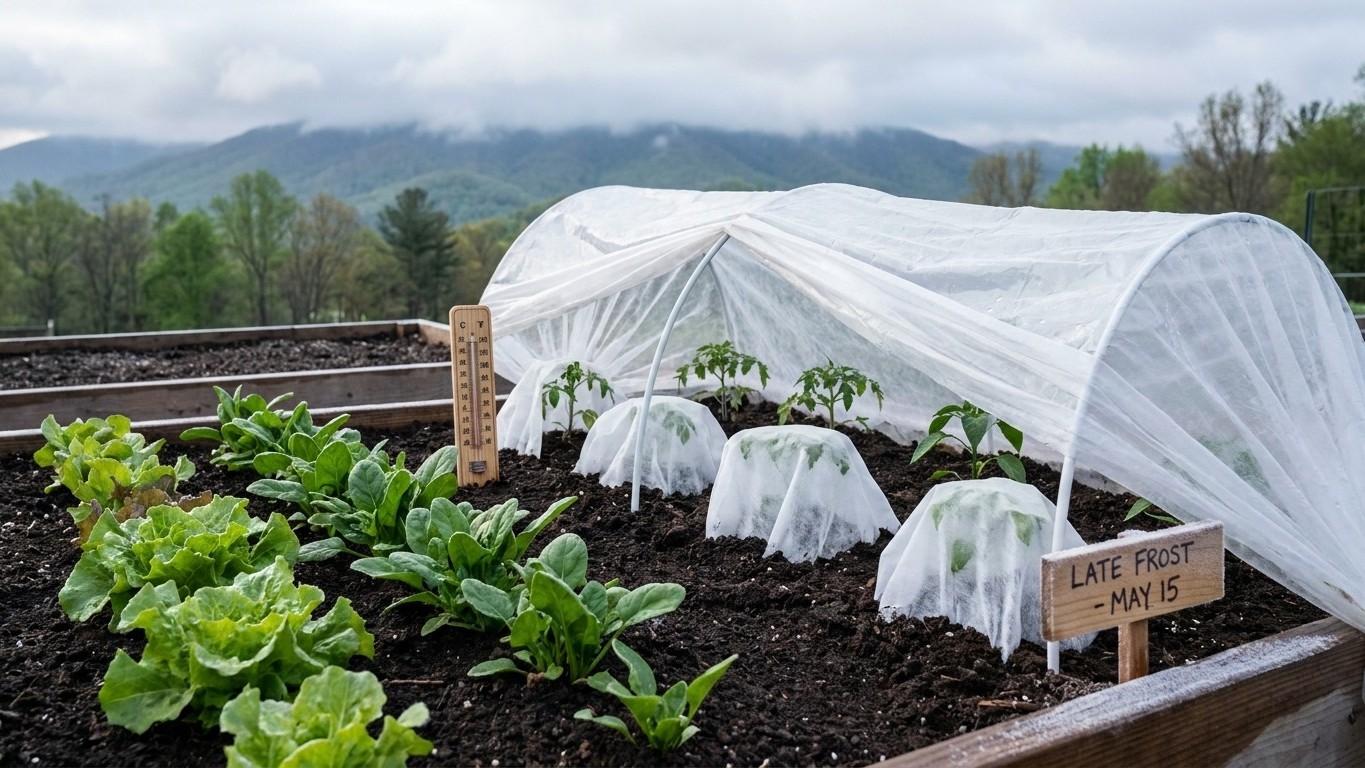

West Virginia gardeners work with a frost-free window that runs roughly six months at low elevation and considerably less in the mountains, inside a hardiness range that spans three full zones. That range, not any single number, is what decides what you can grow and when.
How long your season really is

Start with the numbers that actually run the show. West Virginia sits across USDA hardiness zones 5a to 7a, a spread wide enough to cover a genuinely different climate at the valley floor versus the ridge tops. At the Charleston reference station, the average last spring frost falls somewhere between April 9 and April 23, and the average first fall frost lands between October 18 and November 1.
Put those two windows together and you get a frost-free season that stretches from as little as 178 days to as much as 206 days, depending on which end of each range a given year happens to land on. That’s the number that matters more than the zone label or the season name: the count of frost-free days you can actually plan around, and it’s also what determines When to Carve a Pumpkin in West Virginia as the first fall frost approaches.
Here’s the part gardeners skip past too often. Those dates are averages, not guarantees. NOAA builds them from three decades of freeze probabilities, which means roughly half of all years run colder or later than the average on one end or the other. A last frost date of April 23 doesn’t mean frost stops on April 23. It means in half the years on record, it didn’t.
What that window rules out matters as much as what it allows. A 178-to-206-day season handles the great majority of home garden crops without drama, and even a heat-loving, moderate-season crop like peppers fits comfortably within it, as covered in Growing Peppers in West Virginia, while a shorter-season staple such as potatoes fits even more easily, as detailed in Growing Potatoes in West Virginia, a longer-season warm-weather crop like sweet corn still has room to mature, as laid out in Growing Sweet Corn in West Virginia, a perennial that rewards patience across those same spring frost dates, as explained in Growing Asparagus in West Virginia, and a cool-season leafy crop can even squeeze in two plantings at either end of the frost-free stretch, as shown in Growing Spinach in West Virginia, and a quick-maturing root crop slots in just as comfortably, as explained in Growing Carrots in West Virginia, with another cool-tolerant root crop faring just as well, as shown in Growing Beets in West Virginia, and a slow-maturing but frost-hardy root crop making equally good use of the long window, as covered in Growing Parsnips in West Virginia. But it starts to squeeze anything pushing past 100 to 120 days, a threshold that pumpkins often bump right up against, as detailed in Growing Pumpkins in West Virginia days to maturity, especially in a cooler year or at higher ground. Long-season winter squash, some dry beans, and full-season melon varieties become a bet on a good year rather than a plan you can count on, particularly outside the river valleys.
And that last qualifier carries real weight here. Charleston sits in a river valley, which runs warmer and frosts later than the ridges and hollows that make up so much of the state. A gardener at higher elevation should expect the frost-free window to arrive later in spring and end earlier in fall than these figures suggest, sometimes by weeks rather than days.
What the summer does to a garden here
Charleston averages 16.0 days a year at or above 90F. That’s not a brutal number by national standards, but it doesn’t take many 90-degree stretches to cause real damage in the vegetable patch. Tomato flowers commonly stop setting fruit once daytime heat pushes past roughly 90F, because pollen viability drops off at that threshold. Lettuce and spinach bolt to seed under the same heat, turning bitter and useless within days.
The coldest month here averages a daily minimum of 26.1F, the figure that actually decides whether perennials and overwintering crops survive the cold at all. That’s a meaningfully harder winter than a Gulf Coast or coastal garden faces, and it’s the real reason the hardiness zone matters for anything you’re not replanting every spring.
Sixteen hot days a year is too few to split the West Virginia growing season into two separate windows with a dead, unusable middle, the pattern gardeners further south have to plan around. Here, heat-loving crops like tomatoes, peppers, beans, and squash generally run straight through the middle of the season without a forced pause. What changes is the cool-season crops. Lettuce, spinach, and other greens need to go in early enough to mature before the hottest stretch of July, then again in late summer for a fall crop, because the handful of 90-plus days in between is enough to end their run early.
The practical shape of a West Virginia garden year, then, is one continuous season for heat lovers, bookended by two shorter windows for anything that bolts in the heat.
What tends to go wrong in West Virginia
WVU Extension’s pest guidance for home gardens points to a handful of insects that show up reliably enough to plan around, rather than the dozens that technically exist somewhere in the state. Four are worth knowing before you plant:
- Colorado potato beetle, which appears on potato foliage early in the season and can strip leaves fast enough to stunt tuber development.
- Cucumber beetles, active on young cucurbit seedlings in late spring and early summer, doing damage that goes beyond chewed leaves since they vector bacterial wilt.
- Corn earworm, extension’s named primary economic pest of sweet corn in the state, showing up as ears fill in midsummer and feeding directly on the kernels.
- Japanese beetle, arriving in the heat of midsummer to skeletonize leaves on everything from beans to roses.
This is not the full list of insects a West Virginia gardener could ever meet. It’s the short list the state’s own extension service flags as the pests home gardeners actually deal with, which is a more useful thing to carry into the season than an exhaustive catalog. Pressure on any one of these varies by county and by year, and identification matters more than a generic treatment plan you found somewhere online. If something’s chewing on your plants and you’re not sure what it is, that’s a question for your county office, not a guess.
Where to check before you plant
Everything above is a state-level starting point, built from figures that describe conditions at one reference station in one river valley. West Virginia’s hardiness range alone, 5a to 7a, tells you the state covers real climate differences from one county to the next, and elevation changes those numbers faster here than in flatter states.
A planting calendar written for Charleston can run three weeks off at either edge of the state, too early for a high mountain garden and too late for a warm river bottom. That gap is exactly why the West Virginia University Extension Service exists, and why its guidance is worth checking against whatever a state-wide average suggests.
Your own county extension office is the better move for anything specific: local frost date records, pest pressure reports for your area, and soil test recommendations that account for what’s actually happening on your ground, not what’s average for the state. That’s the next real step, not another set of state averages.