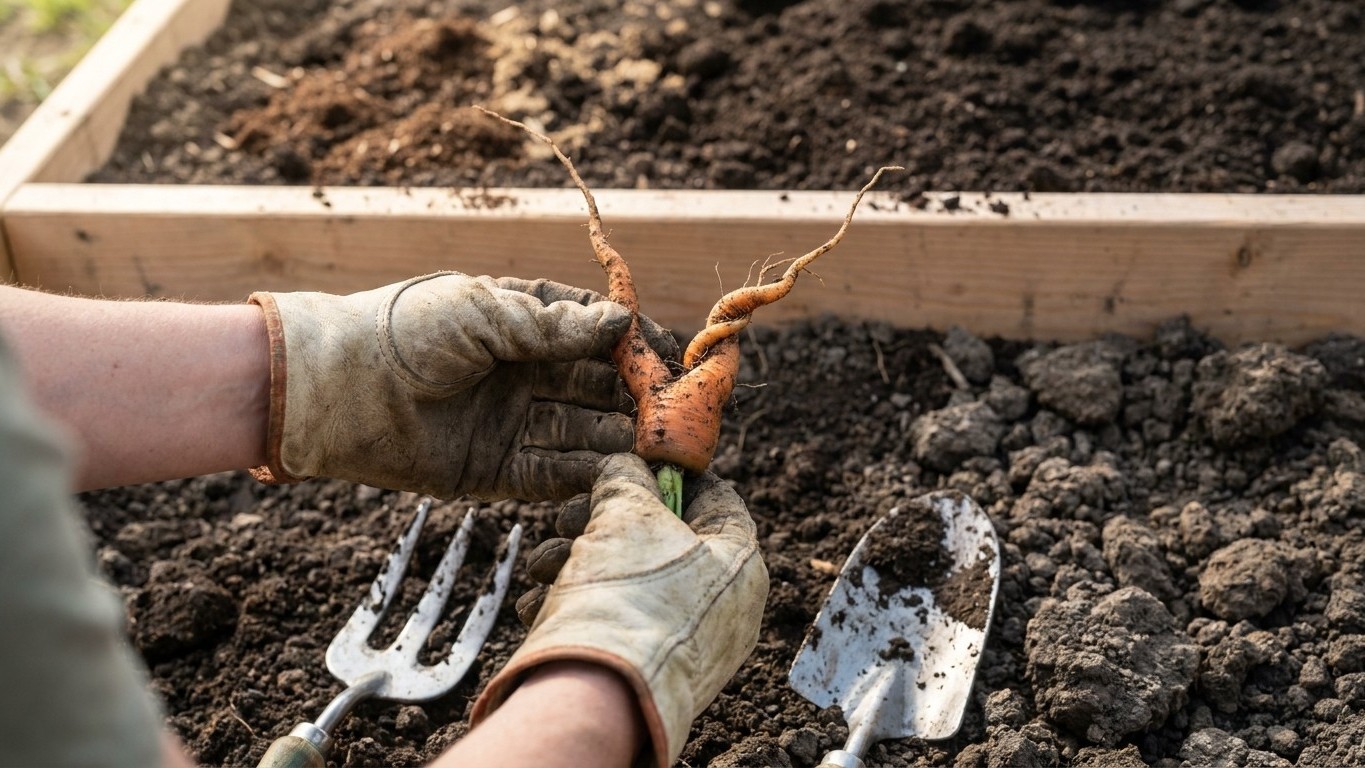

Wisconsin’s state soil, the Antigo series, is a well-drained silt loam that leans toward compaction rather than looseness. Carrots want depth and sand, not silt and clay, so forking is a real risk in unworked ground. The fix in a heavy bed is compost and double digging, or simply building up rather than digging down. But that soil profile describes one mapped series among hundreds across the state, not the dirt under your own trellis.
The short answer
The Antigo series carries the title of Wisconsin’s official state soil, a designation set by state law. It’s an Alfisol, the kind of forest-derived ground found across the northern hardwood belt, and it holds nutrients reasonably well without being especially rich. The surface horizon runs slightly acid, with a pH around 5.5, and its texture breaks down to roughly 20 percent sand, 10 percent clay and 70 percent silt, which puts it solidly in the silt loam category. Organic matter sits around 3.0 percent at the surface, and the drainage class is listed as well drained.
That combination is a mixed bag for carrots. Well drained is good news; carrots hate wet feet and rot fast in soil that holds standing water after rain. But 70 percent silt with a meaningful dose of clay is exactly the texture that tends to crust on the surface and compact underneath, especially after tilling equipment or foot traffic pushes it around over a season. So Will Carrots Fork in Wisconsin Soil? A carrot root pushing through that kind of ground doesn’t always find an easy path straight down. When it hits resistance, whether that’s a compacted layer, a buried stone, or clay that’s gone dense and stubborn, the root splits and forks around the obstacle instead of growing as one clean taproot.
The remedy isn’t a different variety of carrot. It’s changing what the root has to push through. Working several inches of compost into the top foot of bed loosens silt loam enough to let a root run straight, and double digging (turning the soil a full spade deep, then a second spade deeper still) breaks up any hardpan sitting below the topsoil. Where the ground is especially heavy or rocky, many gardeners skip the fight altogether and build a raised bed filled with a looser, sandier mix, sidestepping the native soil’s texture problem entirely.
None of this is a diagnosis of your yard. Wisconsin spans hundreds of distinct soil series, and the Antigo profile is a statewide representative figure, not a survey of every garden bed in the state. A lot filled during construction, a river-bottom garden, or a plot on a completely different parent material can look nothing like this. Treat the state soil as a hint about what the region’s ground tends toward, silt-heavy, moderately acid, prone to compacting, and then confirm what’s actually under your own rows before you decide how much compost to haul in. Once the bed is prepped, timing matters just as much as texture, so it’s worth checking When to Sow Carrots in Wisconsin before you put seed in the ground.
The test that settles it in your own garden
- Dig a hole at least a foot deep where you plan to sow. Look at the sides of the hole rather than just the surface. Note where the topsoil color changes to a paler or denser subsoil, and how far down that happens.
- Check for stones and hardpan. Push a shovel or a metal rod straight down. If it stops hard well before a foot, something (rock, compacted clay, old construction fill) is sitting in the way of a straight taproot.
- Feel the texture. Take a handful of moist soil from the hole and try to roll it into a ribbon between your fingers. Soil that forms a long, smooth, bendable ribbon is heavy on clay. Soil that won’t hold together at all is sandy. Something in between, gritty but able to form a short ribbon, is closer to the loam carrots actually want.
- Watch how water drains. Fill the hole with water and time how long it takes to disappear. Water that sits for hours points to a drainage problem worth solving with raised beds or added organic matter before you plant a root crop that resents wet feet.
- Repeat in more than one spot. Soil texture can change dramatically over a few yards, especially near foundations, driveways, or old fill areas, so one test hole in the whole yard tells you less than three or four.
When to sow here
Carrots go straight into the ground as seed; there’s no transplanting step to count from, so every date below runs from the seeding day itself.
- Start with your last spring frost window. Climate normals for Wisconsin put that date somewhere between April 16 and April 29, depending on where you are in the state. That’s the anchor point for everything that follows.
- Count backward two to three weeks. Carrot seed tolerates cool soil better than most vegetables, so the recommended sowing window opens two to three weeks before that last frost date, not after it. For a last-frost date in the last week of April, that puts sowing somewhere in the first half of April; for a last-frost date closer to mid-April, sowing can start even earlier in the month.
- Check the soil temperature before you trust the calendar. Carrot seed needs a soil temperature of at least 40 degrees Fahrenheit just to have a shot at germinating at all. If a cold snap follows an early thaw, the calendar date can arrive before the soil does, and it pays to check the ground with a simple soil thermometer rather than guessing.
- Aim for the real germination sweet spot. Seeds sprout fastest and most evenly between 55 and 65 degrees Fahrenheit. Sowing right at the 40-degree minimum works, but expect a slower, more uneven emergence than sowing once the soil has warmed further into that range.
- Remember the lakeshore effect if it applies to you. Lake Michigan pushes the first fall freeze later along the shoreline, which matters more for fall harvest timing than spring sowing, but it’s worth knowing your local microclimate doesn’t necessarily match the statewide normal.
What goes wrong here
- Forking in heavy ground. Antigo-type silt loam, and plenty of Wisconsin soils like it, compact easily once worked. A root that meets a dense layer or a buried stone splits instead of growing straight. Work in several inches of compost and double dig the bed before sowing, or switch to a raised bed filled with a looser mix.
- Poor germination during a hot spell. Carrot seed germinates best between 55 and 65 degrees Fahrenheit, and a sudden warm stretch right after sowing can dry the seedbed’s surface faster than the seed can sprout. Keep the top inch of soil consistently moist with light, frequent watering until seedlings are up, rather than one deep soak that lets the surface crust over in between.
- Splitting from uneven watering. Once roots are established, a dry stretch followed by heavy rain or a deep watering makes carrots swell too fast and crack. Even, regular watering through the growing season, rather than feast-or-famine cycles, keeps the roots growing at a steady rate.
- Slow, patchy stands from soil that’s too cold at sowing. Jumping the gun before soil hits that 40-degree floor leaves seed sitting in cold ground rather than sprouting, and some of it simply rots before it germinates. A soil thermometer costs little and settles the question faster than guessing from the air temperature.
Checking this against your own county
State-level figures are a starting point, not a substitute for what’s happening on your own block. The University of Wisconsin-Madison Division of Extension, reachable through extension.wisc.edu, runs county offices across the state that can point you toward local soil testing services, county-specific frost data, and planting guidance tuned to your particular corner of Wisconsin. A soil test through your county office will give you an actual pH and nutrient reading for your bed, rather than the statewide representative figures used here, and that’s the number worth acting on.
Common questions
Can I fix forked carrots without building a raised bed?
Yes, in many cases. Double digging a bed a full two spade-depths down, working in compost as you go, breaks up the compacted layer that causes most forking in silt loam soils like Antigo. A raised bed is the easier fix where the native soil is especially rocky or the compaction runs deep, but it’s not the only option.
Is Wisconsin’s clay-heavy soil the same everywhere in the state?
No. The Antigo series is the officially designated state soil, but Wisconsin holds hundreds of distinct soil series, and river bottoms, sandy outwash areas, and disturbed urban lots can differ completely from that profile. A soil test through your county extension office is the only way to know what you’re actually working with.
Why does soil temperature matter more than the calendar date for sowing?
Carrot seed needs the soil to reach at least 40 degrees Fahrenheit before it will germinate at all, and it sprouts fastest between 55 and 65 degrees. A calendar date two to three weeks before the last frost is a useful guideline, but a cold snap can leave the soil below that threshold even after the date arrives, so checking the ground directly avoids sowing into soil that’s still too cold.
Does organic matter in the soil affect how carrots grow?
It does. Soil richer in organic matter tends to hold moisture more evenly, which helps prevent the cracking and splitting that comes from uneven watering, and it also loosens heavy silt or clay soils enough to reduce forking. Working compost into a bed before sowing addresses both problems at once.