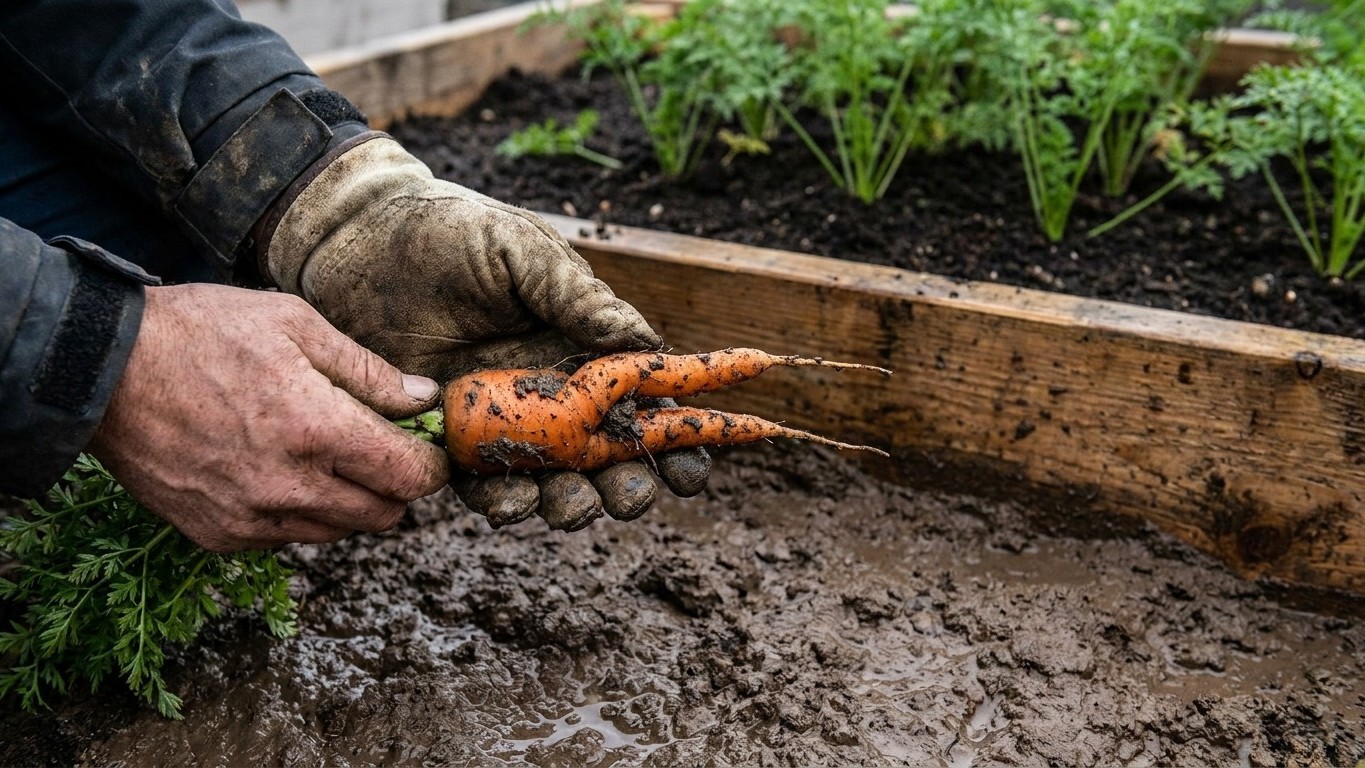

Yes, carrots planted straight into unmodified ground that matches Alaska’s representative soil profile are likely to fork or stall. That ground, mapped by USDA as the Tanana series, is a poorly drained silt loam sitting over permafrost, strongly acid at the surface, with almost no true topsoil to speak of. The fix isn’t a different variety. It’s a raised bed or heavily amended ground built specifically for a straight taproot.
The short answer
Alaska’s representative soil, mapped by USDA NRCS as the Tanana series, is not what most gardeners picture when they think of workable farmland. It’s classified as a Gelisol, a soil order defined by permafrost sitting within reach of the profile. Pulled apart in a soil lab, the surface horizon runs 30 percent sand, 7 percent clay, and 63 percent silt, a texture that lands closer to a loam or silt loam than anything sandy. Drainage is rated poor. Surface pH averages about 4.7, which is strongly acid. And the organic matter content sits near 90 percent, a figure so high it signals this surface layer isn’t cultivated topsoil at all. It’s a natural organic mat, peat, muck, or forest litter, sitting over mineral soil below.
Take that texture at face value. Seven percent clay is low, so this isn’t the sticky, cracking clay that famously wraps around a carrot root and splits it into forked legs. Silt loam with poor drainage is a different problem, though. Water sits. Roots that want to punch straight down instead meet a saturated, cold layer, especially where permafrost sits close beneath the surface. A carrot growing in that kind of ground doesn’t necessarily fork because of clay density, it stalls, stunts, or bends around waterlogged pockets and ice-cored soil. Utah State University Extension’s guidance on carrots states plainly that the crop wants deep, sandy, well-drained ground rich in organic matter, and that heavy or rocky soil is what forks the root. Poor drainage isn’t the same mechanism as heavy clay or buried rock, but the outcome for a carrot’s taproot is nearly identical: something blocks the straight path down, whether that something is solid or simply saturated, and the root splits or curls trying to get around it.
The fix Utah State lists for heavy ground is compost worked in generously and double digging to break up compaction below the surface. Against a Tanana-type profile, that advice still holds for loosening the silt loam, but drainage is the bigger obstacle here, not density. A raised bed changes the equation more directly than digging alone: it lifts the root zone above any standing water table and above the reach of residual permafrost influence, and it lets a gardener bring in a lighter, sandier mix from day one instead of fighting native silt every season.
None of this describes any single garden with certainty. Alaska spans hundreds of mapped soil series, from river-bottom silt to gravelly outwash to fill dirt trucked in around a foundation. The Tanana series is simply what USDA lists as representative of the state as a whole, a starting point for guessing what regional ground tends to do, not a lab result for one particular raised bed or backyard row.
The test that settles it in your own garden
A state-level soil series can only point in a general direction. What actually happens to a carrot root happens in one specific patch of dirt, and the only way to know that patch is to dig into it. None of the following steps require a lab, just a shovel, a bucket of water, and some patience.
- Dig a hole at least a foot deep where the carrot bed will go. Note what you hit: solid rock, a hardpan layer, standing groundwater, or just soil the whole way down.
- Check the depth to any obstruction. A carrot needs open ground to grow into, so measure how far down the shovel goes before it meets stone, gravel, hardpan, or waterlogged mud.
- Feel the texture. Grab a handful of moist soil and rub it between your fingers. Gritty means sand. Smooth and slick means clay. A silky, floury feel that holds a shape but crumbles easily means silt, which is what the state-representative Tanana profile leans toward.
- Run a simple drainage check. Pour a bucket of water into the hole and time how long it takes to disappear. Water that lingers for hours points toward the same poor-drainage pattern the state soil carries; water that vanishes quickly points toward a lighter, better-draining mix.
- Look for standing moisture after rain. A bed that stays soggy a day or two after a storm is telling you the same thing the drainage check will: this ground holds water longer than a straight-growing taproot wants.
None of these steps replace a formal soil test for nutrients or exact pH, but they answer the one question that actually predicts forking: can a root push straight down through this ground, or will it hit something solid or saturated first? If the answer is “hits something,” the remedy is the same one Utah State recommends for heavy soil, generous compost and double digging, or simply building up and out with a raised bed.
What goes wrong here
- Forking in heavy, poorly drained ground. A taproot meeting waterlogged silt or a compacted layer splits or curls instead of growing straight. Utah State University Extension’s fix for heavy soil is to work in plenty of compost and double dig the bed before sowing, loosening ground well below where the root will travel. Where drainage rather than density is the main issue, a raised bed filled with a lighter mix sidesteps the problem entirely.
- Poor germination during a hot, dry stretch. Carrot seed is small and sits shallow, so the top inch of soil drying out even briefly can stop germination cold. Keeping that top layer consistently moist with light, frequent watering until seedlings emerge solves this, regardless of what the deeper soil looks like.
- Splitting from uneven watering. A root that grows steadily through a dry spell and then gets hit with a heavy soak swells too fast and cracks. Even, regular watering on a set schedule, rather than long dry gaps followed by a flood, keeps root growth steady enough to avoid the split.
- Stunted roots in acidic, poorly drained pockets. Where the ground matches the strongly acid, poorly drained profile the state soil represents, roots can simply stop growing rather than fork outright. Building the bed up above grade and filling it with amended, well-drained soil gives the root the open, aerated path it needs instead of asking it to fight through native conditions.
Common questions
Does sandy soil guarantee straight carrots?
It helps, but it isn’t the whole story. Utah State University Extension notes that carrots want soil that’s deep, sandy, well-drained, and rich in organic matter together. Sand alone without depth or drainage still won’t give a root the open, obstruction-free path it needs.
Is a raised bed always necessary in Alaska?
Not necessarily. It depends entirely on what a gardener finds when they dig and test their own plot. Ground that already drains well and has no hardpan or standing water within reach of the root zone may need nothing more than compost and loosening. The Tanana series is a state-level representative soil, not every yard’s actual ground.
How deep should a carrot bed be dug to avoid forking?
The published guidance doesn’t specify an exact depth figure. What Utah State University Extension does specify is the method: double digging heavy soil to loosen compaction, combined with generous compost, gives roots the open path they need to grow straight rather than fork.
Since carrots are sown directly, when should forking risk be checked?
Carrots are sown in place, with no transplanting step, so the 70 to 100 days to maturity run from the seeding date itself. That means any soil prep, digging, testing texture, checking drainage, needs to happen before seed goes in the ground, since there’s no later chance to move the row to better soil once it’s growing.