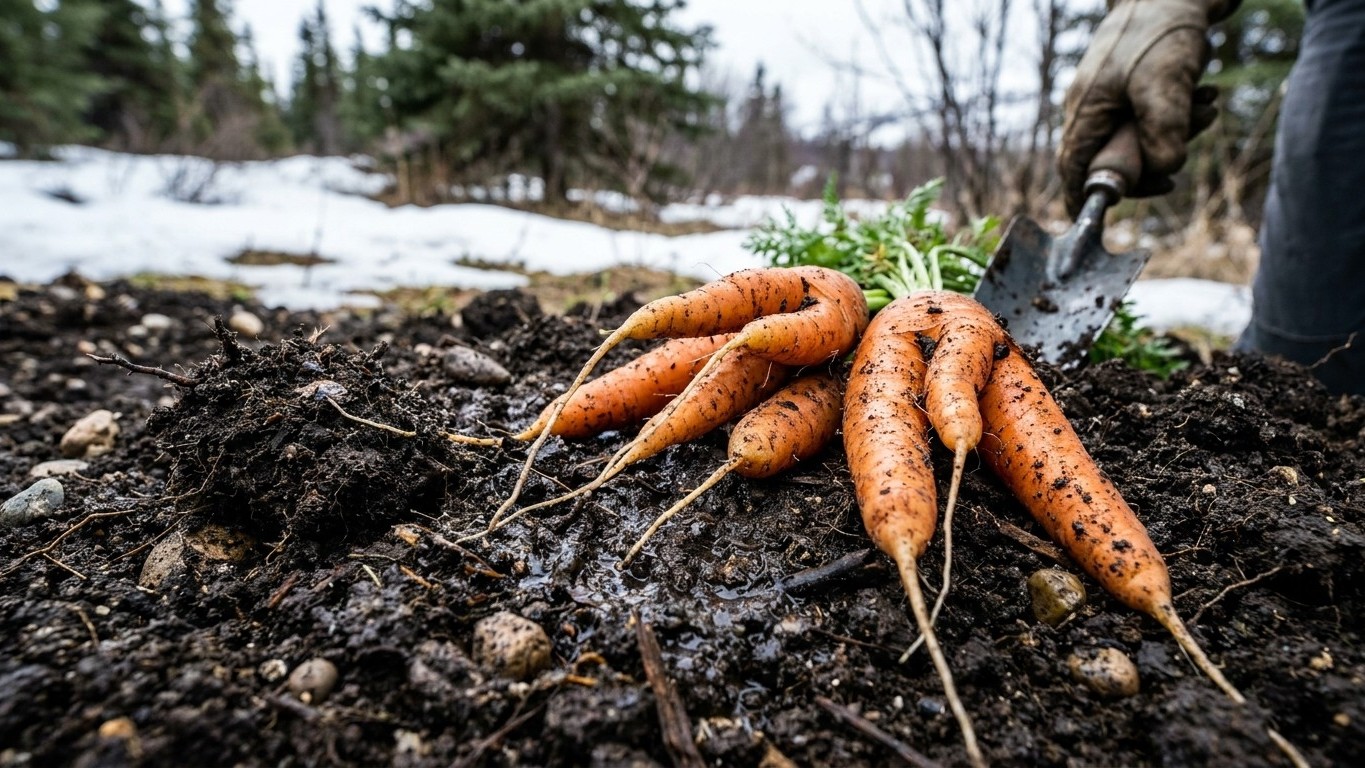

Alaska carrots go into the ground after the soil has thawed and the danger of frost has passed at your specific location, then you count forward, not backward: seed date plus 70 to 100 days for the variety to mature. The “counting back” part only works once you know your own last-frost date, and in a state this size that date can shift by weeks depending on where you garden.
The short answer
Alaska’s representative soil, the one the USDA lists as this state’s official series, is the Tanana. It’s a Gelisol, meaning permafrost sits within reach of the profile, and its surface horizon runs strongly acid at a pH around 4.7. Texture-wise it’s a silt loam: about 30 percent sand, 7 percent clay, and 63 percent silt, with organic matter averaging close to 90 percent at the surface and drainage classed as poor. That organic-matter number is a signal in itself. Anything above roughly 20 percent usually means you’re looking at a natural peat, muck, or forest-litter layer rather than a worked garden bed, which is exactly what shows up under Tanana’s native cover.
None of those numbers spell disaster for carrots on their own, but stacked together they explain a lot of frustration. Silt-heavy ground with poor drainage tends to stay cold and wet longer into spring, and carrots sitting in soil like that are prone to forking, the root splitting into two or three legs instead of growing straight down. Utah State University Extension’s guidance on carrots is blunt about this: the crop wants deep, sandy, well-drained soil rich in organic matter, and heavy or rocky ground makes the root fork. Their fix isn’t a different variety, it’s soil work, plenty of compost worked in and double digging to loosen the profile, or building up a raised bed where drainage and depth are under your control instead of the native ground’s.
A strongly acid pH near 4.7 is also worth flagging, since most root vegetables prefer soil closer to neutral. The Tanana series figure is the state’s representative value though, not a number you should assume applies to your yard.
That caution matters more here than almost anywhere. Alaska spans hundreds of distinct soil series, from river-bottom silt to gravelly outwash to soils a builder scraped and refilled decades ago. The Tanana series describes a broad, mapped pattern, not a verdict on any one backyard. Treat it as a reason to test your own dirt, not a diagnosis of it.
The test that settles it in your own garden
State-level soil data tells you what the region tends toward. It can’t tell you what’s actually under your raised bed or back fence. That takes a few minutes with a shovel.
- Dig a hole at least 12 inches deep in the spot you plan to sow carrots. Note what stops you, whether it’s a rock layer, dense clay, standing water, or frozen ground, and at what depth.
- Look at the sides of the hole for stones. Carrots need a rock-free path straight down; frequent stones at root depth will deform the crop no matter what the topsoil looks like.
- Rub a moist handful of soil between your fingers. Gritty means sandy, slick and sticky means clay, smooth and floury means silt. Most gardens are some blend, but the dominant feel tells you which problem you’re managing.
- Fill the hole with water and time how long it takes to drain. Water still standing after several hours points to the same poor-drainage pattern the Tanana series shows at the state level, and it calls for the same fix: raise the bed or amend heavily.
- Repeat the dig in more than one spot if your yard has slope, shade differences, or areas that were graded or filled during construction. Soil can change completely within twenty feet.
Skip the temptation to guess your pH by eye or by taste. A real reading requires a lab test or a home kit, and until you have that number, don’t treat the state figure as your own.
What goes wrong here
The combination of a poorly drained, silty, strongly acid surface soil and a short, unpredictable growing season creates a specific short list of carrot failures in Alaska gardens.
- Forking roots. Heavy, silt-dominant ground like the Tanana series resists a taproot’s straight downward path, and any compaction or buried stone splits it further. The remedy is mechanical, not varietal: double dig to break up the profile and work in compost, or skip the native soil altogether with a raised bed filled with a loose, sandy mix.
- Slow, uneven germination. Carrot seed germinates slowly under the best conditions, and cold, wet, silt-heavy soil that drains poorly holds the chill longer into the season. Waiting for soil to warm and loosen before sowing, rather than working by the calendar alone, avoids a patchy stand.
- Splitting from uneven watering. Poorly drained ground swings between waterlogged and crusty as it dries, and that inconsistency cracks roots open. A steady, even watering schedule matters more on this kind of soil than on ground that drains freely on its own.
- Stunted growth near permafrost. Where the profile stays frozen or saturated at shallow depth, roots run out of room and out of oxygen. Raised beds that keep the growing zone above the cold, wet layer sidestep the problem entirely.
Common questions
How do I count Back From the Last Frost if I don’t know my local date?
You need a station-specific figure before the math works. NOAA’s National Centers for Environmental Information (NCEI) maintains local frost and freeze data by station, and because Alaska covers such a wide range of climates, a date for one region can be off by weeks for another. Look up the record for your nearest station rather than relying on a single statewide figure.
Do the 70 to 100 days to maturity start at seeding or at transplanting?
At seeding. Carrots are sown directly in the ground and are never transplanted, since disturbing the taproot early causes exactly the forking and deformity this crop is prone to already. Count maturity from the day the seed goes into the soil, full stop.
Should I add lime to fix the Tanana series’ acid pH?
Only after testing your own soil. The pH 4.7 figure is the representative value for the Tanana series as mapped, not a confirmed reading for your garden. A real soil test will tell you whether lime is needed and how much, and applying it blind risks overcorrecting.
Is a raised bed really necessary, or will compost alone fix heavy soil?
It depends on how poor the drainage is once you’ve dug your own test hole. Utah State University Extension lists compost and double digging as the standard fix for heavy or rocky ground. If your dug hole still holds standing water after hours, or if permafrost or dense clay sits within a foot of the surface, a raised bed gives you more reliable control than amending in place.