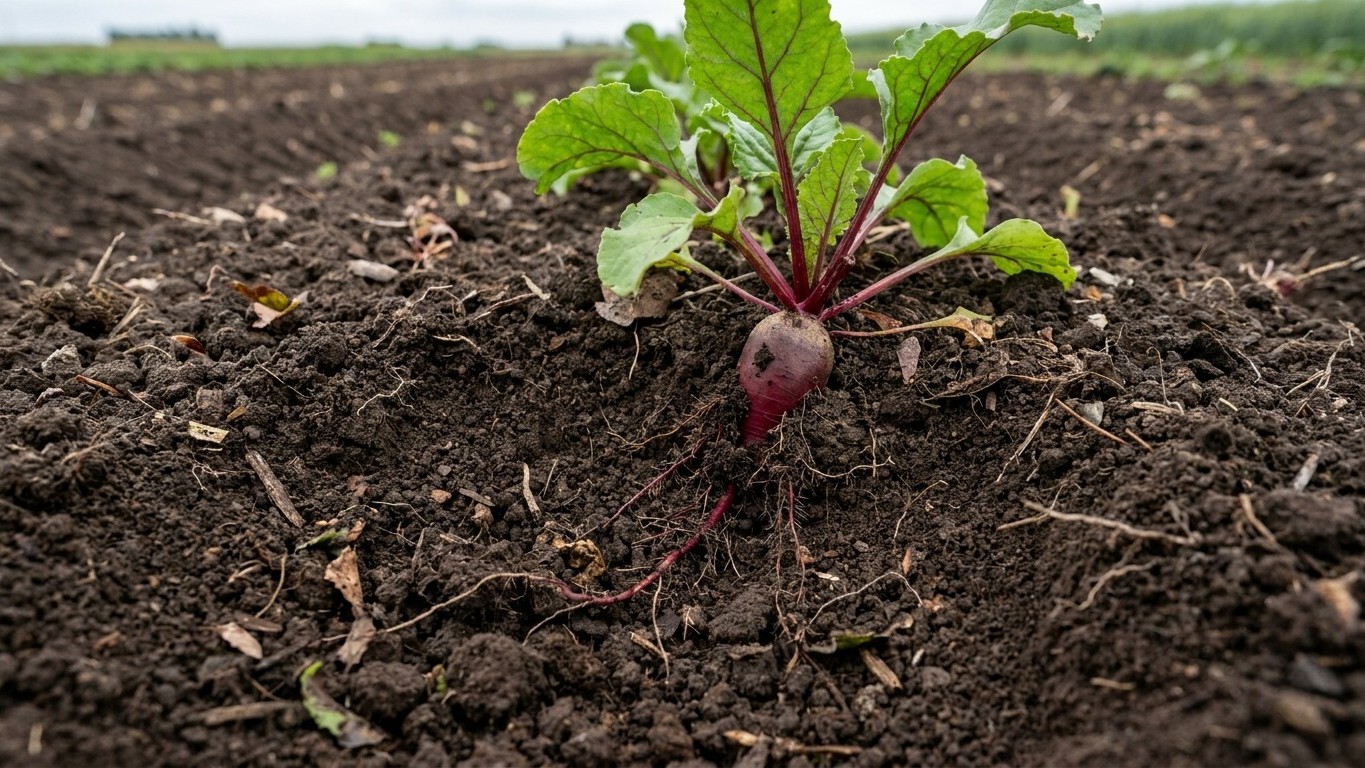

Alberta’s most common cropland soil, a Chernozem, gives beets a solid enough start: deep, dark, well drained, loamy, and naturally rich in organic matter. That’s the short version. The fuller answer depends on which of Alberta’s hundreds of mapped soils actually sits under your own beet bed, how close your last frost lands to the province’s May 21 average, and whether summer heat catches your beets already thirsty. Two separate failures can end a beet crop here: bolting from early drought, and woody roots from later heat.
The short answer
Chernozem covers roughly 40 percent of Alberta’s mapped agricultural surface, more than any other soil order in the province, with Luvisolic soils coming in second. Where the median numbers hold, the surface horizon runs 37 percent sand, 21 percent clay, and 42 percent silt: a loam leaning silty, not a heavy clay and not a sandy, blow-away soil either. Drainage classifies as well drained. Organic matter sits around 5.2 percent, high by garden standards, built up over long stretches of grass roots decaying in place. Surface pH lands near 6.5, on the acid side of neutral.
For a beet, that combination reads mostly in its favor. Utah State University Extension calls for deep, sandy, well-drained soil rich in organic matter as the baseline beets want, and Alberta’s dominant profile checks the drainage and organic-matter boxes without much amending needed. The texture runs a shade heavier than “sandy,” which mostly matters for how easily a root pushes down and how fast the topsoil warms in spring. A silty loam holds moisture longer than sand, and that cuts both ways: less risk of the bed drying out in a dry week, more risk of a crust forming after rain that a seedling has to punch through to reach daylight.
Heat is the other half of the beet equation, and this is where the record for this page runs thin. Utah State’s threshold is specific: heat above 85°F combined with water stress is what turns a beet root woody. How many days a year the Calgary area actually crosses 90°F isn’t a figure carried in the sourced climate record used here, so no number is stated for it. What can be said is that Alberta’s growing season runs short and generally cool by continental standards, which lowers the odds of long, sustained heat stretches. Still, a single hot, dry week in midsummer can catch a beet bed that missed a watering, and the 85°F threshold belongs in any planting plan regardless of how many days actually hit it in a given year.
None of this replaces a soil test. Alberta’s agricultural zone alone spans hundreds of mapped soil series, and the province’s northern reaches sit outside the survey behind these median numbers entirely. River-bottom ground, drained wetland, and anything scraped or filled during construction can sit far outside the Chernozem median in texture, drainage, or pH. Treat the numbers above as a starting point for what the region’s ground tends to do, then confirm what’s actually under your own beet bed before amending anything.
The six weeks that decide it here
Beets are sown directly in the ground, never transplanted, and the 60 to 80 days to harvest count from that seeding date, not from any later step. Sow two to three weeks ahead of the last frost, and the first six weeks of a beet’s life in most of Alberta fall across late April into June, anchored to a last-frost average of May 21 at Calgary International Airport. That average is a midpoint, not a guarantee: in roughly half of all years on record, frost arrives after that date, and northern or upland parts of the province typically run behind Calgary’s timing by weeks, not days.
Sowing that early means the six-week window that decides bolting risk lands during a stretch of Alberta spring known for swinging rather than settling. Chernozem soils themselves are a clue to that pattern. They form under grassland climates where rainfall is limited and uneven, not under the steady, soaked conditions of a forest floor. That history is baked into the ground beets are growing in: soil built by drought-tolerant grass roots sits in a climate that has never reliably delivered rain on a schedule. Warm, dry stretches can arrive early, sometimes pushed by chinook-style wind events that spike temperatures for a few days before cooling back down, and a young beet caught dry during those first six weeks reads the stress as a signal to flower rather than to keep building a root.
That’s the bolting mechanism specifically, and it’s a different problem from the woodiness that shows up later in the season. Bolting is an early-season, water-stress event tied to the first six weeks after seeding. Woodiness is a mid-to-late-season event tied to heat above 85°F arriving while the soil is dry, closer to harvest than to seeding. Treating both as “keep it watered” misses the difference: the early window calls for steady, shallow moisture while roots are small and germination is still uneven, while the later window calls for deeper, less frequent watering that keeps the whole root zone from drying out during a heat run. Knowing which of Alberta’s two risky stretches a beet bed is in changes what the watering can should actually be doing that week.
What goes wrong here
- Bolting from a dry, swinging spring. Seed sown two to three weeks ahead of the May 21 average frost date lands its first six weeks in a stretch of Alberta spring prone to warm, dry swings. Water stress during that window signals the plant to flower instead of building a root. Keep the top few inches of soil consistently damp with light, frequent watering until true leaves are established, and use a floating row cover to buffer sudden warm-dry spikes.
- Woody roots from a hot, dry stretch later on. This is a separate failure from bolting: once beets are established, heat above 85°F combined with dry soil turns the root fibrous. Mulch to hold soil moisture, water deeply and less often as the root fills out, and avoid letting the bed dry to the point of cracking during a midsummer heat run.
- Slow, crusted germination in the silty-loam surface. The 42 percent silt fraction common in Alberta’s dominant soil can seal into a crust after a hard rain, which a fine beet seedling struggles to push through. Keep the seed row lightly moist rather than soaked, and break any crust gently with a rake tine before seedlings are due to emerge.
- Forked or misshapen roots where the subsoil turns heavier. Luvisolic soils, common outside the Chernozem belt, carry clay-enriched subsoil layers that a beet root can hit and split around. Work the bed a full 8 to 10 inches deep before sowing and add composted organic matter, capped at 1 inch per 100 square feet, rather than leaving a hard layer for roots to deflect off.
- Assuming the province-wide numbers are your numbers. A median pH of 6.5 and 5.2 percent organic matter describe the mapped agricultural average, not any single yard. Run a soil test before amending anything, since river-bottom ground, drained wetland, and disturbed urban lots can sit well outside that median.
Common questions
Is Alberta’s soil naturally good for beets?
The province’s dominant profile, a Chernozem, checks two of the boxes Utah State University Extension lists for beets: it’s well drained and rich in organic matter. Its texture runs to a silty loam rather than the sandier soil beets prefer most, which mainly slows water infiltration and can crust after rain. It’s a workable starting point, not a guarantee for any one garden.
When should beet seed go into the ground in Alberta?
Two to three weeks ahead of the last frost is the general rule, and Calgary’s average last frost falls on May 21. That date is a long-term average, not a safe cutoff. Frost lands later than that average in roughly half of all years, and northern or higher-elevation parts of the province typically run behind Calgary’s timing.
What’s the difference between bolting and woody beets?
Bolting happens early, within the first six weeks after seeding, when water stress pushes the plant to flower instead of growing a root. Woodiness happens later, when heat above 85°F hits a root that’s already short on water. The fixes differ: light, frequent watering early on, and deeper, less frequent watering once the heat sets in.
Does Alberta’s soil pH need adjusting for beets?
The median surface pH across the province’s mapped agricultural soils runs about 6.5, slightly acid, which sits in a workable range for most root vegetables. That figure is a provincial median, not a promise about any specific yard, so a home soil test remains the only way to know the number that actually applies to a beet bed.