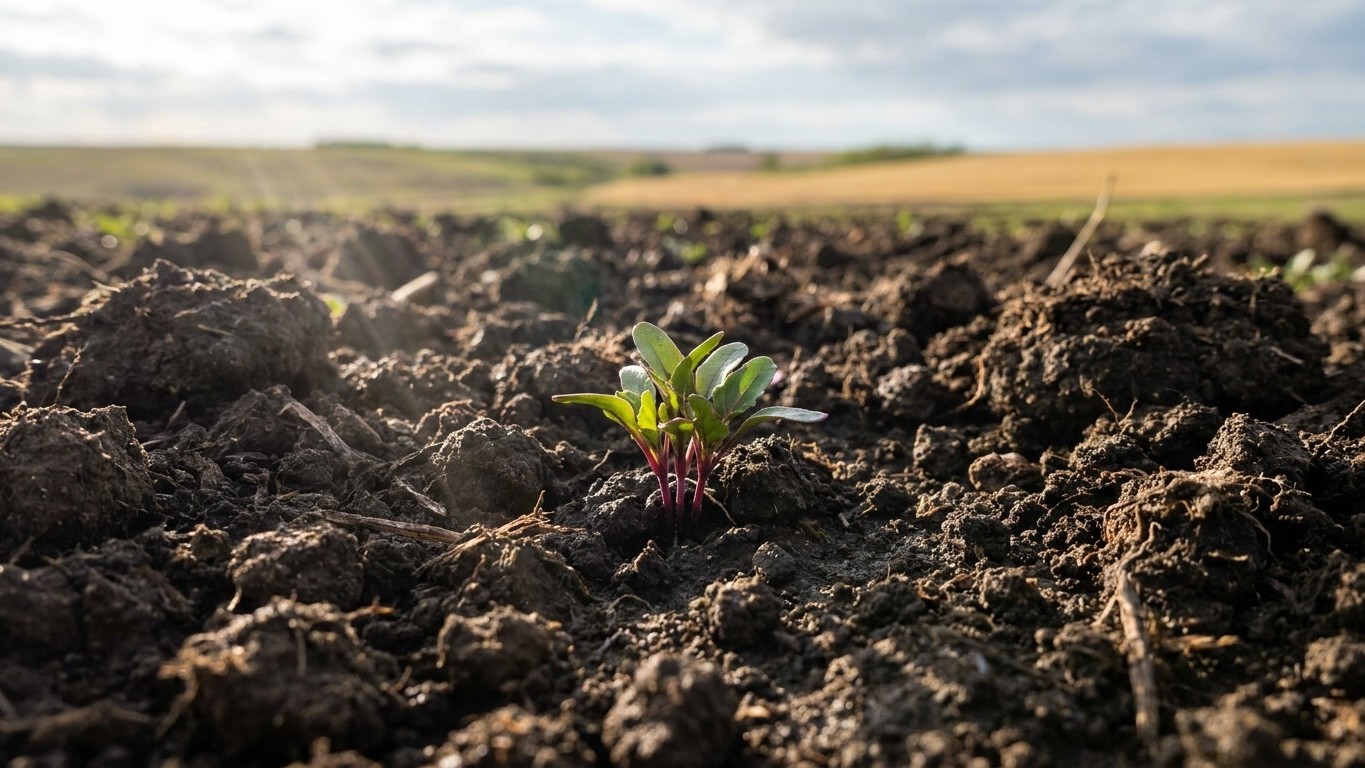

Alberta’s dominant Chernozem soil is loam to silt, well drained, and rich in organic matter, a solid base for beets. But the crop’s real test isn’t the ground itself; it’s the first six weeks after sowing, when a cold snap or a dry chinook wind can trigger bolting no matter how good the dirt is. Calgary’s average last frost lands May 21, and that date is a coin flip, not a guarantee. See When to Sow Beets in Alberta for how to plan around it. Get the timing and the water right, and this soil does most of the rest.
The short answer
Most Alberta cropland sits on Chernozem, the deep, dark grassland soil that covers about 40 percent of the province’s mapped agricultural surface, with Luvisolic soils coming in second. Across the surface horizons of 2,154 mapped soil components sampled by the Canadian Soil Information Service, the median texture works out to 37 percent sand, 21 percent clay and 42 percent silt, a loam-to-silt profile that drains well without turning to dust by midsummer. Median surface pH runs about 6.5, slightly acid, and organic matter averages 5.2 percent, high by most garden standards. For a beet, that combination reads close to ideal on paper: enough silt to hold moisture between waterings, enough sand to keep the root out of standing water, and enough organic matter to keep the ground loose as the taproot pushes down.
Utah State University Extension describes the beet’s own preference in nearly the same terms: deep, sandy, well-drained soil rich in organic matter, amended with no more than 1 inch of composted material per 100 square feet. Overdo the compost and the plant tips the other way, putting its energy into leaves rather than root. Alberta’s median organic matter figure, at 5.2 percent, already sits on the generous side, one more reason to go light on extra compost rather than heavy.
Where heat fits, and where it doesn’t
How many days a year the Calgary area spends above 90 F isn’t a figure published in the sources behind this page, so it won’t be guessed at here. What Utah State University Extension does establish is the mechanism that matters more than any single temperature threshold: heat above 85 F combined with water stress is what turns a beet root woody. Alberta’s shorter, cooler prairie summers generally keep the plant out of that danger zone more often than a warmer region would, which shifts the balance of risk here toward the cold, dry side rather than the hot, dry side.
None of this replaces a soil test from your own yard. Alberta spans hundreds of distinct soil series, from the black Chernozems of the central parkland to sandier ground in the south and Luvisolic soils under the aspen parkland further north, and land near a river bottom or a lot a builder has graded and filled can sit nowhere near this provincial median. Treat the Chernozem profile as a starting assumption for Beet Soil in Alberta, then confirm it before you plant.
The six weeks that decide it here
Beets are direct-sown, never transplanted, and the 60 to 80 days to harvest that seed packets quote start counting from the day seed goes into the ground, not from any seedling stage raised indoors. Utah State University Extension’s guidance is to sow 2 to 3 weeks before the last expected frost, which in the Calgary area means working from an average last frost date of May 21. That date comes from Environment and Climate Change Canada’s 1981-2010 climate normals for station Calgary Int’l A, and it’s a mean, not a promise: in roughly half of all years, frost arrives later than May 21, sometimes well into the seedling’s first days above ground.
Sow on that schedule and the plant’s first six weeks fall squarely into an Alberta spring, a season known locally for swinging hard rather than settling into a steady warm-up. Chinook winds can push temperatures up sharply for a day or two in March or April, only for a cold front to drop things back down before the ground has fully thawed underneath. That volatility is exactly the condition Utah State University Extension flags as the trigger for premature flowering: water stress in the first six weeks of a beet’s life, whatever the cause, tells the plant to skip growing a root and go straight to seed.
In Alberta, that stress is as likely to come from a dry, warm chinook spell as from an outright cold snap. A week of wind and unseasonable warmth can dry out the top inch of soil fast, especially in the sandier pockets of the province’s loam-to-silt texture, right when a beet seedling has almost no root system to draw on. The risk here sits less in any single frost event and more in the gap between sowing and germination, when a seed bed can flip from cold and wet to dry and warm within days.
That makes the six weeks after sowing, not a transplant stage this crop never goes through, the period to watch closest. A consistent watering schedule through that stretch, rather than reacting once the leaves have already wilted, is the difference between a root that sizes up normally and one that bolts before it gets the chance.
What goes wrong here
- Bolting after a chinook warm spell: a week of chinook wind can warm the soil enough to trigger germination, then a cold front drops right back to near freezing before the seedling has built any real root system. Utah State University Extension traces bolting to water stress in the first six weeks, and that swing counts. Remedy: hold seed in the ground a few extra days after a chinook spike rather than reading warm weather as the signal to plant, and keep the seed bed evenly moist through the swing.
- A crusted seed bed after rain: with clay making up about a fifth of the province’s typical texture, a hard rain right after sowing can seal the surface into a crust that beet seedlings, which push up as a small cluster rather than a single sprout, struggle to break through. Remedy: rake in a light layer of compost, no more than the 1 inch per 100 square feet Utah State University Extension recommends, and break any crust that forms with a light hand rake before seedlings are due.
- Frost arriving after the average date: May 21 is a mean from Environment and Climate Change Canada’s Calgary Int’l A normals, and in close to half of all years the last frost lands later than that. Sowing on the assumption that May 21 is a hard deadline can put tender seedlings under a late freeze. Remedy: treat the date as the middle of a window, not the end of one, and keep a floating row cover on hand for the two weeks on either side of it.
- Overfeeding an already rich soil: Alberta’s Chernozem carries a median organic matter content of about 5.2 percent, already high, and it’s tempting to add more compost to soil this dark. Extra nitrogen pushes the plant toward leafy top growth at the expense of the root. Remedy: stay at or under the 1 inch per 100 square feet ceiling Utah State University Extension sets, and skip additional feeding once the bed is already dark and crumbly.
- Woody roots from a late heat spell: this is a separate failure from bolting, showing up later in the season rather than in the first six weeks. If a stretch of days above 85 F lands while the soil has dried out, Utah State University Extension’s guidance points to fibrous, tough roots as the result, no matter how well the plant got through its early weeks. Remedy: keep watering consistent through any hot spell later in summer, since a crop can clear the bolting risk cleanly and still turn woody weeks after.
Checking this against your own county
Everything above describes Alberta’s agricultural land as a whole, built from the median of 2,154 mapped soil components and a single Calgary weather station. Your own garden could easily sit outside both. A yard on a river terrace, land near muskeg in the north, or a lot where a builder scraped topsoil and brought in fill can carry a texture, drainage class and organic matter level nothing like the provincial Chernozem median described here, and a district well north or west of Calgary can see its own last frost date land weeks apart from May 21.
Alberta Agriculture and Irrigation is the place to check both. The department’s site, at alberta.ca/agriculture-and-irrigation, carries soil and crop guidance broken down by region, and it’s the starting point for finding local extension contacts, county agricultural fieldmen, or a soil testing lab that can put an actual number on your own texture and pH rather than the provincial median. A basic soil test before sowing does more to predict how a beet crop will perform on your ground than any provincewide figure ever will.
Common questions
When should I sow beets in Alberta?
Utah State University Extension recommends sowing 2 to 3 weeks before the last expected frost. In the Calgary area that means working around the average last frost date of May 21, treated as a midpoint rather than a fixed deadline, since frost lands later than that in roughly half of all years.
Why do my beets bolt instead of forming a root?
Utah State University Extension identifies water stress during the first six weeks after sowing as the trigger for premature flowering, or bolting. In Alberta that stress often comes from a dry chinook wind spell as much as from cold, so consistent watering through that early window matters more than the frost date alone.
Does Alberta’s Chernozem soil need extra compost for beets?
Not much. The province’s dominant Chernozem soil already carries a median organic matter content of about 5.2 percent, and Utah State University Extension caps recommended amendment at 1 inch of composted material per 100 square feet. Going heavier tends to push leafy growth at the root’s expense.
Do Alberta summers make beets woody?
Less often than in hotter regions, but it can still happen. Utah State University Extension ties woodiness to heat above 85 F combined with water stress, and Alberta’s cooler prairie summers keep the crop out of that combination more often than not. A hot, dry stretch late in the season, chinook-driven or otherwise, can still produce it if watering lapses.