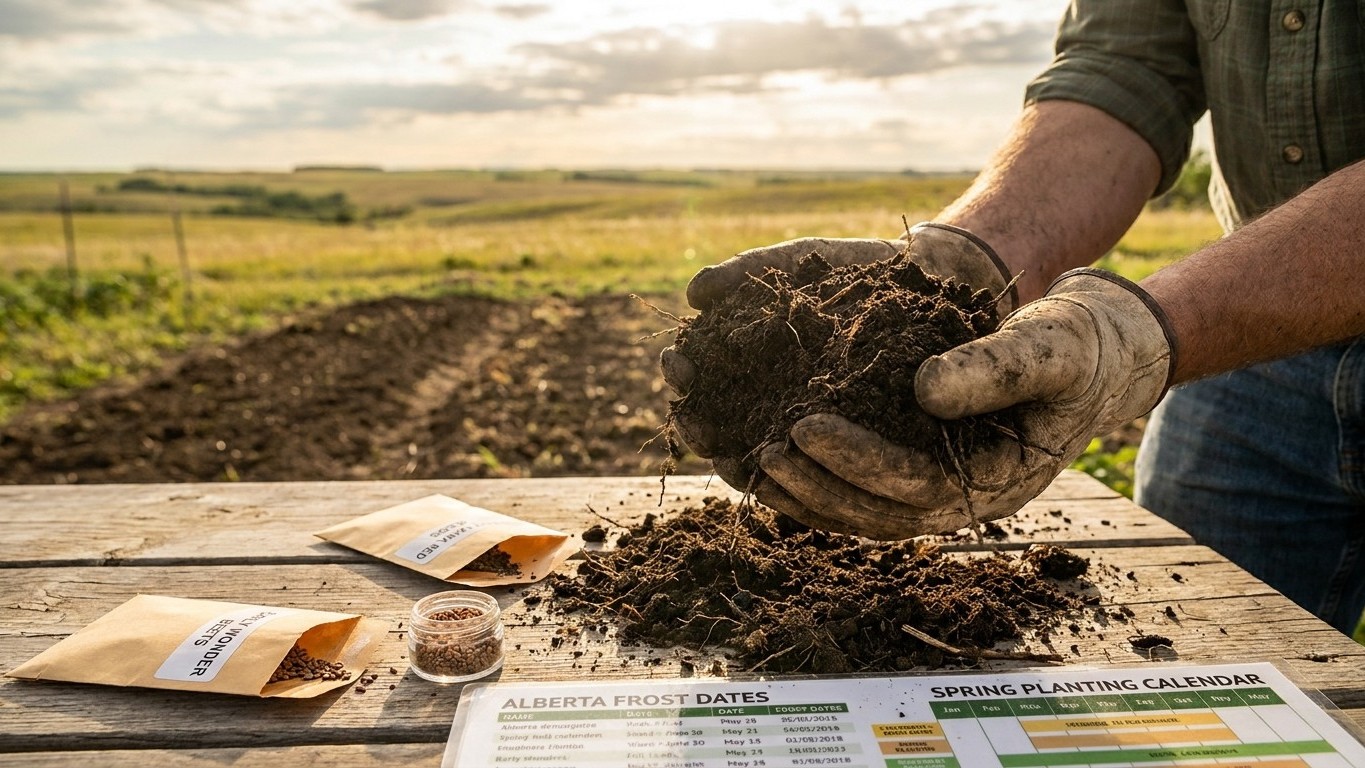

Sow beet seed directly into the ground two to three weeks before the last spring frost, which averages May 21 at Calgary. That puts most Alberta gardeners in the field from late April to the first days of May. Beets don’t transplant well, so this seeding date is also the start of the 60 to 80 days most varieties need to reach harvest size.
The short answer
Across Alberta’s mapped agricultural land, the dominant soil order is Chernozem, the deep, dark grassland soil the prairies are known for, covering about 40 percent of the mapped surface, with Luvisolic soils the next most common. The median surface pH runs around 6.5, slightly on the acid side. Texture skews toward silt: 37 percent sand, 21 percent clay, and 42 percent silt, which puts most of this ground in the loam-to-silt loam range. Organic matter sits around 5.2 percent, and drainage is classed as well drained.
None of that is your backyard’s number. Alberta spans hundreds of individual soil series, and the survey behind these figures covers the province’s agricultural belt, not the far north, so anyone gardening outside that band is working with an unmapped profile here. River flats, old sloughs, and any lot a builder has cut, filled, or graded will read nothing like the median. Treat this as the region’s tendency, not your test result, and pull an actual soil sample before you plan amendments.
Beets want deep, sandy, well-drained ground carrying plenty of organic matter, and Utah State University Extension recommends working in no more than 1 inch of composted organic matter per 100 square feet. Alberta’s dominant Chernozem already runs high in organic matter, which favors beets, but the silt-heavy texture is finer than the sandy loam beets prefer, so a bed that stays soggy after rain needs help loosening up rather than more compost piled on top.
Heat is the other half of the equation, and it works differently than soil does. Utah State’s guidance is specific: water stress in the first six weeks after seeding triggers premature flowering, or bolting, while temperatures above 85 F combined with water stress later on turn the root woody. No day count above 90 F for Calgary or any other Alberta location appears in the source data behind this page, so that specific figure isn’t published here. What’s established instead is the mechanism, and it matters more for planning than a single seasonal average would.
The six weeks that decide it here
Sowing two to three weeks ahead of that May 21 average frost date lands the seed, and the six critical weeks that follow, squarely in Alberta’s spring. That average is a mean, not a guarantee, drawn from the Canadian Climate Normals for 1981-2010 at the Calgary International Airport station. In one year out of two, the last frost actually falls later than May 21, sometimes considerably later, and any garden north of Calgary or at higher elevation should expect its own frost-free window to lag behind the station’s by weeks, not days.
Alberta spring doesn’t settle into one pattern. It swings. A dry, wind-scoured stretch can run for a week or two, drying out a freshly seeded bed just as the beet’s most vulnerable phase begins, and then a system moves through and drops the whole thing under cold rain. Chinook winds along the foothills add another wrinkle, pushing temperatures up fast and drying exposed soil surfaces even while frost risk lingers underneath. None of that is unusual for the province. It’s the normal texture of an Alberta spring, and it’s exactly the six-week window that decides whether a beet bolts.
The risk sits squarely with the dry stretches, not the cold ones. Utah State’s finding is that it’s water stress in those first six weeks, not the cold itself, that pushes a beet toward bolting. A cold snap that doesn’t dry the bed out is a nuisance; a warm, windy week with no irrigation behind it during that same six-week stretch is the more consequential threat in most Alberta yards. Gardeners who seed in the recommended late-April to early-May window need to plan around both possibilities at once, because either can show up in the same spring, sometimes in the same month.
What goes wrong here
- Bolting from an early dry spell. A windy, dry stretch in the first six weeks after seeding is the classic Alberta bolting trigger, per Utah State’s research. Keep the bed evenly moist through that stretch, checking it more often during chinook-driven dry winds, rather than watering on a fixed schedule.
- Woody roots from a hot, dry midsummer. Temperatures above 85 F paired with water stress later in the season toughen the root. This is a separate failure from bolting, tied to summer heat rather than spring dryness, so watch soil moisture again once warm weather sets in and don’t assume the early watering effort is enough to carry the crop through.
- Surface crusting on silt-heavy ground. With silt making up roughly 42 percent of the province’s typical surface texture, a hard rain followed by sun can seal the top of the bed and block beet seedlings, which push up as a small loop, from breaking through. A light raking after a heavy rain, before the crust fully sets, keeps the seedbed workable.
- Standing water in heavier pockets. Even where the regional average leans well drained, individual Luvisolic or clay-heavy pockets hold water longer. Raised rows or beds solve this without altering the surrounding soil.
- Over-amending instead of loosening. Alberta’s Chernozem already runs around 5.2 percent organic matter, well above many garden soils, so piling on more compost doesn’t fix a heavy texture. Utah State’s ceiling of 1 inch of composted organic matter per 100 square feet is a limit worth respecting here, with any remaining drainage problem addressed through structure, not more organic matter.
Common questions
Can I sow beets before the last frost date in Alberta?
Yes, and it’s the recommended approach. Sowing two to three weeks ahead of the average May 21 last frost is standard practice, since beet seed tolerates cool soil better than the plant tolerates a late-season water deficit. Just remember May 21 is a mean date, not a cutoff, so a frost after that date is not unusual in any given year.
How long do beets take to mature from seed in Alberta?
Most garden beets reach harvest size in 60 to 80 days, and that count starts the day the seed goes into the ground, not from any transplant date. Beets are a direct-seeded crop; they don’t move well once started elsewhere, so the seeding date is also the maturity clock’s start.
Does Alberta soil need amendment before sowing beets?
It depends on the individual bed more than on the province. Alberta’s dominant Chernozem soil already carries strong organic matter, around 5.2 percent at the surface, so most beds don’t need heavy compost additions, and Utah State’s guidance caps composted organic matter at 1 inch per 100 square feet regardless. A soil test is still the only way to know if a particular yard’s texture or pH differs from the regional pattern.
What causes beets to go woody in Alberta gardens?
Woodiness comes from heat above 85 F combined with water stress later in the growing season, according to Utah State University Extension. It’s a different problem than bolting, which is triggered by dry conditions in the first six weeks after seeding, so a beet bed can fail either way depending on which stretch of an Alberta summer runs short on water.