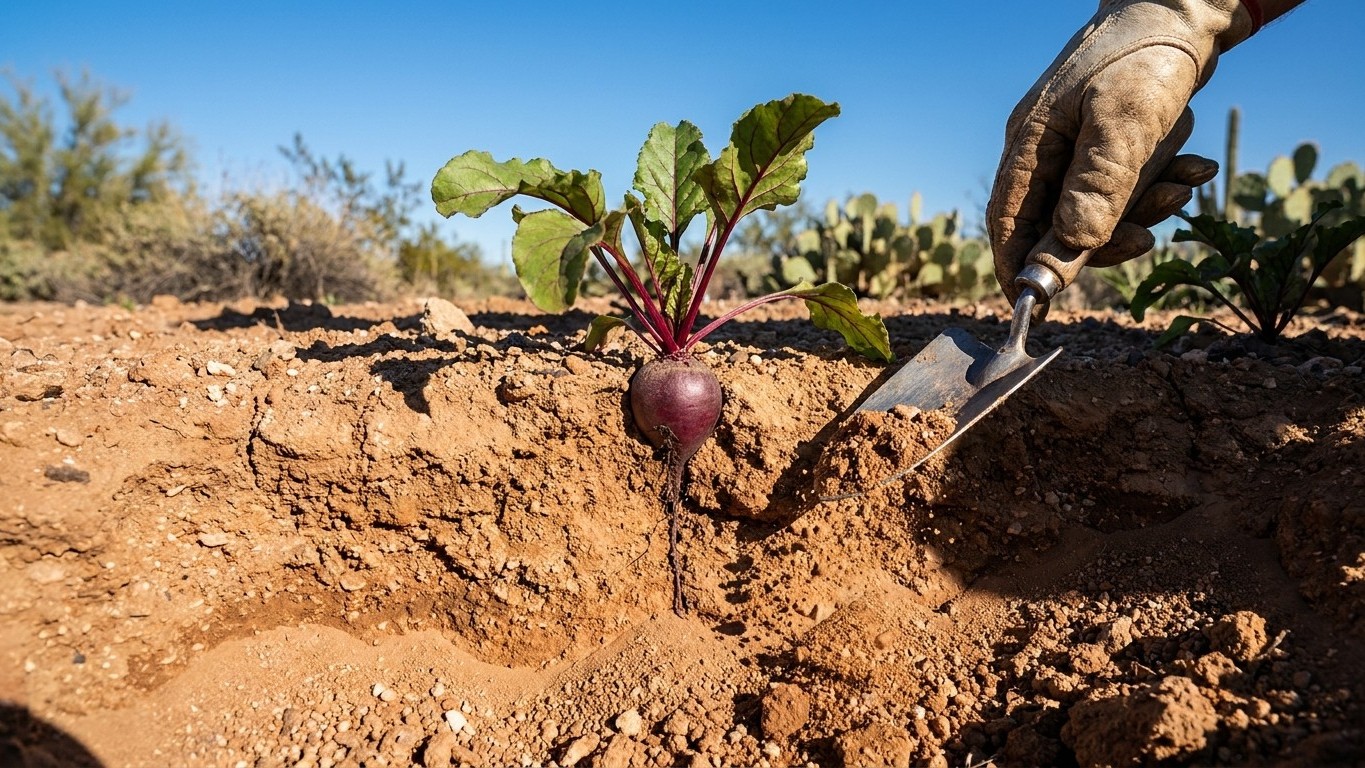

Arizona’s benchmark soil, the Casa Grande series, is well drained and mineral-heavy with almost no organic matter, and its surface runs alkaline at pH 8.5. That combination isn’t really the problem for a beet root; the state’s near-total absence of frost is. Beets struggle here less from cold and more from months of heat that stop root growth outright, so timing has to work backward from summer, not forward from a last-frost date that barely exists in the low desert.
The short answer
The Casa Grande series, the soil USDA lists as representative of Arizona, is an Aridisol, the classification reserved for dry-climate ground that spends most of the year without enough moisture to weather chemically the way soils in wetter states do. Its surface horizon runs about 64 percent sand, 14 percent clay, and 22 percent silt, with organic matter around 0.8 percent and a pH near 8.5. It drains well, which actually lines up with what a beet wants: Utah State University Extension describes the crop’s ideal ground as deep, sandy, and well drained, rich in organic matter, the kind of profile that lets a taproot push straight down instead of stalling on a hardpan or sitting in standing water.
Casa Grande gets the texture and drainage right and the organic matter badly wrong. At under 1 percent, there isn’t enough decayed material in the surface to hold moisture between waterings or buffer the root against the swings of desert irrigation, and Extension’s own guidance caps the fix at no more than 1 inch of composted organic matter per 100 square feet, which rules out the kind of heavy compost dump that might otherwise offset that shortfall in a single season.
Texture and organic matter are only half the story. What decides whether a beet root turns tender or woody in Arizona has less to do with what’s under the seed and more to do with what’s happening above it for a good stretch of the year. NOAA’s 30-year climate record lists Phoenix’s frost-free season at 365 days in most years, so cold isn’t the limiting factor a gardener elsewhere would plan around. An exact day count of how many days a year Phoenix spends above 90 F isn’t part of the sourced record used here, but the marker Extension gives is simpler and lower anyway: once air temperatures pass 85 F, a beet root already under water stress turns fibrous and woody, and Phoenix crosses that line for a large share of the calendar, not just a scattering of afternoons.
None of this describes any single garden. Arizona spans hundreds of soil series, and Casa Grande is the state’s representative profile, not a survey of what sits under a particular yard. A lot next to a wash, a hillside lot, or any ground a builder graded and refilled can carry a different sand-clay-silt split, a different pH, and a different drainage class entirely. Casa Grande is useful for what it says about the region broadly, alkaline, mineral, thin on organic matter, well drained, and it’s a reasonable place to start planning. It isn’t a substitute for pulling an actual sample from the bed.
The six weeks that decide it here
The standard advice to sow beets 2 to 3 weeks before the last frost assumes a garden has a last frost worth counting back from. Most of low-desert Arizona doesn’t. NOAA’s daily record for the Phoenix station shows the ground reaching 32 F in only 6 of 30 springs, and every one of those cold snaps landed between late December and mid-January, not in the March or April window where a “last frost” would normally sit. For the six weeks that decide a beet crop, there isn’t a fixed frost date here to work backward from.
That doesn’t mean the first six weeks after sowing stop mattering. It means the calendar has to be read differently. Whichever six-week stretch a gardener picks, it falls into whatever the desert’s dry season happens to be doing at the time, and low-desert spring is generally dry and warms quickly once it starts, with humidity dropping and soil drying out faster than a quick look or feel of the surface would suggest. That matters because Extension’s guidance is specific about the mechanism at work: water stress during the first six weeks after sowing is what triggers premature flowering, the process gardeners call bolting, and a beet that bolts early stops building root mass and starts building a flower stalk instead.
In Casa Grande soil, with its 64 percent sand and 0.8 percent organic matter, water moves through the root zone fast and doesn’t stay held there the way it would in a heavier, richer profile. That raises the bolting risk specifically in this state, because the six-week window that matters most for early root development is also the window where a sandy, thin-on-organic-matter soil drains before a young plant can fully draw on it. The fix isn’t really a different sowing date so much as a tighter watering routine through those six weeks, since this soil won’t buffer a missed watering the way a clay-heavy bed elsewhere might. Consistency in that early stretch, more than the calendar day it starts on, is what keeps a beet root growing instead of flowering.
What goes wrong here
- Bolting from an early dry spell. Casa Grande’s sandy profile, 64 percent sand, 22 percent silt, 14 percent clay, drains fast, so a missed watering in the first six weeks after sowing produces water stress sooner than it would in denser soil, and Extension’s guidance ties that stress directly to premature flowering. Remedy: water on a fixed schedule through the first six weeks rather than waiting for the surface to look dry.
- Woody roots from heat layered on thirst. Once air temperatures pass 85 F, a beet root already under water stress turns fibrous rather than tender, and Phoenix’s frost-free, 365-day season means that heat threshold arrives early in the year and stays late. Remedy: plan harvest before the hottest stretch rather than leaving roots in the ground hoping for a cool spell that low-desert Arizona mostly doesn’t get.
- Low organic matter starving the root zone. At roughly 0.8 percent organic matter, Casa Grande’s surface has little to hold moisture between waterings or feed soil biology. Remedy: work in compost, capped at 1 inch per 100 square feet, since more than that is treated as excess rather than added benefit.
- Assuming the state soil is the garden’s soil. Casa Grande represents Arizona broadly; a yard near a wash, a hillside lot, or fill dirt from construction can carry a different sand-clay-silt mix and a different drainage class entirely. Remedy: pull an actual soil sample from the bed before amending for a profile that may not match what’s really there.
- Treating high-country Arizona like the low desert. The frost pattern described here, rare cold snaps confined to late December through mid-January, applies to the low desert, not to Flagstaff and the high country, which freeze hard on a normal seasonal schedule. Remedy: gardeners above the low desert need an actual frost-based calendar, not the heat-driven one that fits Phoenix.
Common questions
Does beet root need extra lime in Arizona soil?
No. Casa Grande’s surface already runs alkaline at pH 8.5, well past neutral, and beets tolerate that range without added lime. Pushing pH higher offers no benefit and risks locking up nutrients the root would otherwise be able to reach.
How long does it take beets to reach harvest when seeded in Arizona?
Beets are sown directly in place rather than transplanted, and the crop generally reaches harvest somewhere in the 60- to 80-day range after seeding. That count starts the day the seed goes into the ground, not from any later seedling stage.
Is the Casa Grande series really Arizona’s official state soil?
It’s the soil USDA’s NRCS State Soils program lists as representative of Arizona, not a designation set by state law. It describes the state’s average profile, alkaline, sandy, low in organic matter, well drained, not any single reader’s yard, which could easily be heavier clay, pure sand, or disturbed fill dirt with none of Casa Grande’s 64/14/22 sand-clay-silt split.
Can beets be grown through summer in Arizona’s low desert?
Not really. Past 85 F, especially with any water stress, roots turn woody rather than tender, and the state’s near year-round frost-free window doesn’t translate into a year-round growing window. The real block in Arizona is heat, not cold, so a sowing plan built only around the absence of frost misses the constraint that actually matters.