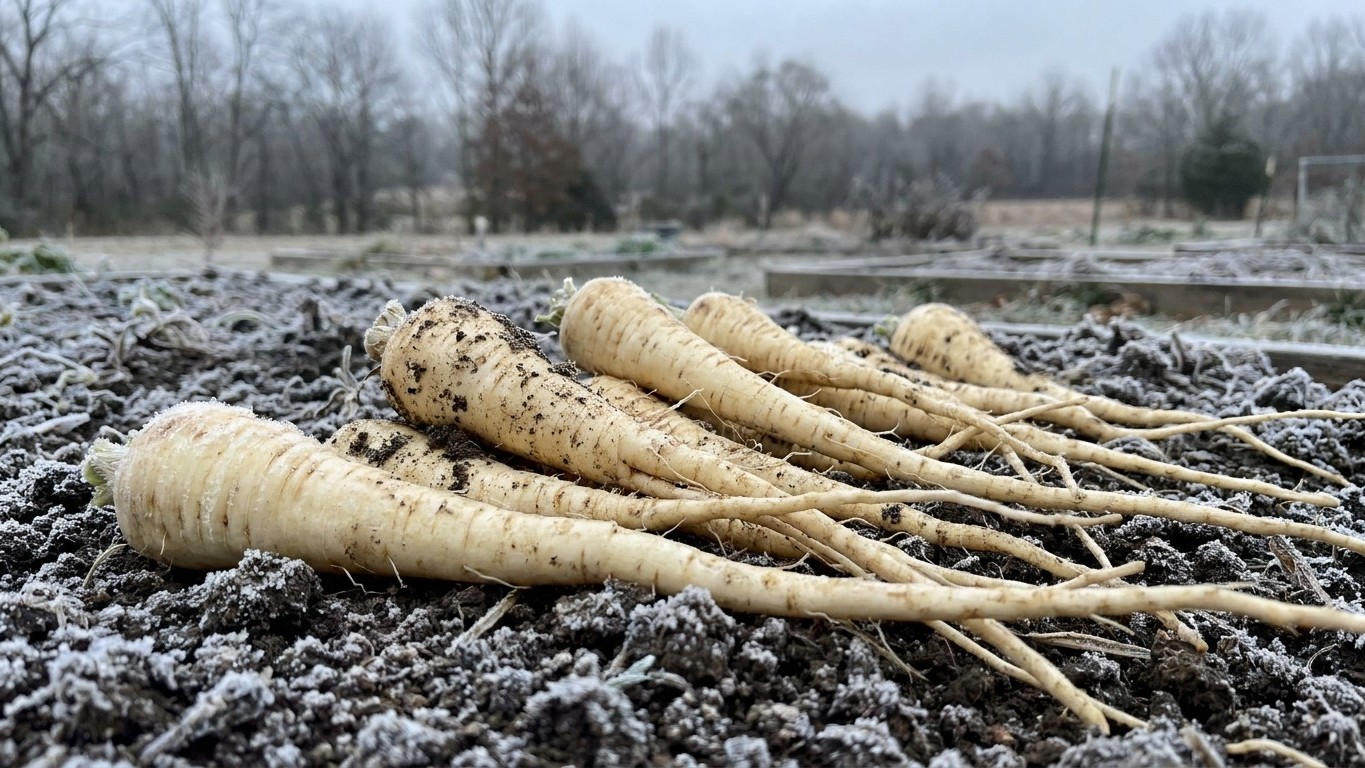

Coastal Maine gets cold enough, reliably, to turn a parsnip’s stored starch into sugar. The mean minimum for the coldest month near Portland sits at 15.6°F, well past the frost threshold that triggers sweetening. The season length works too, though it fits more comfortably along the coast than inland. The short version: grow them here, leave them in past the first hard frost, and they’ll taste the way parsnips are supposed to taste.
The short answer
The question that actually decides this isn’t which hardiness zone a map assigns to your town. It’s whether the ground here goes through several weeks of genuine frost before you dig. A hardiness zone tells you what survives the winter. It says nothing about whether a root vegetable sitting in that same ground gets cold enough, often enough, to convert starch to sugar. Those are two different mechanisms, and mixing them up is the most common mistake gardeners make with this crop.
Using Portland as the reference point, NOAA’s 1991-2020 climate normals put the mean daily minimum for the coldest month at 15.6°F. That’s not a record low and it’s not a monthly average temperature. It’s the typical overnight low during the coldest stretch of winter, and it’s a meaningful number because it tells you this region doesn’t just dip below freezing once and bounce back. It sits below freezing, repeatedly, for weeks at a stretch. That’s exactly the kind of sustained cold exposure a parsnip needs to sweeten.
So the answer for coastal Maine is straightforward: parsnips grown here will sweeten, not merely grow. Leave the roots in the ground after the first fall frost, let them sit through several more cold nights, and the starch-to-sugar conversion happens on its own. No extra work required beyond patience and a fork to dig them out later.
Inland and northern Maine push this even further in the crop’s favor. Colder winters there mean an earlier, more reliable frost season, which is good news for sweetening even though it tightens the growing window on the front and back end. The tradeoff is worth naming plainly: the coast gives you an easier planting and harvest schedule, the interior gives you colder cold, and either way the frost is doing the work, not the zone number on a seed packet.
Where this could go wrong is a winter mild enough, or a garden bed insulated enough by heavy mulch or a warm microclimate, that the roots never really experience sustained frost. That’s not a Maine problem. It’s the failure mode for places with genuinely mild winters, and it’s worth knowing about because the fix, when it does apply, is simple: pull the mulch back once the ground has frozen a little, and let the cold reach the roots.
Does the season fit?
Parsnips are sown directly in the ground, not started indoors and transplanted, and Utah State University Extension puts the timeline at 100 to 120 days from seeding to a root worth pulling. The planting rule of thumb is to sow 2 to 3 weeks before the last expected spring frost. Here’s how that lines up against Maine’s frost dates.
- Sowing window: With the last spring frost falling between April 22 and May 1 near Portland, sowing 2 to 3 weeks earlier puts seed in the ground somewhere around April 1 to April 17, assuming the soil is workable that early.
- Germination wait: Parsnip seed is slow. Count on 14 to 21 days before you see any green. Don’t dig up the row and re-sow just because nothing has shown by day 10; that’s normal for this crop, not a failure.
- Maturity date: Add 100 to 120 days from seeding to that April sowing date, and roots reach harvest size somewhere between early July and mid-August.
- Comparing against the first fall frost: The first fall frost near Portland arrives between October 9 and October 21. That leaves eight to ten weeks, sometimes more, between when the roots are technically ready and when frost actually shows up.
- The verdict: Along the coast, the season fits comfortably, with enough spare weeks after maturity to let the roots sit in the ground through several frosty nights before you dig. Inland and northern Maine compress both ends of this window, later spring frost, earlier fall frost, so the season fits more tightly there, but it still works.
The extra weeks between “mature” and “harvested” matter more for this crop than for most vegetables. A parsnip pulled the day it reaches size will taste fine but bland. A parsnip left another month, through a handful of frosty nights, tastes noticeably sweeter. Maine’s frost window gives coastal gardeners room to let that happen without racing a hard freeze that locks the ground solid.
What goes wrong here
- Forked roots from heavy or stony ground. Parsnips push a single long taproot, and if it hits a rock, a clay lens, or compacted subsoil, it splits into two or three legs instead of growing straight down. The Utah State University Extension guidance calls for deep, sandy soil, and says heavy soil needs to be double dug before planting. Work the bed to at least a foot deep and pull out stones as you go.
- Forked roots from overwatering. This is a separate cause from soil texture, and it’s easy to conflate the two. Too much water, especially uneven watering that swings from soggy to dry, encourages the root to branch instead of growing as one straight taproot. Water on a steady schedule rather than flooding the bed after a dry stretch.
- A season that runs out before the roots mature. This shows up mainly inland and in northern Maine, where the frost window is tighter. If a late spring pushes sowing past mid-April, the 100 to 120 day clock can bump right up against the first fall frost with little room to spare. Sow as early as the soil allows, and don’t wait for a calendar date if the ground is already workable.
- A mild stretch that never delivers enough frost. Rare in Maine but not impossible in an unusually warm winter, or in a bed insulated by thick mulch. If the roots don’t seem sweeter after the first frost, leave them longer and pull back any heavy mulch so the cold can actually reach them.
A Word of Caution Before You Dig
North Carolina State Extension puts it in plain terms: “All parts of this plant contain furocoumarins which can make skin sensitive to light causing burns so be sure to wear gloves, long sleeves and long pants when dealing with it.” That’s not limited to the leafy tops. It covers the whole plant, roots included, which surprises most gardeners who assume the danger, if there is one, sits in the foliage.
The reason this catches people off guard is the mechanism itself. The burn doesn’t come from the sap alone. It comes from sap on the skin combined with sunlight. That combination is exactly what a harvest day usually delivers: bright sun overhead while you’re pulling tops, brushing wet leaves against your forearms, kneeling in a patch with bare skin exposed. The reaction isn’t instant either. It tends to show up hours after the exposure, once the skin has had time to react to the light, which means a gardener can finish a sunny afternoon in the parsnip bed with no idea anything happened until later that evening.
That delay is exactly why the protection has to happen before you touch the plant, not after. Gloves, long sleeves, and long pants during harvest do the job. Washing your hands once you’re done, after the sap has already been on bare skin in daylight, doesn’t undo the exposure that already occurred.
Checking this against your own county
The figures here come from a single reference station near Portland, and Maine’s climate shifts meaningfully as you move inland or north. A frost date that holds on the coast can run a week or more later in spring, and a week or more earlier in fall, once you’re away from the water. Soil type changes county to county too, and that matters directly for whether a parsnip grows straight or forks.
The University of Maine Cooperative Extension is the resource built for exactly this kind of local check. They can confirm frost dates, soil conditions, and planting windows specific to your county rather than a single coastal station. Reach them at extension.umaine.edu before you commit a full row to parsnips, especially if you’re gardening inland or north of the coastal belt.
Common questions
Do parsnips need a specific variety to sweeten in Maine?
No variety is specified in the sourced guidance here, and none should be assumed. The sweetening comes from frost exposure after the roots mature, not from a particular cultivar.
Can I leave parsnips in the ground all winter in Maine?
The sourced guidance covers sweetening through several frosty weeks, not full winter storage. Once the ground freezes solid, digging becomes the practical limit, so plan to harvest before deep freeze sets in rather than assuming an all-winter stay.
Why didn’t my parsnip seeds come up after two weeks?
That’s within the normal range. Germination takes 14 to 21 days for this crop, and giving up before three weeks have passed is the most common reason gardeners think their seed failed when it hadn’t.
Is the skin reaction from parsnip sap the same as poison ivy?
No. The mechanism is different. Poison ivy triggers an allergic reaction on contact. The parsnip reaction requires sap on the skin plus sunlight exposure, which is why it shows up hours later and specifically on days you’re out harvesting in bright light.