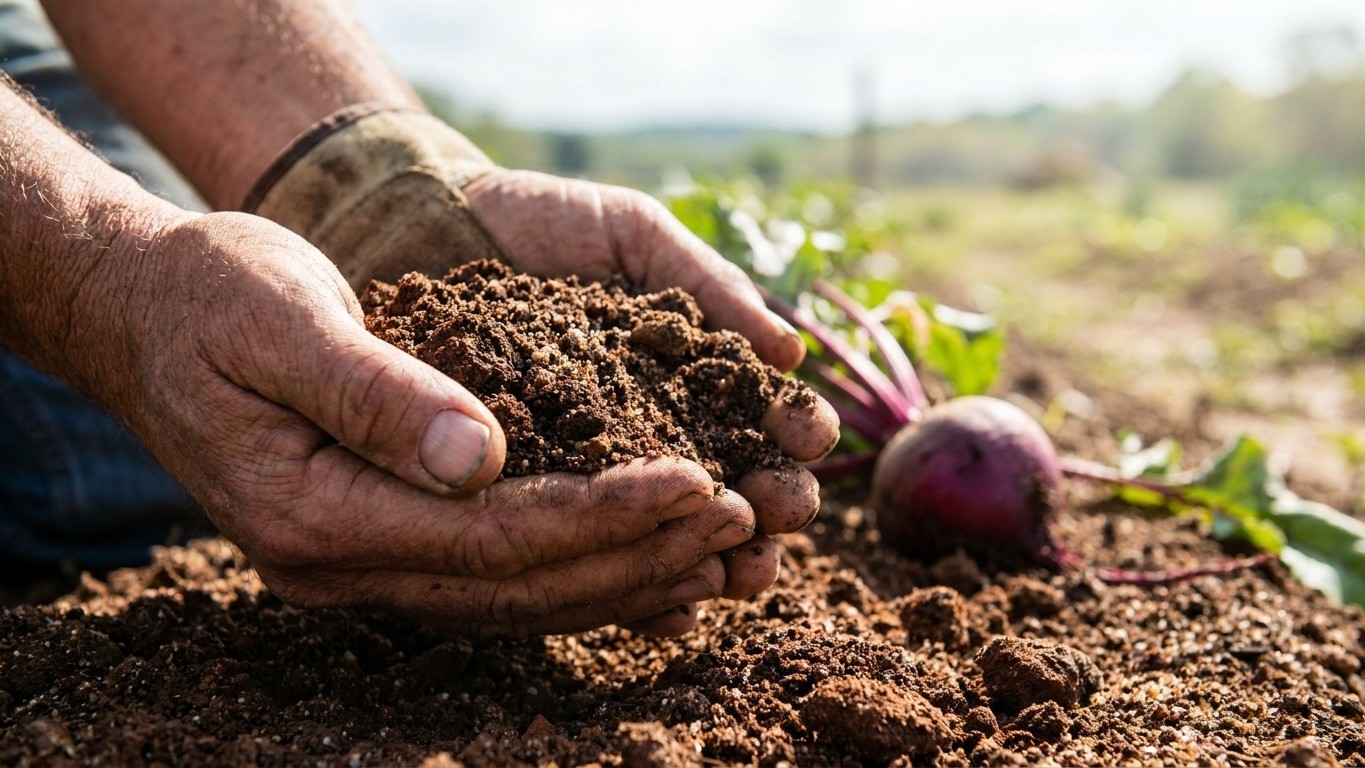

Iowa’s representative ground, the Tama series, is a deep, dark prairie soil built more for corn than for carrots. It’s well drained but heavy with silt and clay, not the loose, sandy profile beets actually want. That mismatch, paired with summer heat that can push roots toward woodiness, means growing beets here takes more soil prep than the seed packet suggests.
The short answer
The soil USDA lists as representative of Iowa is the Tama series, a Mollisol, the kind of deep, dark prairie soil that built the Corn Belt. Its surface horizon runs about 4 percent sand, 26 percent clay and 70 percent silt, with organic matter around 3.5 percent and a surface pH near 6.5, slightly acid. It’s classified as well drained, and it comes from USDA’s own Soil Survey Geographic Database, drawn from 246 sampled components across the state.
For a beet, that’s a mixed report card. Utah State University Extension is blunt about what the root wants: deep, sandy, well-drained ground loaded with organic matter. Tama gives you the “well drained” and the organic matter is respectable at 3.5 percent, but the texture is nearly the opposite of sandy. Only 4 percent of the particle mix is sand; the rest is fine silt and clay that packs down after rain and resists the easy push a beet root needs to grow straight and smooth. In ground like this, roots are more likely to come up forked, flattened on one side, or rough-skinned than they would in a loose sandy loam.
The organic matter figure matters for a different reason. Utah State’s guidance caps amendment at no more than 1 inch of composted organic matter per 100 square feet, because beets can actually suffer from too much rich, loose material as easily as too little. Tama’s native 3.5 percent puts a gardener close to a reasonable starting point rather than needing a heavy rebuild, which is one advantage of gardening on a prairie-derived soil instead of a sandy or heavily eroded one.
There’s no published figure here for how many days a year an Iowa reference city clears 90 F, so that specific count isn’t something this page can hand you. What’s on record is the mechanism: Utah State’s research shows that once temperatures climb above 85 F while the plant is also short on water, the root turns woody and loses eating quality. Iowa summers run warm enough, often enough, that this threshold is a real risk in most gardens across the state, not a rare event.
None of this describes the dirt under your own tomato cage. Iowa spans hundreds of mapped soil series, river-bottom ground, hill soils, and anything a builder has cut, filled, or compacted, and all of it can differ completely from the Tama series’ numbers. Treat this as the region’s tendency, not your reading, and pull an actual soil test before you plan amendments.
The six weeks that decide it here
Beets go in the ground as seed, not transplants, and the standard advice is to sow 2 to 3 weeks before the last expected frost. In Iowa, NOAA’s 1991-2020 climate normals put the 32 F freeze probability window at April 12 to April 24, based on airport station data. That puts a typical sowing date somewhere in late March to early April for gardeners working off that airport record.
Worth flagging: Iowa State Extension’s own county-level figures, built from 1950-2021 data, run about 4 days later in spring than that airport number. So the April 12-24 window is the optimistic end of the range, not a guaranteed floor. A gardener planning around the airport date alone could get caught by a slightly later frost than expected.
Either way, sowing in that window means the first six weeks of a beet’s life, the stretch that decides everything, land squarely in Iowa’s spring. That’s a season known for swinging hard between stretches: a dry, wind-dried few weeks that pulls moisture out of topsoil fast, followed by heavy rain events that can pond on a silty surface like Tama’s before draining through. Neither extreme is rare in a Midwest spring, and a beet seedling doesn’t get much say in which one shows up during its first six weeks.
That timing matters because Utah State’s research ties water stress in exactly this early window to premature flowering, known as bolting. A beet plant that bolts stops building a usable root and shifts its energy into a flower stalk instead. In Iowa, the bolting risk isn’t a heat problem at this stage. It’s a dry-spell problem, the kind that shows up when a cold, dry snap follows sowing and nobody’s watering because it still feels like early spring. Gardeners who assume beets are safe from stress until summer heat arrives are missing the window where the actual damage happens.
What goes wrong here
- Forked or rough roots from clay-heavy ground. Tama’s texture, just 4 percent sand against 26 percent clay and 70 percent silt, resists the smooth downward push a beet root needs. Work the bed deeper than usual and mix in organic matter, staying within Utah State’s cap of 1 inch of composted material per 100 square feet, so the amendment loosens texture without overfeeding the plant.
- Bolting from a dry spring stretch right after sowing. The first six weeks after seeding are the window where water stress triggers premature flowering, according to Utah State’s guidance. A dry snap in April or early May, common in Iowa’s variable spring, can hit before a gardener starts a regular watering routine. Water consistently from the day seeds go in, not from the day the ground looks dry.
- Woody roots from summer heat layered on thirst. Once temperatures pass 85 F, a beet under water stress turns fibrous and loses its eating quality, per Utah State’s research. Iowa’s warm-season stretch makes this a recurring risk rather than an occasional one. Mulch to keep soil temperature down and keep watering through hot weeks instead of letting the bed dry out between rains.
- Surface crusting and slow drainage after heavy rain. Even though Tama is mapped as well drained, its heavy silt content (70 percent) can crust and pond briefly after a hard rain before water works through. That standing moisture at the surface can encourage rot around the crown. Raised rows or a light layer of coarse organic mulch help water move off the surface instead of sitting on it.
Common questions
Is my yard actually Tama soil?
Probably not exactly. Tama is the series USDA lists as representative of Iowa as a whole, built from sampled components across the state, but it’s one series among hundreds mapped within Iowa’s borders. River bottoms, hill ground, and any yard that’s been graded or filled during construction can carry a completely different texture and drainage class. Use Tama’s numbers as a regional tendency and confirm your own bed with a soil test.
When exactly should I sow beets in Iowa?
Aim for 2 to 3 weeks before the last frost. NOAA’s airport-station data puts that frost window at April 12 to April 24, but Iowa State Extension’s county-level figures run roughly 4 days later in spring, so treat the airport date as the earliest realistic edge rather than a firm target.
Can heavy clay-silt soil be fixed for beets, or should I just build a raised bed?
Both work. Mixing in composted organic matter, capped at 1 inch per 100 square feet per Utah State’s guidance, loosens a silt-heavy bed like Tama over a season or two. A raised bed filled with a sandier mix gets you there immediately if you don’t want to wait on soil amendment to take effect.
How do I tell bolting apart from woody roots, since both ruin the harvest?
They’re two separate failures with two separate causes. Bolting happens early, within the first six weeks after sowing, when the plant is short on water and shifts energy into a flower stalk instead of a root. Woodiness happens later, once summer heat passes 85 F while the plant is also thirsty, turning the root fibrous instead of tender. Watering matters for both, but the timing of the stress, spring versus summer heat, is what determines which failure you get.