
The short answer is that timing in Iowa starts with two separate calculations: the days a carrot needs to mature and the soil texture it has to push through to get there. Carrots run 70 to 100 days from seeding to harvest, counted from the day you drop seed in the ground, since carrots are sown in place and never transplanted. Once you know your local last frost date from NOAA NCEI climate records, you count backward from your target harvest, and check whether the ground itself will let a carrot grow straight.
The short answer
Iowa’s benchmark soil is the Tama series, a Mollisol, the deep, dark prairie soil that built the Corn Belt. In its surface layer, USDA NRCS records show about 4 percent sand, 26 percent clay and 70 percent silt, with organic matter around 3.5 percent and a surface pH near 6.5, slightly on the acid side. It’s classed as well drained, which sounds like good news for a root crop, and mostly it is: water moves through it, roots don’t sit in a swamp, and the organic matter is generous by national standards.
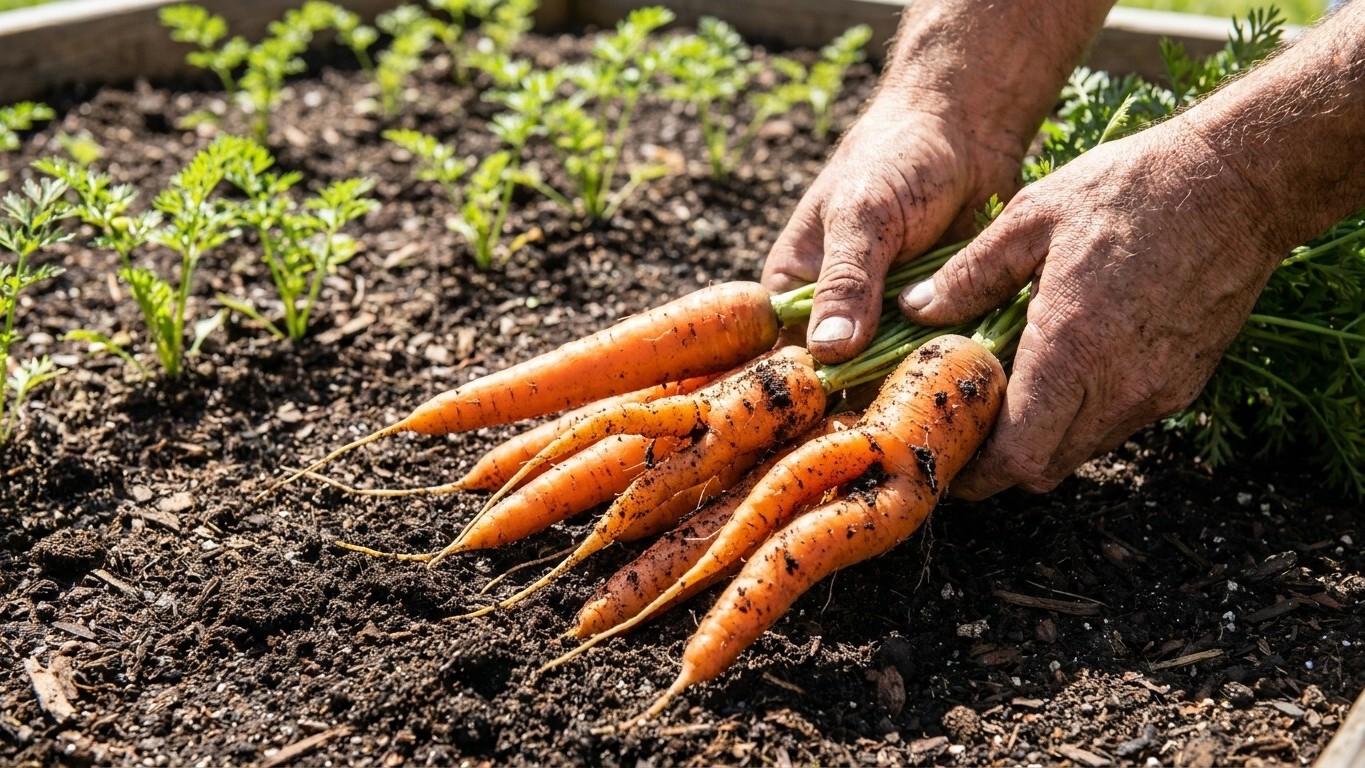
The catch is the clay. At 26 percent clay and 70 percent silt, this isn’t sand a carrot can slide through unbothered. It’s a heavier, silty-clay texture, and Utah State University Extension is direct about what that does to a carrot root: heavy or rocky soil makes the root fork. A carrot doesn’t stop growing when it hits resistance underground, it splits around it, and you end up pulling something shaped more like a wishbone than a taproot.
The fix isn’t a different variety, it’s working the ground. Utah State University Extension recommends plenty of compost worked in, plus double digging, loosening and turning the soil a full spade’s depth or more so there’s no compacted layer waiting a few inches down. In a Tama-type bed, that means digging deeper than feels necessary and mixing in compost until the texture loosens noticeably in your hand. If the ground stays stubborn, a raised bed filled with a loose, sandy-loam mix sidesteps the problem completely, since you control the texture from the start instead of fighting what’s already there.
None of this is a diagnosis of your yard. Iowa spans hundreds of mapped soil series, and the Tama series is simply the one USDA lists as representative of the state as a whole. River bottoms, hill country, and any lot where a builder graded, filled, or stripped topsoil can carry soil that has nothing in common with these numbers. Treat the Tama figures as a starting point for what the region’s ground tends to do, not as a reading of the dirt under your own carrots.
The test that settles it in your own garden
- Dig a test hole in the exact spot you plan to plant, going down at least as deep as a garden trowel’s handle, and pile the soil beside the hole so you can read it as one continuous cross-section instead of scattered clumps.
- Look at what came out: note whether the color or texture shifts with depth, whether the shovel hit a hard, compacted layer that resisted digging, and how many stones or rock fragments turned up in the pile.
- Grab a handful of moist soil from partway down and squeeze it. Sandy soil falls apart the moment you open your hand. Clay-heavy soil holds together in a slick ribbon and stays sticky. Loam breaks into loose crumbs that hold their shape only briefly.
- Fill the hole with water and watch how it behaves. Water that disappears steadily points to decent drainage. Water that just sits there, barely moving, tells you there’s a heavy or compacted layer working against your carrots below the surface.
- Repeat the process in two or three other spots around the bed. Soil can change sharply over a few feet, especially near a foundation, a driveway, or anywhere fill dirt was brought in during construction.
Once you’ve done this, you have something more useful than any state average: an actual read on the ground your carrots will spend the next 70 to 100 days pushing through.
What goes wrong here
- Forking in heavy, clay-rich ground. On Tama-type soil or anything similarly dense, a carrot root meets resistance and splits instead of growing straight down. The remedy is loosening the bed well beyond the top few inches through double digging, and working in compost until the texture opens up. If the clay layer runs deep and won’t loosen, skip it altogether and grow in a raised bed filled with looser soil.
- Poor germination during a hot, dry stretch. Carrot seed is small and sits shallow, so it dries out fast once the weather turns warm and the topsoil crusts over. The remedy is keeping the seedbed consistently damp through the germination window, watering lightly and often rather than deeply and rarely, and a thin layer of mulch or straw to slow surface drying between waterings.
- Splitting from uneven watering. A root that grows through a dry spell and then gets hit with a heavy soak swells fast and cracks along its length. The remedy is a steady watering routine from the start, rather than letting the bed dry out and then compensating with a flood once you notice.
- Slow, stunted growth over compacted subsoil. Even well-drained topsoil can sit over a dense layer that blocks the taproot from reaching down. The test hole from the previous section catches this before you plant. If you hit that resistant layer at digging depth, break it up or build up instead of planting directly on top of it.
Common questions
Can I sow carrots right after the last frost in Iowa?
Carrots are seeded directly in the ground, and gardeners commonly time that sowing around their local last frost date, then count 70 to 100 days forward to estimate harvest. The exact last frost date for your specific location isn’t a single statewide figure and isn’t published on this page. Check your county’s data through NOAA NCEI climate records for a reading specific to your area before you commit to a date.
Do I need to amend Tama-type soil before planting carrots?
If your soil shares the Tama series’ clay-heavy texture, roughly a quarter clay and mostly silt, plan on working in compost and double digging before you sow. Utah State University Extension links that kind of heavy soil directly to forked roots, and the same source names compost and deep digging, or a raised bed, as the fix.
How do I find my exact last frost date instead of guessing?
Your county’s local climate records through NOAA NCEI are the place to look for a frost date specific to your location, rather than relying on a single number for the whole state. Iowa’s climate varies enough from the northern counties to the southern ones that a statewide average won’t match every garden.
Can I sow a second carrot crop for a fall harvest?
Because carrots run 70 to 100 days from seeding, a second sowing is a matter of counting that window backward from your area’s first fall frost rather than forward from spring. As with spring sowing, the specific fall frost date for your location comes from your own local NOAA NCEI climate data, not from a single figure that applies across the whole state.