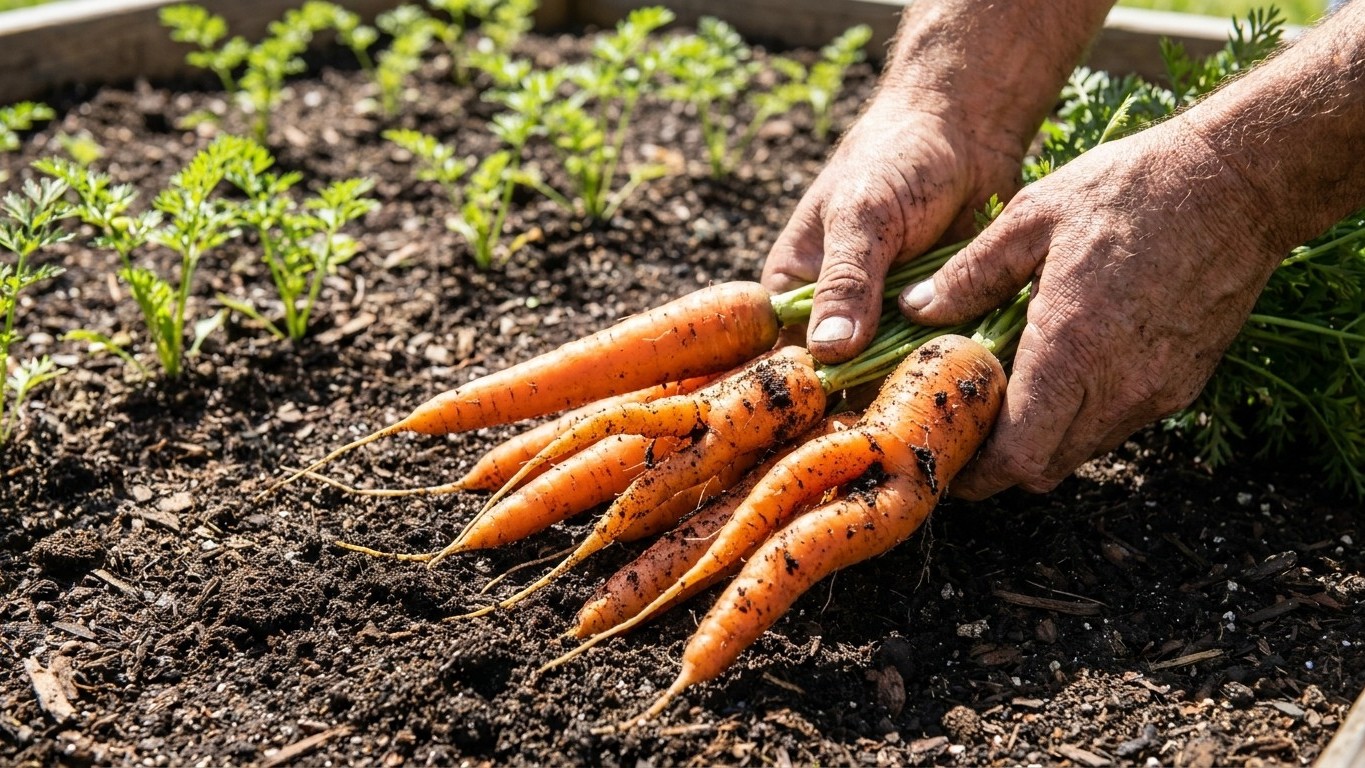

The direct-seed answer for carrots barely depends on the calendar. Because carrots tolerate light frost and go straight into the ground with no transplanting, most Maryland gardeners count back a few weeks from their local last-frost date and get away with it. But whether the roots come up straight or twisted has almost nothing to do with timing and everything to do with what’s under the seed.
The short answer
Maryland’s representative soil, the one the USDA lists as the state’s benchmark, is the Sassafras series: an Ultisol, meaning it’s old, heavily weathered, and leached of a lot of its natural fertility. The surface layer runs 67 percent sand, 10 percent clay, and 23 percent silt, with organic matter around 1.6 percent and a surface pH near 5.3, which counts as strongly acid. It drains well. That combination, sandy and permeable rather than dense and sticky, is actually closer to what carrots want than what most vegetable gardens start with.
Carrots need deep, sandy, well-drained ground rich in organic matter to grow a straight root, according to Utah State University Extension. Heavy or rocky soil is what makes a carrot fork, splitting into two or three legs as the taproot hits resistance and detours around it. Measured against that standard, Sassafras soil’s low clay content and good drainage mean forking from sheer heaviness is less likely here than in a soil built on clay. The catch is the organic matter number: 1.6 percent is thin, and thin soil starves a root crop of the steady fertility it needs to size up.
So the practical read is this: if your garden actually sits on ground like Sassafras, you’re not fighting a heavy-soil problem, you’re fighting a lean-soil problem, and the fix is generous compost worked into the bed before sowing rather than the double-digging you’d need to break up clay. If your garden runs heavier than that, with more clay and slower drainage, the fork risk goes up, and a raised bed filled with loosened, amended soil solves it more reliably than trying to rework the native ground in place.
None of this is a diagnosis of your yard. Maryland spans hundreds of mapped soil series, from river-bottom silt to hill-country clay to whatever a builder trucked in and graded flat during construction. Sassafras is the state’s representative soil on paper, not a description of every backyard in it. Treat it as a starting point for what the region’s ground tends to do, then check your own dirt before you commit a season of carrot seed to it.
The test that settles it in your own garden
A state-level soil series can’t tell you what’s eighteen inches under your own carrot bed. That takes a few minutes with a shovel, not a lab.
- Dig a hole at least a foot deep where you plan to sow, and look at how far down the soil stays loose before it hits a hard layer, dense clay, or a shelf of rock and rubble.
- Pull out any stones larger than a marble as you go and count how many you’re finding. A handful of pebbles is normal; a bed that’s mostly gravel will push carrots sideways no matter how the soil chemistry looks.
- Grab a moist handful from a foot down and squeeze it. Soil that forms a slick, sticky ribbon between your fingers is high in clay. Soil that falls apart the moment you open your hand is sandy. Something in between that holds a loose shape but crumbles with a light poke is closer to a workable loam.
- Fill the same hole with water and watch how fast it disappears. Water still sitting there after several hours points to poor drainage and a soil that will hold too much moisture around a carrot root. Water that vanishes almost as fast as you pour it suggests the opposite problem, ground that dries out quickly between waterings.
Run through those four checks before you decide whether you need a raised bed, a season of compost, or nothing extra at all. It’s the only test that actually describes the ground you’re about to plant, rather than the state average.
What goes wrong here
Even with reasonable timing, a handful of predictable problems show up once carrots are in the ground, and each one traces back to either the soil or the weather rather than the sowing date.
- Forking in heavy ground. A taproot meets clay, compacted subsoil, or buried rock and splits into two or three legs trying to get around it. The fix is working in plenty of compost and double-digging the bed deeply before sowing, or skipping the native soil altogether with a raised bed filled with loose, amended mix.
- Poor germination during a hot stretch. Carrot seed is slow to sprout under the best conditions, and a run of hot, dry days on the surface can dry out the seed bed before the seedlings ever show. Keeping the top inch of soil consistently damp with light, frequent watering until germination, and mulching lightly to hold moisture in, gets more seeds up.
- Splitting from uneven watering. Roots that go through a dry spell and then get soaked, or the reverse, tend to crack along the length of the root as growth speeds up and slows down unevenly. A steady watering schedule rather than feast-or-famine soakings keeps the root growing at one pace.
- Stunted, pale roots in thin soil. Ground that’s naturally low in organic matter, which describes a fair amount of Maryland’s sandier, older soils, can grow a straight carrot that’s simply small and underfed. Working compost into the bed before sowing, not just once at planting time, addresses the fertility gap rather than the shape problem.
Common questions
Do I need to know my exact last-frost date to sow carrots?
It helps for planning, but carrots tolerate cool soil and light frost better than many vegetables, and because they’re sown directly in place with no transplanting step, there’s more flexibility in the exact week than with crops raised indoors first. A specific frost date for your part of Maryland isn’t part of the soil data this page draws on; check with a local source for your own zip code before you lock in a date.
How many days until carrots are ready to harvest?
Most carrot crops run 70 to 100 days from the day the seed goes into the ground. Because carrots are direct-sown, that count starts at seeding, not at any transplant date, since there isn’t one.
Should I test my soil’s pH before planting carrots?
Maryland’s representative soil runs strongly acid at a surface pH near 5.3, but that’s a state benchmark, not your garden’s number. A home soil test is the only way to know where your bed actually sits, and that’s worth checking before you decide whether any amendment is needed.
Is raised-bed soil always necessary for straight carrots?
No. It’s a fix for a specific problem: soil that’s too heavy, rocky, or shallow for a taproot to push through cleanly. If your dig test shows loose, stone-free soil to at least a foot down, working compost into the native ground before sowing is usually enough.