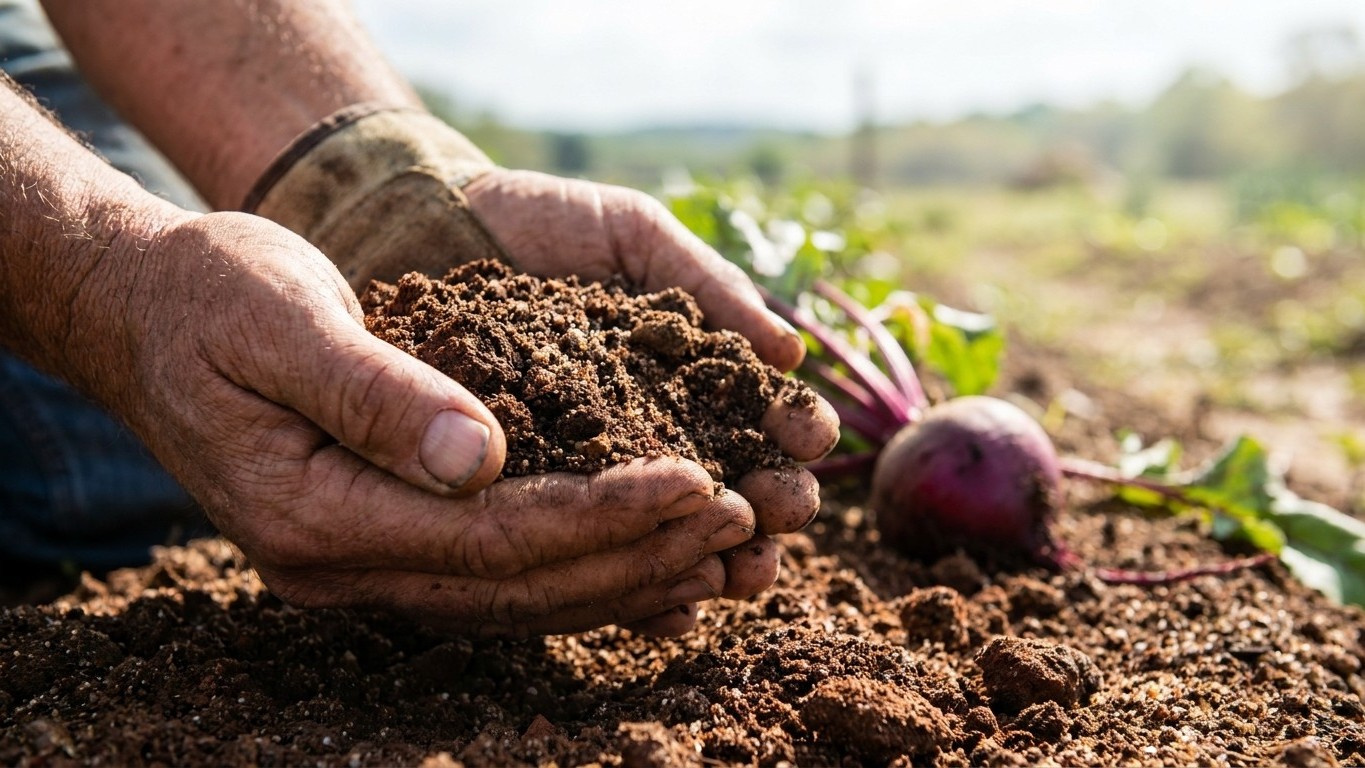

Nebraska’s benchmark ground is a deep, dark silt loam, not sand, and that matters before a single beet seed goes in. The soil beets actually want is loose, sandy and well drained; the soil that represents the state is a Mollisol built from wind-deposited silt, only lightly sandy, and slightly acid. It’s productive ground, but not shaped for a taproot to slide through without resistance. Add a spring window that can flip from dry to soaked within days, and the season’s outcome is largely set before the leaves even show.
The short answer
Nebraska’s state soil is the Holdrege series, a Mollisol, officially named the state soil by Nebraska law in 1979 under the USDA NRCS State Soils programme. Its surface horizon runs 11 percent sand, 22 percent clay and 67 percent silt, with a pH around 6.2 and organic matter near 2.0 percent. It’s well drained, which is the one point in a beet’s favor here, since standing water rots a root faster than almost anything else. But the texture is the opposite of what a beet wants. Beets want deep, sandy, well-drained soil rich in organic matter, according to Utah State University Extension, and a silt-dominant soil with 22 percent clay doesn’t loosen the way sand does. That clay fraction is enough to firm up a few inches down, and a beet root meeting resistance there doesn’t push through it. It splits, forks, or simply stalls and stays stubby.
| What beets want | What Holdrege gives (surface horizon) |
|---|---|
| Sandy, loose texture | 11% sand, 67% silt, 22% clay |
| Well drained | Well drained |
| Rich in organic matter | About 2.0% organic matter |
The organic matter figure tells its own story. At about 2.0 percent, this ground has decent baseline fertility for a row crop, but it’s short of what a beet bed benefits from. Utah State University Extension recommends amending with no more than 1 inch of composted organic matter per 100 square feet, which is a small, controlled addition, not a heavy top-dressing. Overdo it and you get the opposite problem, a root that forks chasing pockets of loose, rich material instead of growing straight down.
How many days a year the reference city spends above 90 F isn’t published in the data behind this page, so that count won’t be guessed at here. What is sourced is the threshold that actually damages a beet root: heat above 85 F combined with water stress turns the root woody and fibrous. That’s a lower bar than 90 F, and it’s the number worth tracking through the season, not a headline heat statistic.
None of this describes every garden in Nebraska. The state carries hundreds of mapped soil series, and the Holdrege series is a representative benchmark, not a stand-in for a specific yard. River-bottom ground, hill country, and anything a builder has cut, filled or graded will behave differently from the figures above. Treat this as the starting tendency of the region’s ground, sandy or heavy, quick-draining or slow, and confirm the real number with a soil test before planning amendments.
The six weeks that decide it here
Sowing beets 2 to 3 weeks before the last frost is the standard approach, and in Nebraska that last spring frost falls between April 12 and April 23, based on NOAA NCEI’s 1991-2020 Climate Normals for the reference weather station. That puts a typical Nebraska sowing date somewhere in late March to early April, which means the first six weeks after seeding, the window that decides whether the crop bolts or not, lands squarely in Nebraska’s early spring. That’s a specific, knowable stretch of the calendar, and it’s worth planning around rather than guessing at.
Early spring on the Nebraska plains doesn’t settle into one steady pattern. It tends to swing, a dry, windy stretch that dries the top few inches of soil fast, followed by a sudden heavy rain event that soaks everything at once. Neither extreme on its own is the problem. The problem is the swing, because beet seedlings don’t have deep roots yet to buffer against it. A week of dry wind right after germination, followed by a week of standing wet, stresses the plant twice in two different directions inside that same six-week window.
Where the bolting risk actually sits
Utah State University Extension is specific about the mechanism: water stress in the first 6 weeks causes premature flowering, meaning the plant bolts, sends up a flower stalk, and stops investing in the root. In Nebraska’s case, that six-week window is early spring, precisely the stretch most likely to include a dry, windy patch before the soil has had a chance to build any moisture reserve. That’s different from a woody root problem, which shows up later and is driven by heat, not by this early window. The bolting risk here is front-loaded, tied to the sowing date and the frost window, not to midsummer conditions.
Because that April 12 to April 23 range comes from one airport weather station, it’s a reference point, not a county-by-county guarantee. Suburban and rural gardens in Nebraska typically see the last frost later than that window, sometimes by one to two weeks, and more at higher elevation. Anyone planning a sowing date around it should check their own county’s typical last frost before setting a calendar date, and lean a few days later rather than earlier if there’s any doubt.
What goes wrong here
- Crusted surface blocking germination. A soil that’s 67 percent silt forms a hard crust after a heavy rain hits bare, freshly worked ground, and a beet seedling doesn’t have the strength to push through it. Keep the top inch loose with a light raking after any hard rain, and use a thin layer of fine mulch over the seed row to soften the impact of the next downpour.
- Forked or stubby roots. The 22 percent clay fraction in this soil firms up a few inches down, and a taproot meeting that resistance splits instead of driving straight. Loosen the bed 8 to 10 inches deep before sowing, and skip fresh manure, which encourages the root to fork chasing nutrient pockets instead of growing down.
- Bolting during the first six weeks. Utah State University Extension links early flowering directly to water stress in that establishment period, and Nebraska’s early spring is prone to dry, windy stretches right when the seedlings are most vulnerable. Water on a consistent schedule through that window rather than reacting after the soil has already dried out.
- Woody, fibrous roots later in the season. Heat above 85 F combined with dry soil is the trigger, per Utah State University Extension, and that’s a separate failure from bolting, driven by summer heat rather than spring dryness. Mulch to hold soil moisture, water deeply and less often rather than shallow and frequent, and harvest before an extended hot, dry stretch if the forecast allows it.
- Weak root sizing from low organic matter. At around 2.0 percent organic matter, this soil has less to draw on than a bed rich in composted material. Add up to 1 inch of composted organic matter per 100 square feet, no more, since overdoing it creates the same forking problem as uneven clay pockets.
Common questions
When should beets be sown relative to the last frost in Nebraska?
The standard guidance is 2 to 3 weeks before the last frost. With the reference last frost falling between April 12 and April 23, that puts a typical sowing window in late March to early April, though suburban and rural gardens often see their own last frost later, so a local check is worth doing first.
Does Nebraska’s soil need amending before planting beets?
Likely yes. The state’s representative soil runs low in organic matter (about 2.0 percent) and is silt-and-clay heavy rather than sandy, both a mismatch for what beets prefer. Utah State University Extension recommends no more than 1 inch of composted organic matter per 100 square feet worked into the bed.
Why did my beets bolt instead of forming a root?
Bolting traces to water stress during the first six weeks after sowing, the establishment period. In Nebraska, that window falls in early spring, a stretch prone to dry, windy spells that can catch young seedlings before their root systems are established.
Why are my beet roots woody or tough instead of tender?
That’s a separate problem from bolting, tied to heat above 85 F combined with dry soil later in the season, according to Utah State University Extension. Consistent deep watering and a layer of mulch through hot stretches address it directly.