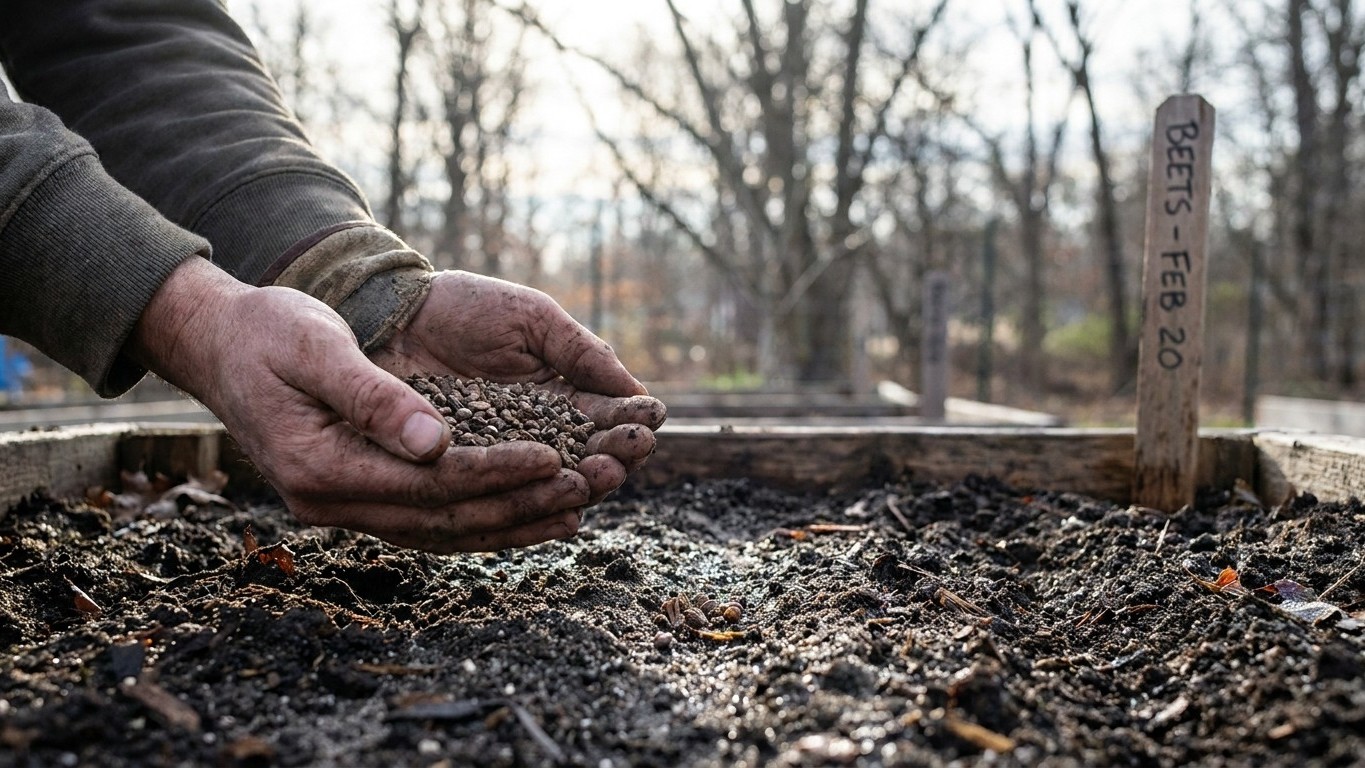

Sow beets in Newfoundland and Labrador two to three weeks before the average last spring frost, which lands near May 30 for the St. John’s area. That puts most seed in the ground around the second week of May. Because that frost date is a long-term average and not a guarantee, treat it as a midpoint, not a deadline, and expect the window to shift by weeks depending on where in the province you garden.
The short answer
The ground under most of the province’s farmed and gardened land is a Podzol, the acid, leached soil that forms under conifer cover once rain has stripped the bases out of the surface layer. It covers 59 percent of the mapped surface, with Organic soils coming in second. The median surface reading sits at pH 4.3, which counts as strongly acid, and the texture runs 56 percent sand, 9 percent clay and 35 percent silt, loam to silt in character, with organic matter around 3.3 percent and drainage rated imperfect.
Beets want deep, sandy, well-drained ground rich in organic matter. The province’s dominant profile gets partway there on texture, since sand dominates the mix, but the acidity and the imperfect drainage cut against it. A pH of 4.3 is well outside what most root vegetables tolerate without correction, and imperfect drainage means water can sit longer around a beet’s taproot than the crop prefers. Neither problem is fatal on its own, but together they explain why beets grown straight into unamended provincial ground often come up patchy or stall early.
On the heat side, the published record for this page doesn’t carry a day-count of how often St. John’s crosses 90 F, so no figure is given here. What can be said plainly is that Newfoundland’s maritime exposure keeps its summers cool by continental standards, which shifts the balance of risk. Woodiness driven by heat above 85 F combined with water stress, the failure mode Utah State University Extension flags for beets, is less of a provincial signature than it would be in a hot inland state. The bigger local variable is the ground itself: acid, imperfectly drained, and highly variable from one parish to the next.
None of this describes any single backyard. The province spans hundreds of mapped soil series, and a garden built on riverbottom silt, drained bog, or fill brought in during construction can behave nothing like the median. Use the Podzol profile as a starting point for what the region’s ground tends to do, then confirm your own pH and drainage with a soil test before you commit a season’s beets to it.
The six weeks that decide it here
Sowing two to three weeks ahead of the May 30 mean frost date puts the first six weeks of a beet’s life squarely in Newfoundland’s early spring, roughly the back half of May running into the back half of June. That stretch of the calendar in this province tends toward cool, damp, and fog-prone rather than dry, shaped by the province’s exposure to Atlantic systems and, along parts of the coast, lingering sea ice that keeps air temperatures pinned down well after inland areas have warmed. Wide day-to-day swings are common: a mild, still afternoon can be followed by a cold, wind-driven rain within a day.
That pattern changes where the bolting risk sits. Utah State University Extension is clear that water stress in a beet’s first six weeks is what triggers premature flowering, and in a climate that leans wet and cool through late spring, straightforward drought stress is less likely to be the trigger here than it would be in a dry continental spring. The more realistic threat runs the other way at first: cold, saturated soil in an imperfectly drained Podzol can slow germination and leave young roots sitting in conditions they don’t like, even without any shortage of water.
The risk doesn’t disappear, though. Sandy surface layers drain quickly once a dry spell sets in, and Newfoundland’s spring wind can pull moisture out of an exposed bed fast between rain events. A week of dry, breezy weather in early June, right inside that six-week window, can still put young beets under the kind of stress that pushes them toward bolting rather than root growth. Consistent moisture matters here precisely because the weather swings, not because the season runs reliably dry.
Remember, too, that May 30 is a mean date from Environment and Climate Change Canada’s Canadian Climate Normals for the ST JOHN’S A station, covering 1981 to 2010. In one year out of two, frost falls later than that. Districts north or inland of St. John’s, and higher ground anywhere in the province, typically run weeks behind that station’s timing.
What goes wrong here
- Cold, wet soil stalls germination. Beet seed sown into a saturated, still-chilly Podzol in mid-May can sit without sprouting for far longer than the seed packet suggests. Wait for the top few inches of soil to warm and drain visibly after a rain before sowing, rather than sowing strictly by the calendar.
- Imperfect drainage waterlogs the taproot. With drainage rated imperfect across most of the province’s mapped ground, water can linger around a developing beet longer than the crop wants. Raised rows or beds, and working in organic matter at no more than 1 inch per 100 square feet as Utah State University Extension recommends, both help water move through faster.
- Strongly acid soil stunts growth before you notice. A median surface pH of 4.3 is well outside comfortable range for most root crops, and the effect can look like a nutrient problem rather than a pH one. A soil test, followed by lime worked in ahead of sowing based on that test’s own recommendation, is the only reliable fix.
- A dry, windy stretch inside the six-week window triggers bolting. Even in a generally damp spring, a run of dry, breezy days on sandy surface layers can pull moisture out of a bed fast enough to stress young beets. Even watering through that stretch, rather than a heavy soak after the fact, keeps the crop out of the water-stress zone that pushes premature flowering.
- Frost arrives after the average date. Because May 30 is a mean and not a cutoff, an early sowing can still meet a late frost. Keep a floating row cover on hand for beds sown at the early edge of the two-to-three-week window, especially away from the immediate St. John’s area.
Common questions
Can I sow beets earlier than two to three weeks before the last frost in Newfoundland and Labrador?
Sowing much earlier than that window raises the odds of seed sitting in cold, saturated soil without germinating, given the province’s typically damp, slow-warming spring. The two-to-three-week guideline balances getting an early start against the risk of rot in ground that’s still cold.
Does the province’s acid soil actually stop beets from growing?
Acid soil around pH 4.3, the provincial median, doesn’t necessarily stop growth outright, but it works against beets, which do better in soil closer to neutral. A soil test followed by lime, applied at the rate the test recommends, is the standard correction before sowing.
How many days after sowing should I expect to harvest?
Beets are sown directly in place, and the 60 to 80 days commonly cited for the crop run from that seeding date, not from any transplant. Cooler provincial springs can push actual harvest toward the longer end of that range.
Is bolting or woodiness the bigger risk in this province?
Bolting, triggered by water stress in the first six weeks, is the more likely risk given Newfoundland’s cool, damp spring pattern and its dry, windy interruptions. Woodiness, which needs heat above 85 F layered on top of water stress, is less common here simply because the province’s summers run cooler than that threshold implies for much of the growing season.