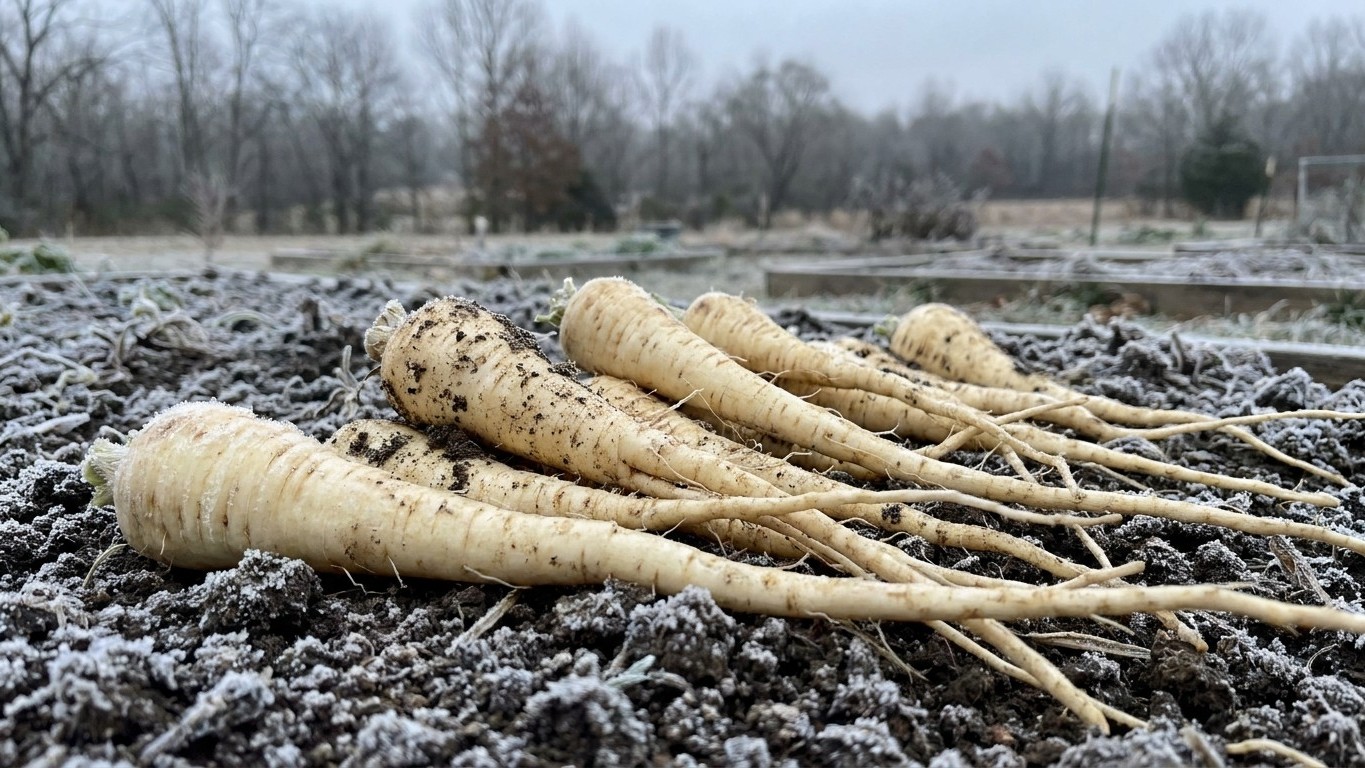

Rankin Inlet’s growing season lasts about three months, and even that stretch comes with no guarantee. Parsnips need 100 to 120 days from seeding just to size up, and a sweet parsnip needs several more weeks of frost on top of that. The frost-free window here runs roughly 86 days in an average year, before counting the two to three weeks parsnip seed takes to germinate. The short version: a parsnip sown in Nunavut soil is more likely to run out of season than to sweeten in it.
The short answer
Rankin Inlet’s coldest month averages a mean daily minimum of -29.8°F, according to Environment and Climate Change Canada’s 1981-2010 climate normals. That number describes deep winter, the kind of cold that would freeze a parsnip root solid along with most of the garden shed. It says nothing directly about the kind of cold a parsnip actually wants.
Sweetening in a parsnip root is a chemical process, not a temperature threshold. Utah State University Extension describes it as several weeks of cool, frosty weather converting stored starch into sugar, a gradual conversion that happens while the root sits in soil that is cold but not yet locked solid. That is a fall event, tied to the stretch right around the first frost. A hardiness zone rating measures something else entirely: whether a plant survives winter at all. The two numbers answer different questions, and neither substitutes for the other.
Here is where Nunavut’s calendar matters more than its January cold. The mean last spring frost around Rankin Inlet falls June 19, the mean first fall frost falls September 13, which is not a generous shoulder season to begin with. Once that first frost lands, a climate whose coldest month sits nearly 30 degrees below zero does not tend to idle in a gentle in-between state for long. There is no published record here of a slow, weeks-long taper between first frost and hard freeze; what the record shows instead is a winter that arrives fast and deepens quickly.
So the honest answer splits into two separate problems. Getting a parsnip to reach usable size in an 86-day frost-free window is already a stretch against a 100-to-120-day crop. Getting one to sweeten on top of that would require the slow, cool fall stretch this climate is not built to provide before the ground freezes hard. A parsnip grown to harvest in Nunavut soil is far more likely to come out undersized and starchy than sweet.
Does the season fit?
Lay the calendar next to the crop’s needs and the arithmetic gets uncomfortable fast.
- The frost-free window itself runs from a mean last spring frost of June 19 to a mean first fall frost of September 13. Counted forward, that is 86 days of frost-free ground in an average year, and since these are mean dates rather than guaranteed ones, roughly half of all years see frost arrive earlier than September 13, shrinking the window further.
- Parsnips are seeded directly in place, and Utah State University Extension recommends sowing 2 to 3 weeks before the last frost date. Applied here, that points to seeding sometime between May 29 and June 5, assuming the ground has thawed and dried enough to work that early, which is its own open question this far north.
- Parsnip seed germinates slowly, taking 14 to 21 days to break the surface. A late-May or early-June sowing would not produce visible seedlings until mid to late June, right around the mean last frost date itself.
- Counting from a June 5 sowing to the September 13 mean first frost gives about 100 days. Counting from a May 29 sowing gives about 108 days. Either way, the span from seed to fall frost lands at the very bottom of the 100-to-120-day range the crop needs, with no room for a cool summer or a slow spring to eat into it further.
- The season fits, but only in the loosest sense: only in a year that behaves exactly like the average, and only at the minimum end of the maturity window. A late spring frost or an early fall one pushes the math into territory where the root simply doesn’t finish.
What goes wrong here
- Forked roots from heavy or stony ground: a parsnip taproot splits around any obstruction it meets, whether that’s rock, clay clumps, or unbroken subsoil. Utah State University Extension calls for deep, sandy soil, and says heavy ground needs to be double dug before sowing so the root can drive straight down without hitting resistance.
- Forked roots from overwatering: this is a separate cause worth keeping distinct from soil texture. Too much water applied unevenly can push a taproot to fork even in soil that is otherwise loose and workable. Even, moderate moisture, not a soggy bed, keeps the root growing in one direction instead of branching.
- A season that runs out before the root sizes up: with an 86-day frost-free window against a crop that needs 100 to 120 days, this is the most likely failure in Nunavut, ahead of anything soil-related. No amendment fixes a season that is simply too short. The only lever available is sowing as early as the ground allows, and accepting a small, immature root as a realistic outcome rather than a failed one.
- A freeze that arrives too fast for the sweetening to finish: sweetening needs several weeks of cool, frosty weather while the root is still workable underground. In a climate whose coldest month averages -29.8°F, the shift from first frost to hard freeze leaves little room for that slow taper. A gardener who does manage to grow a parsnip to size here may still end up with a starchy root rather than a sweet one, simply because the ground locked up before the conversion had time to complete.
Every part of a parsnip plant carries a compound family called furocoumarins, and the North Carolina Extension Gardener Plant Toolbox states the warning without softening it: “All parts of this plant contain furocoumarins which can make skin sensitive to light causing burns so be sure to wear gloves, long sleeves and long pants when dealing with it.” That covers the roots, the stems, and the leaves alike, not just the foliage most gardeners assume carries the risk.
The mechanism is what catches people off guard. Furocoumarins on skin alone don’t do much on their own. The burn happens when sap contacts skin and that skin is then exposed to sunlight, a combination that a bright harvest day delivers almost by design: sun overhead, bare forearms, sap on the hands from pulling tops and roots. The reaction doesn’t show up on contact, either. It can take hours to surface, well after anyone has forgotten which patch of skin brushed against a broken leaf or a nicked root.
That delay is also why washing up afterward isn’t the real safeguard. By the time skin reacts, the sunlight exposure has already happened. The protection has to come before contact, in the form of gloves, long sleeves, and long pants, whenever hands and forearms will be anywhere near parsnip foliage or roots on a sunny day.
Checking this against your own county
Rankin Inlet is a single weather station standing in for a territory that spans coastal Kivalliq communities and the high Arctic islands. A community farther north or at higher elevation can run weeks behind the dates used here; a sheltered spot near the coast might run slightly ahead. Before committing seed and a full growing season to parsnips, it’s worth checking local frost records against these figures rather than assuming they carry across the territory unchanged.
Agriculture and Agri-Food Canada (agriculture.canada.ca) is the federal starting point for growing conditions and soil information relevant to Canadian regions. Pairing that with whatever local frost data a nearby community or research station has recorded gives a far better read than a single reference station can offer on its own.
Common questions
Can parsnips survive winter in the ground in Nunavut?
Root survival depth isn’t covered by the figures used on this page, but a coldest-month mean minimum of -29.8°F describes ground that freezes deep and hard. Where parsnips are grown for sweetening elsewhere, the crop is typically harvested after fall frosts rather than left through a full winter, and there’s no published basis here for expecting a different outcome in Nunavut.
When should parsnip seed go in the ground in Nunavut?
Utah State University Extension’s guidance of sowing 2 to 3 weeks before the last frost points to a window of roughly May 29 to June 5, based on Rankin Inlet’s mean last frost of June 19. That assumes the ground is thawed and workable by then, which isn’t guaranteed every year.
Why do parsnip roots fork instead of growing straight?
Two separate causes produce the same result: heavy, stony, or compacted soil that deflects the taproot, and uneven overwatering that does the same even in loose ground. Double digging heavy soil and keeping moisture even, rather than heavy, addresses each cause on its own.
Is it safe to handle parsnip tops and roots with bare hands?
North Carolina Extension Gardener Plant Toolbox warns that all parts of the plant contain furocoumarins that can cause skin burns when combined with sunlight. Gloves, long sleeves, and long pants are the recommended protection, since the reaction depends on sun exposure after contact rather than the sap alone.