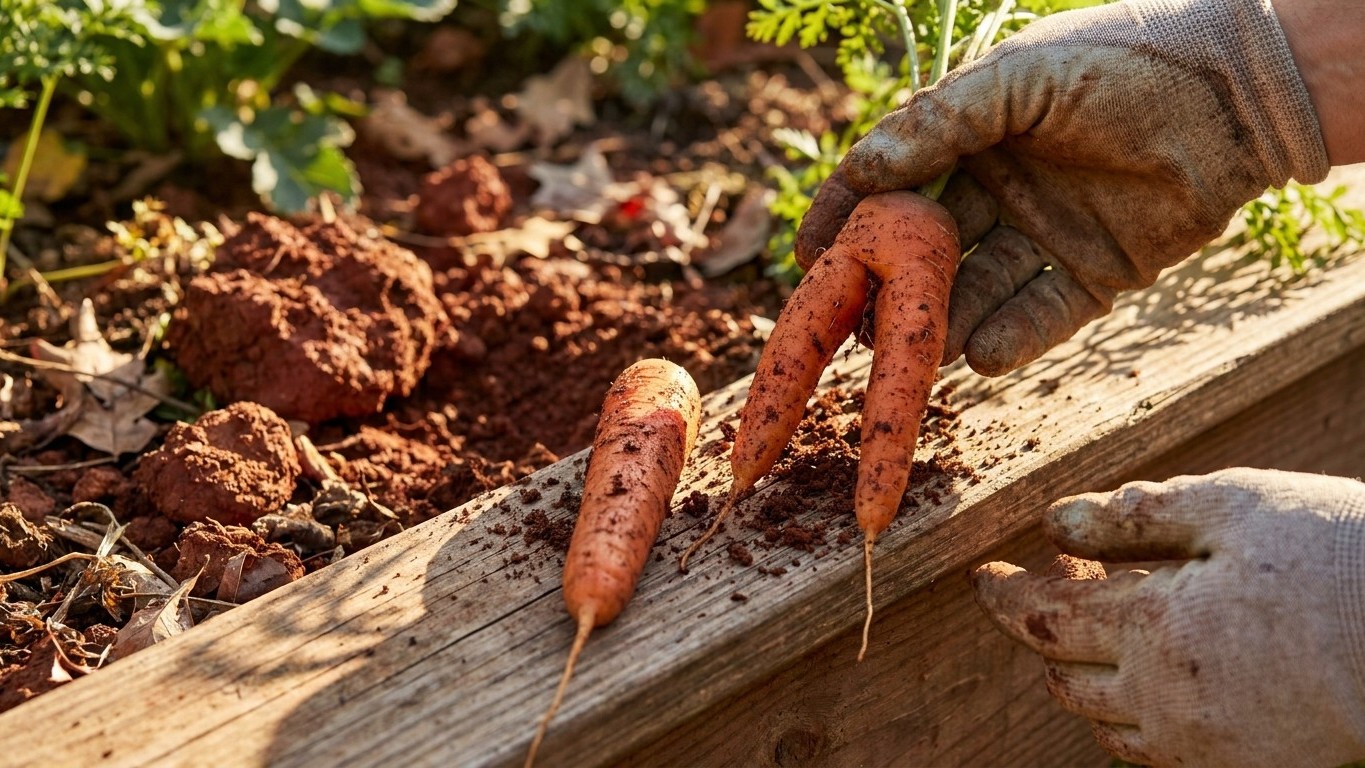

Pennsylvania’s benchmark soil, the Hazleton series, runs 46 percent sand, 42 percent silt and 12 percent clay, a loam light enough that carrots usually grow straight instead of forking. The catch is a strongly acid surface, pH near 4.6, and any hardpan, buried rock or compaction will still split a taproot no matter how sandy the mix reads on paper. Compost worked in deep, a double-dug bed or a raised frame answers both problems, and neither takes more than a weekend to set up.
The short answer
The USDA lists the Hazleton series as the soil that represents Pennsylvania under its State Soils programme, and its numbers describe a fairly forgiving mix. The surface horizon runs 46 percent sand, 42 percent silt and 12 percent clay, a texture that lands squarely in loam territory rather than the heavy clay that ruins carrot roots elsewhere. It carries about 3.0 percent organic matter and is classed as well drained, and it belongs to the Inceptisol order, a young soil group that hasn’t had time to build the dense, layered horizons older soils develop. Surface pH sits around 4.6, which USDA records as strongly acid.
Set that texture against what Utah State University Extension says a carrot actually needs: deep, sandy, well-drained ground rich in organic matter, because heavy or rocky soil forces the taproot to split around whatever it hits and fork. At 12 percent clay and well drained by USDA’s own classification, the Hazleton profile sits closer to what a carrot wants than what ruins it. A root growing in ground built like this should run straight down rather than branch, provided nothing underneath, a plow pan, a rock layer, a patch of construction fill, gets in its way. The acidity is the bigger flag: soil at pH 4.6 sits well below the range most vegetable crops prefer, and it can slow germination and stunt growth even where the texture is fine.
The practical answer for anyone gardening in ground close to that description is that forking isn’t the default risk here, texture-wise, but the low pH still means lime and compost belong in the bed before seed goes in. Where the local ground runs heavier than the state figures suggest, the same Extension guidance applies as it would anywhere else: work in plenty of compost, double dig to break up compaction below the topsoil, or skip the argument entirely and build a raised bed filled with a loose, sandy mix.
None of this is a diagnosis of any one backyard. A state spans hundreds of mapped soil series, and the Hazleton profile is simply the one USDA names as representative, not a survey of every plot within the state line. River bottoms tend to run sandier and drain faster; low spots and old pasture ground tend to run heavier and hold water longer; anywhere a builder has scraped, graded or filled will bear little resemblance to any mapped series at all. Treat these numbers as a sense of what the regional ground tends to do, then go check the actual bed.
The test that settles it in your own garden
The state’s representative soil is a starting point, not a verdict on any single bed. The only way to know whether carrots will fork in a particular patch is to look at that patch directly, before a single seed goes into the ground.
- Dig a hole where the row will go, as deep as the shovel allows, and look at what comes up. A carrot needs open ground for its full length, so a layer of rock, hardpan or heavy clay partway down is more likely to cause forking than whatever the topsoil looks like.
- Sift through what the shovel turned over and check for stones and debris. Gravel, construction rubble or a dense mat of old roots will deflect a growing tip sideways, and the root branches around the obstruction rather than pushing through it.
- Wet a handful of soil and rub it between your fingers. Soil that feels gritty and falls apart is sandy; soil that rolls into a smooth, sticky ribbon runs heavy in clay; something in between that holds a loose shape and crumbles is closer to loam, the texture carrots prefer.
- Watch how water moves through the bed after a hard rain or a heavy watering. Ground that puddles and stays wet for a long stretch is telling you drainage is poor; ground that darkens, then dries at a normal pace, is behaving the way well-drained soil should.
- Compare what’s found to the state figures above. Sand and loam with no obstruction below suggests the bed will behave close to what the Hazleton numbers describe. Clay, rock or standing water means treating the ground as a heavy-soil case and planning compost, double digging or a raised bed before sowing.
What goes wrong here
Even where the ground matches the state’s texture on paper, a few things reliably go wrong with carrots grown in Pennsylvania conditions.
- Forking in heavier pockets. Not every yard sits on the sandy-loam mix the state figures describe; low ground, old pasture and clay pockets are common, and a taproot hitting compacted or heavy clay will split rather than run straight. The fix is the one Utah State University Extension gives for any heavy ground: work in plenty of compost, double dig the bed to loosen soil well below where the root will travel, or build a raised bed filled with a loose, sandy mix instead of fighting the native clay.
- Poor germination during a hot, dry stretch. Carrot seed is small and sits close to the surface, and a crust can form on acidic, organic-poor ground once it dries out between waterings, blocking the seedling before it ever breaks through. Keeping the top inch of the row consistently damp until seedlings appear, rather than letting it dry out and re-wet, is the practical fix, since carrots are sown in place with no transplant to fall back on if the first sowing fails.
- Splitting from uneven watering later in the season. A root that grows through a dry spell, then gets a sudden heavy soak, tends to crack along its length as it swells too fast. A steady, even watering schedule carried from seeding through harvest, rather than long dry gaps followed by a flood, keeps the root growing at a consistent rate.
- Stunted growth from low pH. Ground running strongly acid, the way the state’s representative soil does, sits well below what most vegetable crops want, and carrots grown in that condition without correction can come up short and pale even when the texture is otherwise fine. Working lime into the bed ahead of sowing, based on an actual soil test rather than a guess, brings the pH up before the roots start growing.
Common questions
Does sandy soil guarantee straight carrots in Pennsylvania?
No. Texture matters, but Utah State University Extension is clear that rocky or compacted layers below the surface cause forking regardless of how sandy the topsoil looks. A bed can test out sandy and loamy on top and still have a buried obstruction that splits every root that reaches it.
How long do carrots take to mature once they’re seeded?
Carrots are sown directly in the ground rather than transplanted, so there’s no separate transplant date to count from. Utah State University Extension puts typical maturity at 70 to 100 days from seeding to harvest, with that window running from the day the seed goes into the soil.
Should I test my own soil’s pH before planting?
Yes. The state’s representative soil runs strongly acid at a surface pH around 4.6, and while that figure describes a mapped series rather than any individual yard, it’s a reasonable signal that acidity is worth checking locally. A soil test gives an actual number for the bed in question, which is what decides how much lime, if any, to work in.
What’s the fastest fix for heavy clay soil?
Building a raised bed filled with a loose, sandy growing mix sidesteps the problem entirely, since the roots never have to push through the native clay. Where that’s not practical, working in generous amounts of compost and double digging to loosen the ground below the topsoil is the fix Utah State University Extension recommends for heavy or rocky soil.