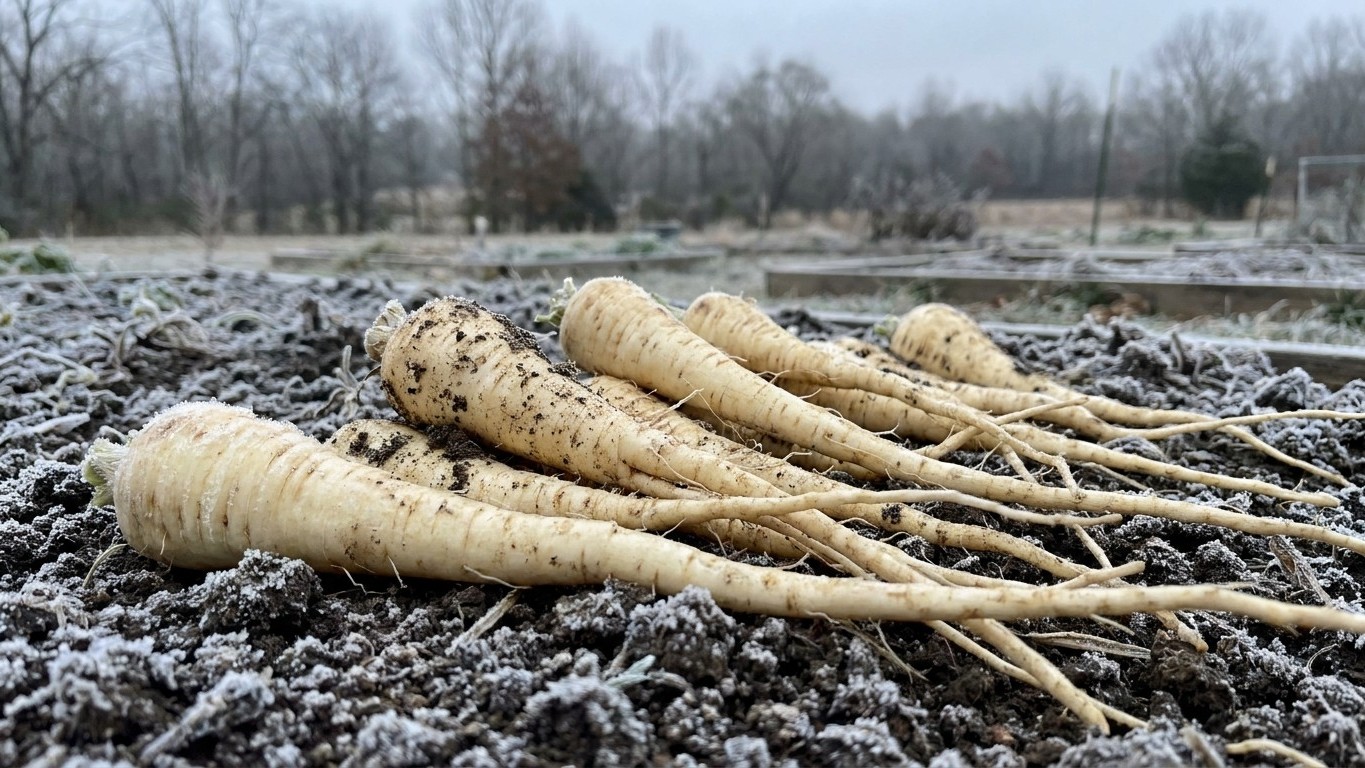

Yes, parsnips grown in Quebec have every reason to sweeten. The province delivers the kind of prolonged, deep-freeze winter that turns a parsnip’s stored starch into sugar, and its frost-free season runs long enough to carry a spring-sown crop through the full 100 to 120 days it needs before that cold sets in. The real question isn’t whether Quebec can grow a sweet parsnip. It’s whether the timing and the soil cooperate.
The short answer
The number that settles this is the mean daily minimum of Quebec’s coldest month: 6.7°F, recorded at the Montreal/St-Hubert reference station under Environment and Climate Change Canada’s 1981-2010 climate normals. That’s not a record low pulled from one freak night. It’s the average low the region sees, night after night, in the heart of winter.
That figure describes frost exposure, which is a different thing entirely from a hardiness zone rating. A zone number tells you whether a perennial survives the winter. It says nothing about how many weeks a root vegetable sits below freezing while still in the ground, and that’s exactly the detail a parsnip cares about. A coldest-month minimum of 6.7°F points to sustained, hard cold rather than a token frost followed by a quick thaw. Sustained cold is what forces a parsnip root to convert its starch reserves into sugar, according to Utah State University Extension, which describes the crop as tasting best “after several weeks of cool, frosty weather.”
So a Quebec-grown parsnip has the winter conditions it needs to sweeten, not just to size up. That distinction matters because plenty of gardens produce a fine-looking parsnip that never develops the flavor gardeners expect. The difference isn’t the variety or the soil. It’s whether the root spent real weeks exposed to frost before it came out of the ground. Pull the crop the day after the first light freeze and you’ve grown a parsnip. Leave it another month, through a stretch of nights near or below 10°F, and you’ve grown a sweet one.
None of this happens automatically, though. A gardener still has to time the sowing correctly, get the roots through a full growing season without forking, and then resist the urge to harvest too early once autumn arrives. Quebec supplies the cold. The rest is technique.
Does the season fit?
Line up the dates and the arithmetic works in the grower’s favor, with room to spare.
- The average last spring frost at the Montreal/St-Hubert station falls on May 6. Sowing 2 to 3 weeks ahead of that puts seed in the ground around mid to late April.
- Parsnip seed is slow. Germination takes 14 to 21 days, so don’t expect green rows until roughly the first or second week of May. Resist digging up bare soil in the meantime and re-sowing; it’s usually still coming.
- From that seeding date, the crop needs 100 to 120 days to mature. Counting forward from mid to late April, that lands root maturity somewhere between late July and mid August.
- The average first fall frost at the same station is October 5. That leaves roughly 6 to 10 weeks between a mature root and the season’s first freeze, well past what the crop technically needs to finish sizing.
- Because sweetening depends on frost exposure rather than maturity date alone, the smart move is to leave the roots in the ground through October and into the weeks that follow, pulling them after several hard frosts rather than the first one.
The margin here is generous, not tight. Even accounting for the fact that both frost dates are averages, meaning the true frost falls later than the stated date in roughly half of all years, there’s enough cushion built into a 152-day frost-free window to absorb a late spring or an early cold snap without threatening the harvest. The bigger risk isn’t running out of season. It’s pulling the crop the moment it looks ready instead of waiting for the cold to do its work.
What goes wrong here
- Forked roots from heavy or stony ground. A taproot meeting a rock or a dense clay layer splits rather than growing straight down. Utah State University Extension recommends deep, sandy soil for parsnips and says heavy soil must be double dug before sowing, loosened well beyond the depth the root will eventually reach.
- Forked roots from overwatering. This is a separate cause from soil texture, not a variation on it. Excess moisture encourages the root to branch instead of driving straight down, so even a well-worked bed can produce forked parsnips if it’s kept consistently soggy. Even, moderate watering beats a heavy soak-and-dry cycle.
- A season that runs out before the roots mature. This isn’t the Quebec grower’s biggest worry given the length of the frost-free window here, but a delayed sowing, pushed to late May or June, can eat into the margin fast. Sow as soon as the soil is workable after the last frost risk has passed rather than waiting for warmer, more comfortable planting weather.
- Pulling the crop before the cold has done its job. A winter cold enough to sweeten parsnips does nothing for a root that’s already sitting in the root cellar. The failure isn’t climate here, since Quebec’s winter is more than cold enough. It’s timing: harvesting at first frost instead of waiting through several weeks of it.
A safety note about parsnip sap
North Carolina Extension Gardener Plant Toolbox puts it plainly: “All parts of this plant contain furocoumarins which can make skin sensitive to light causing burns so be sure to wear gloves, long sleeves and long pants when dealing with it.” Not just the leafy tops. All parts.
The mechanism is what makes this catch people off guard. Furocoumarin compounds in the sap don’t cause a burn on their own. The reaction needs sap on the skin and then sunlight hitting that same patch of skin, a combination called phytophotodermatitis. That’s why it shows up on a bright day of pulling tops or hauling roots out of the bed, why the mark doesn’t appear until hours after the exposure, and why the protection that matters is what you wear while handling the plant, not a scrub-down afterward. Washing the skin later doesn’t undo contact that’s already happened under sunlight. Gloves, long sleeves, and long pants during harvest are what actually prevent it.
Checking this against your own county
A single reference station can’t speak for every microclimate across Quebec. Frost dates run later in the Laurentians and along the St. Lawrence’s northern shore than they do around Montreal, and soil texture shifts from one county to the next in ways that change how deep you need to dig before sowing. Before committing a bed to parsnips, check your local conditions against Quebec’s Ministère de l’Agriculture, des Pêcheries et de l’Alimentation (MAPAQ), which publishes region-specific growing guidance for the province at mapaq.gouv.qc.ca. A local agronome or extension contact can confirm whether your particular soil needs the double-digging Utah State recommends for heavy ground, and whether your frost window runs tighter or looser than the Montreal-area averages used here.
Common questions
Can I harvest parsnips right after the first fall frost?
You can, but the flavor won’t be at its best yet. The sweetening process needs several weeks of frosty weather, not a single overnight dip, so waiting through multiple frosts produces a noticeably sweeter root than pulling at the first sign of cold.
Do parsnips need to be transplanted, or sown directly?
Sown directly, always. Parsnips develop a long taproot that doesn’t tolerate transplanting well, so seed goes straight into the bed where the crop will finish growing.
Why did my parsnip roots come out forked?
Two separate causes produce the same result. Heavy or stony soil deflects the taproot as it grows down, and so does consistently overwatered ground. Loosening the bed well beyond root depth addresses the first; watering evenly rather than heavily addresses the second.
Is it safe to eat parsnip leaves?
The safety concern here isn’t about eating the plant. It’s about skin contact with the sap under sunlight, which can cause burns on any part of the plant, not just the foliage. Gloves and covered skin during handling are the protection that matters.