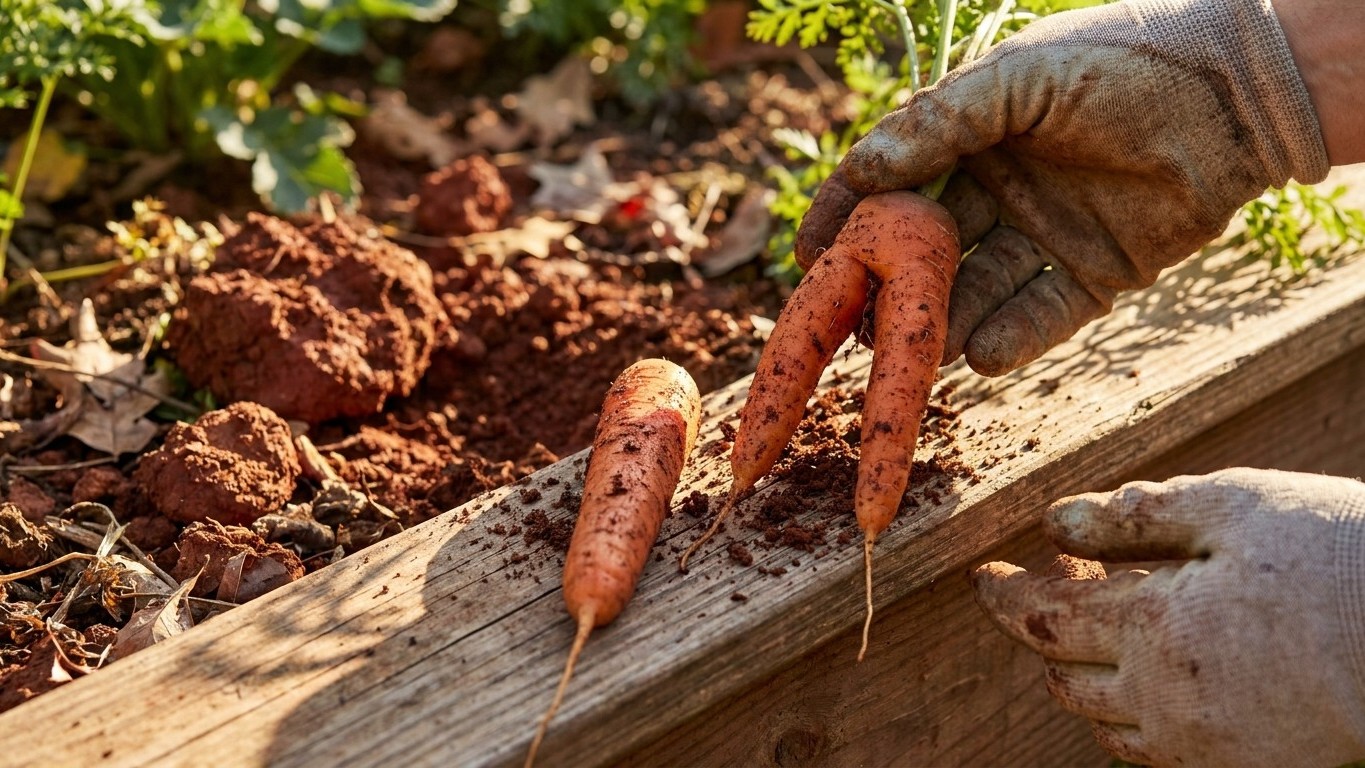

South Dakota’s official state soil, the Houdek series, is a loam-to-silt Mollisol that runs well drained with a surface pH near neutral. That texture profile sits far closer to what a carrot wants than a sticky clay pan does, so the short answer is that carrots are unlikely to fork badly in ground that matches this series. But the state soil is a benchmark, not your backyard, and the real test happens with a shovel in your own bed.
The short answer
The Houdek series became South Dakota’s legal state soil in 1990, part of the USDA NRCS State Soils program that gives each state a representative profile. It’s a Mollisol, the deep, dark prairie soil type that built the Corn Belt, and its surface horizon runs 38 percent sand, 22 percent clay and 40 percent silt, which puts it in loam-to-silt territory rather than heavy clay. Organic matter sits around 3.0 percent, and drainage is classed as well drained. The surface pH averages about 6.7, close to neutral.
Carrots, according to Utah State University Extension, want deep, sandy, well-drained soil rich in organic matter. Heavy or rocky ground is what makes a root fork, splitting into two or three legs as it pushes around an obstruction or compacted layer instead of driving straight down. Judged against that standard, Houdek-type soil is a reasonable starting point. The sand and silt fractions together outweigh the clay by a wide margin, and “well drained” means water isn’t sitting around root tips inviting rot or forcing shallow, crooked growth. That doesn’t mean the soil is carrot-ready out of the bag. A 22 percent clay content can still compact if it’s worked while wet, and 3.0 percent organic matter is respectable but not the loose, friable tilth a carrot bed benefits from.
The practical fix, per Utah State’s guidance, is the same one used on any soil that leans heavy: work in plenty of compost and double dig the bed so the root has a clear, loosened path down through at least a foot of ground. If your actual garden runs stonier or denser than this profile, a raised bed filled with a loose, sifted mix sidesteps the problem entirely rather than fighting it season after season.
Why this figure isn’t your figure
South Dakota spans hundreds of mapped soil series, and Houdek represents an average of 90 sampled components across the state, not a measurement of any one garden. River bottoms tend to run sandier and looser. Hill country and glacial till areas can carry more rock and clay than the state average. And any lot a builder has scraped, graded or filled during construction may bear no resemblance to native soil at all, sometimes stacking subsoil clay right where the topsoil used to be. Treat the Houdek numbers as a regional tendency, useful for guessing whether your area runs toward clay or sand, and nothing more specific than that.
| Property | Houdek series (surface) | What carrots prefer |
|---|---|---|
| Sand | 38% | High sand content |
| Clay | 22% | Low clay content |
| Silt | 40% | Moderate is workable |
| Organic matter | about 3.0% | Rich in organic matter |
| Drainage | Well drained | Well drained |
The test that settles it in your own garden
State-level soil data can’t tell you what’s under your own carrot bed. These steps will.
- Dig a hole in the bed you plan to plant, going down at least 12 to 14 inches, the depth a straight carrot root needs to grow without hitting resistance. Note exactly where the shovel starts fighting you.
- Look at what you pulled out. A hard, pale layer partway down, a shelf of gravel, or a scatter of fist-sized stones all signal trouble. Carrots fork around anything solid in their path, so a rock at 6 inches will split a root that would otherwise run straight.
- Grab a moist handful and squeeze it. Soil that forms a slick ribbon and holds its shape is heavy on clay. Soil that won’t hold together at all is sandy. Soil that clumps briefly, then crumbles when you poke it, is loam, and loam is the easiest texture for carrots to push through.
- Run a simple drainage check: dig a hole about a foot deep, fill it with water, and time how long it takes to disappear. Water gone within a few hours points to decent drainage. Water still standing the next morning means the bed holds moisture the way heavy or compacted soil does, and that’s a condition worth correcting before you sow.
- Repeat the dig-and-feel check in more than one spot if the bed is more than a few feet across. Soil texture can change within the same garden, especially near a foundation, a driveway, or a spot where fill dirt was added at some point.
What goes wrong here
- Forking in heavy or compacted ground. Clay-heavy or compacted soil forces the taproot to split as it meets resistance instead of driving straight down. The remedy is the one Utah State recommends for any heavy soil: work in generous compost and double dig the bed to loosen at least a foot of depth, or skip the fight and build a raised bed filled with a loose mix.
- Stony soil deflecting the root. Even soil that’s otherwise loamy can carry enough small stones to knock a carrot off course. Sifting the top foot of a bed before sowing, or committing to a raised bed, removes the obstacles the root would otherwise grow around.
- Poor germination during a hot, dry stretch. Carrot seed is small and needs steady surface moisture to sprout; it can take two to three weeks even under good conditions, and a hot dry spell right after sowing will dry out that thin seed coat before it germinates. Light, frequent watering and a thin mulch layer over the row help keep the surface from crusting and drying between waterings.
- Splitting from uneven watering. A dry spell followed by a heavy soak makes the root take up water too fast, and the outer layer cracks under the pressure. A steady watering schedule, rather than feast-or-famine watering, keeps growth even and the skin intact.
Common questions
Does South Dakota soil naturally suit carrots?
The state soil, Houdek, leans loam to silt with well-drained conditions, which favors carrots more than a heavy clay soil would. It still isn’t the sandy, loose bed carrots grow best in without amendment, so compost and loosening the top foot of soil remain worthwhile.
What if my soil test shows more clay than the Houdek numbers?
Follow Utah State University Extension’s guidance for heavy soil: add plenty of compost and double dig before sowing, or build a raised bed filled with a looser mix if the native ground is too dense to work economically.
Should I always build a raised bed for carrots in South Dakota?
Not necessarily. If your own dig-and-feel test shows loose, stone-free loam similar to the Houdek profile, in-ground beds with added compost should work fine. A raised bed becomes the more reliable choice once you find compacted clay, a rocky layer, or standing water in your drainage test.
How long do carrots take to mature from seed?
Carrots are sown directly in place, never transplanted, and typically need 70 to 100 days counted from the day the seed goes into the ground, not from any later stage of growth.