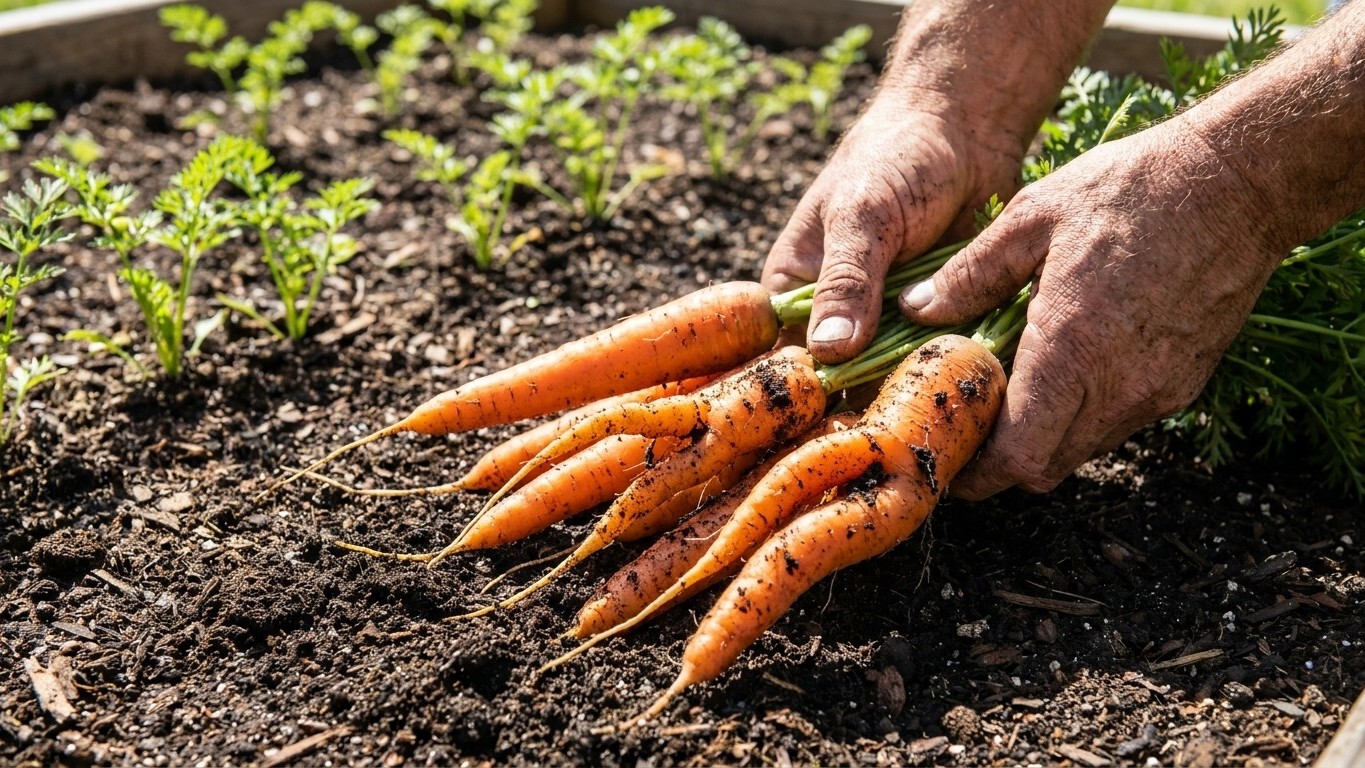

In Tennessee, carrots go into the ground while the soil is still cool, weeks before the last spring frost knocks off the calendar, carrot seed germinates in chilly dirt and a young carrot seedling shrugs off a light freeze without complaint. But the date on the wall isn’t what decides whether that seed turns into a straight, sweet root or a stunted, forked one. What decides it is sitting under your boots right now: the clay content of your bed.
The short answer
The soil that USDA lists as representative of Tennessee is the Dickson series, an Ultisol, an old, heavily weathered, leached soil that runs naturally acid and short on nutrients. Its surface horizon comes in at about pH 5.0, which is strongly acid, with a texture of 11 percent sand, 20 percent clay and 68 percent silt. That makes it a silt loam, and it carries only around 1.5 percent organic matter. Drainage is rated moderately well drained, meaning water moves through it, but not quickly.
None of that is disqualifying for a vegetable garden. It is, however, a fair warning for a root crop. Carrots want deep, sandy, well-drained soil that’s rich in organic matter, according to Utah State University Extension. Push a carrot root through ground with real clay content and any resistance, from a compacted layer to a stray rock, and the root will split, bend, or fork rather than push through cleanly. A silt loam sitting at 20 percent clay and only 1.5 percent organic matter is not the loose, friable bed a carrot wants, it’s closer to the ground that makes carrots fork.
The fix isn’t a different variety. Utah State University Extension is blunt about this: heavy soil needs plenty of compost worked in, along with double digging to break up the profile a foot or more down, loosening compaction and giving the taproot a clear path. Where the native ground is too shallow, too rocky, or too compacted to fix with a shovel and a wheelbarrow of compost, building a raised bed filled with a looser, sandier mix sidesteps the problem entirely rather than fighting it season after season.
All of that said, treat the Dickson series as a starting point and nothing more. Tennessee spans hundreds of soil series, from river-bottom sand to hillside clay to whatever fill dirt a builder pushed around a new subdivision. The Dickson profile tells you what the region’s ground tends to do, hold onto water, run acid, resist a taproot, but it says nothing definitive about the twelve-by-twelve bed behind your house. That’s a question only your own dirt can answer.
The test that settles it in your own garden
State averages are a starting point, not a verdict. The only way to know what your carrots are actually growing into is to go outside and look, and none of the following requires a lab.
- Dig a hole where the bed will go, at least a foot deep. Note whether the shovel meets resistance early, whether you hit a hardpan layer, and whether the sides of the hole stay loose or come away in a dense, sticky clump.
- Check the depth of loose, workable soil before you hit clay, rock, or old fill. Carrots need a clear run of a foot or more; a shallow layer over a hard subsoil will produce short, blunt, or forked roots no matter how good the top few inches look.
- Look for stones as you sift through the dug soil. Anything bigger than a pea sitting in the root zone is a likely fork point, pull them out by hand rather than hoping the root grows around them.
- Feel the texture with wet soil rolled between your fingers. Grit that won’t hold a shape is sandy; a smooth, sticky ribbon that holds together is clay-heavy; something in between, silky rather than gritty or sticky, leans toward loam or silt.
- Watch how water drains. Fill the hole you dug with water and time how long it takes to disappear. Water that sits for hours points to a compacted or clay-heavy profile that needs amending or a raised bed; water that vanishes almost immediately suggests sandy, fast-draining ground that will need more frequent watering and more organic matter to hold moisture.
What goes wrong here
Most carrot failures in Tennessee gardens trace back to one of three predictable problems, and each has a fix that doesn’t involve starting over.
- Forking in heavy ground. A taproot meeting clay, compaction, or buried rock will split into two or three legs instead of growing straight down. Utah State University Extension’s answer is to work in generous compost and double dig the bed before sowing, breaking up the dense layer the root would otherwise hit; where the native soil is too shallow or rocky to fix that way, a raised bed filled with looser soil solves it for good.
- Poor germination during a hot spell. Carrot seed is slow to sprout even in ideal conditions, and a stretch of hot, dry weather right after sowing can dry out the seedbed before the seed ever cracks. Keeping the surface consistently moist, with a light mulch or daily light watering until seedlings appear, keeps the germination clock from stalling out.
- Splitting from uneven water. A dry spell followed by a heavy soak makes the root swell faster than its skin can stretch, cracking it open. Even, regular watering on a set schedule, rather than letting the bed dry hard between waterings, keeps growth steady enough that the root doesn’t split.
Common questions
Do carrots need to be transplanted after starting indoors?
No. Carrots are sown directly in the ground where they’ll grow. There’s no transplanting step, which means the 70 to 100 days carrots typically take to mature are counted from the day the seed goes into the soil, not from any later date.
Is the Dickson series the exact soil in my yard?
Almost certainly not, at least not exactly. Dickson is the soil series USDA lists as representative of Tennessee, but the state contains hundreds of distinct soil series, and local conditions such as a river bottom, a hillside, or disturbed fill from construction can look nothing like it. Use the dig-and-feel test on your own bed rather than assuming the state figures apply directly.
Can I just add sand to heavy clay instead of compost?
Utah State University Extension’s guidance points to compost and double digging as the fix for heavy soil, not sand alone. Mixing sand into clay without enough organic matter can create a dense, concrete-like texture rather than loosening it, so compost worked in through a double-dug bed, or a raised bed with a looser mix, are the more reliable routes.
Why does the surface pH of 5.0 matter for carrots?
A pH near 5.0, which USDA records as strongly acid for the Dickson series’ surface horizon, sits outside the range most root vegetables prefer for nutrient uptake. That figure describes the mapped surface of this particular series, not a measurement of any single garden bed, so a soil test of your own ground is the only way to know whether liming or another amendment is actually needed before you sow.