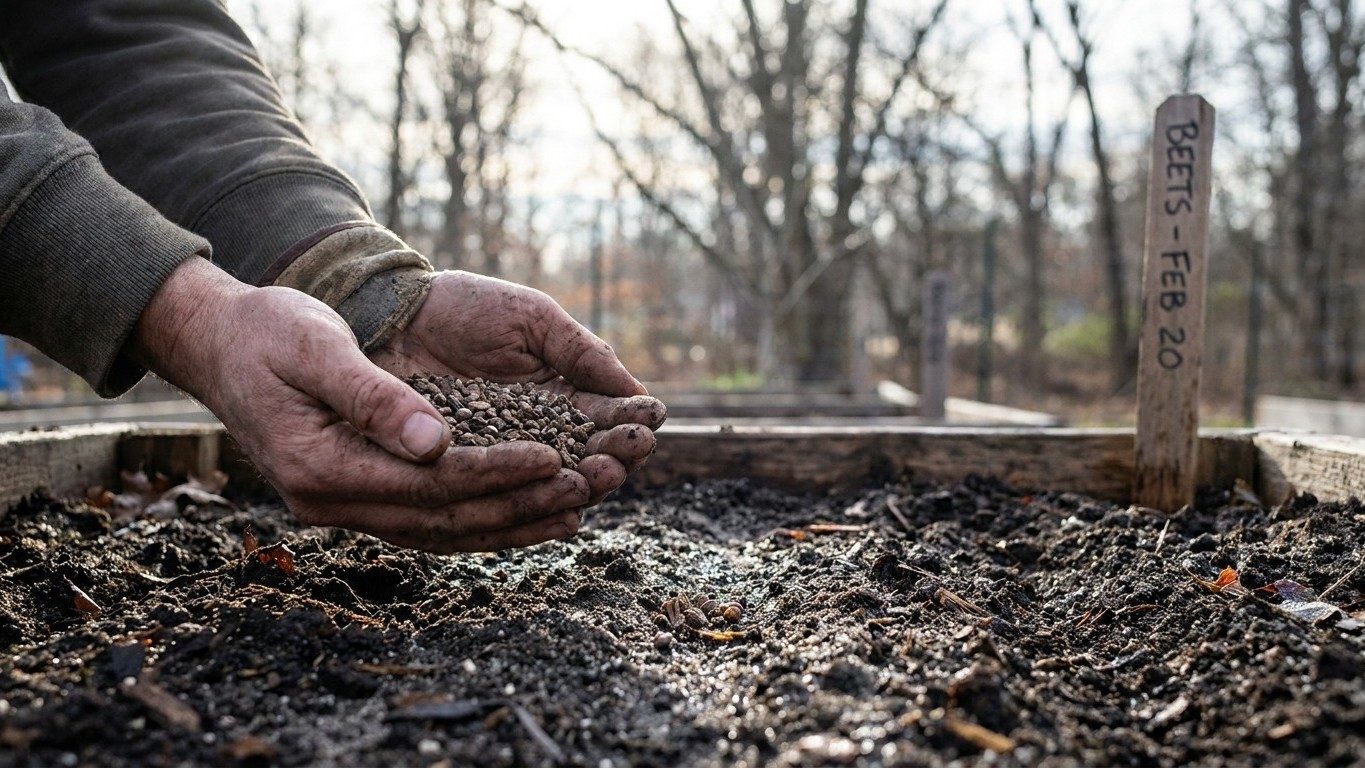

Beet seed goes into Utah ground about two to three weeks before the last spring frost. For the Salt Lake City reference station, that frost date falls somewhere between April 12 and April 29 depending on the year, which puts most valley sowing windows in late March through mid-April. Higher, colder parts of the state push that later; warmer southern pockets push it earlier.
The short answer
USDA lists the Mivida series as the soil that represents Utah, and it tells you something useful before you ever pick up a rake. Mivida is an Aridisol, the soil order that forms under dry climates and tends to run alkaline and carry salts near the surface. The representative surface horizon runs 72 percent sand, 9 percent clay and 19 percent silt, with organic matter around 1.5 percent and a surface pH near 8.1. That’s a fast-draining, low-fertility, alkaline profile, and it matters because beets have a specific ask: Utah State University Extension describes the crop as wanting deep, sandy, well-drained soil rich in organic matter. The texture side of that lines up with Mivida reasonably well. The organic matter side doesn’t. A garden bed sitting on ground like this needs a compost boost, applied at no more than 1 inch of composted organic matter per 100 square feet, because beets planted straight into thin, sandy soil with 1.5 percent organic matter will dry out fast and struggle to size up.
The heat side of the equation is where the record gets thinner. The exact count of days per year the reference city spends above 90 F isn’t published in the data behind this page, so it won’t be guessed at here. What is documented is the mechanism that matters more than any single day-count: heat above 85 F combined with water stress is what turns a beet root woody. That’s a two-part trigger, not a temperature alone, and it means the soil’s drainage class does as much work as the thermometer. Well-drained, sandy ground like Mivida sheds water quickly, so on a hot stretch a bed that isn’t watered on a tight schedule can hit that combined threshold faster than a heavier clay soil would.
None of this is a diagnosis for any one backyard. Utah spans hundreds of mapped soil series, and Mivida is simply the one USDA’s State Soils program flags as representative of the state as a whole. A garden a few miles away, especially one near a river bottom, up a bench, or on ground a builder graded and refilled, can run entirely different numbers. Treat the Mivida figures as a starting point for what the region’s soil tends to do, then confirm the actual texture, drainage and pH with a soil test before amending anything.
The six weeks that decide it here
Sowing beets two to three weeks ahead of the last frost means the first six weeks of that seedling’s life land inside Utah’s spring, specifically the stretch running from the earlier end of the April 12 to April 29 frost window through late May in most valley locations. Because the state’s representative soil is classified as an Aridisol, a soil order defined by forming under dry conditions, the spring that plays out over those six weeks tends to run on the dry side rather than delivering steady, soaking rain. That’s the detail that determines where the bolting risk sits.
Utah State University Extension is specific about the mechanism: water stress during the first six weeks after sowing causes beets to bolt, throwing energy into a flower stalk instead of the root. That’s a different failure than the woodiness caused by later heat, and the two shouldn’t be lumped together as “just keep it watered,” because the timing is what makes each one happen. Bolting is set early, while the plant is still small and the root hasn’t started sizing up. Woodiness is set later, once the plant is established and heat plus a dry spell hit at the same time.
In a state whose soil tends to run sandy and fast-draining, and whose spring tends to run dry rather than reliably wet, the early six-week window is exactly the stretch where a gardener has to supply water on a schedule rather than waiting for rain to do it. A sandy bed that goes even a week without irrigation during that period, right after the seedlings emerge, is doing the two things beets dislike most at once: drying out and doing it in soil that has little organic matter to hold what moisture does fall. That combination is what pushes a crop toward bolting before it’s had six weeks to establish a root worth harvesting.
What goes wrong here
- Sandy soil drains before roots can use the water. With Mivida-type ground running 72 percent sand and well drained, a normal watering can pass through the root zone before beet seedlings pull much of it. The fix is shorter, more frequent watering intervals during the first six weeks rather than a single deep soak once a week, especially since that six-week window is the exact period USU Extension ties to bolting from water stress.
- Low organic matter starves the bed early. At roughly 1.5 percent organic matter, the representative state soil holds little reserve fertility or moisture. Working in composted organic matter before sowing, capped at 1 inch per 100 square feet per USU Extension’s guidance, gives the bed more capacity to buffer dry spells without over-amending sandy ground that doesn’t need heavy organic loading.
- Alkaline pH limits nutrient uptake. A surface pH near 8.1 sits well above neutral, and alkaline soil can tie up nutrients beets need to grow evenly. A soil test before sowing, rather than assuming the state average applies, tells a gardener whether amendment beyond compost is worth doing on their specific bed.
- Heat arriving on top of a dry stretch turns roots woody. Once beets are established, temperatures above 85 F combined with water stress cause woodiness, a separate failure from early bolting. Watering consistently as the plant matures, not just in the first six weeks, is what keeps a root from turning fibrous before it reaches full size.
- Elevation shifts the whole calendar. The April 12 to April 29 frost window comes from a Salt Lake-area station, and most of Utah sits higher and colder than that valley, while parts of the south run milder. Using the valley date without adjusting for local elevation can mean sowing into ground that’s still due for a hard freeze.
Common questions
How long do beets take to mature after sowing in Utah?
Beets are direct-seeded, not transplanted, so the maturity clock starts the day seed goes into the ground rather than from a seedling’s move outdoors. Depending on the variety, that runs roughly 60 to 80 days from seeding to harvest, which is worth counting forward from whatever local sowing date a gardener settles on.
Which beet varieties does Utah State University Extension recommend?
USU Extension’s beet guidance names several varieties suited to home gardens, but it doesn’t tie any single one of them to a particular season, color or intended use. Rather than guessing at those details, it’s worth checking current USU Extension materials directly before choosing seed, since variety performance can shift with local conditions in ways a general list won’t capture.
Do I need to adjust the sowing date if my garden sits above Salt Lake City’s elevation?
Almost certainly yes. The April 12 to April 29 window comes from a valley station, and Utah’s higher ground runs colder with a later last frost. The published data behind this page doesn’t include a separate frost date for higher elevations, so the safest approach is checking local frost records for the specific area rather than applying the valley date statewide.
Can beets be sown again in late summer for a fall harvest in Utah?
A specific late-summer sowing date for Utah isn’t published in the data used for this page. As a general approach, counting backward from the area’s average first fall frost by the variety’s days-to-maturity, plus a buffer for slowing fall growth, is the standard way growers plan a second sowing, though local frost timing should be confirmed rather than assumed.