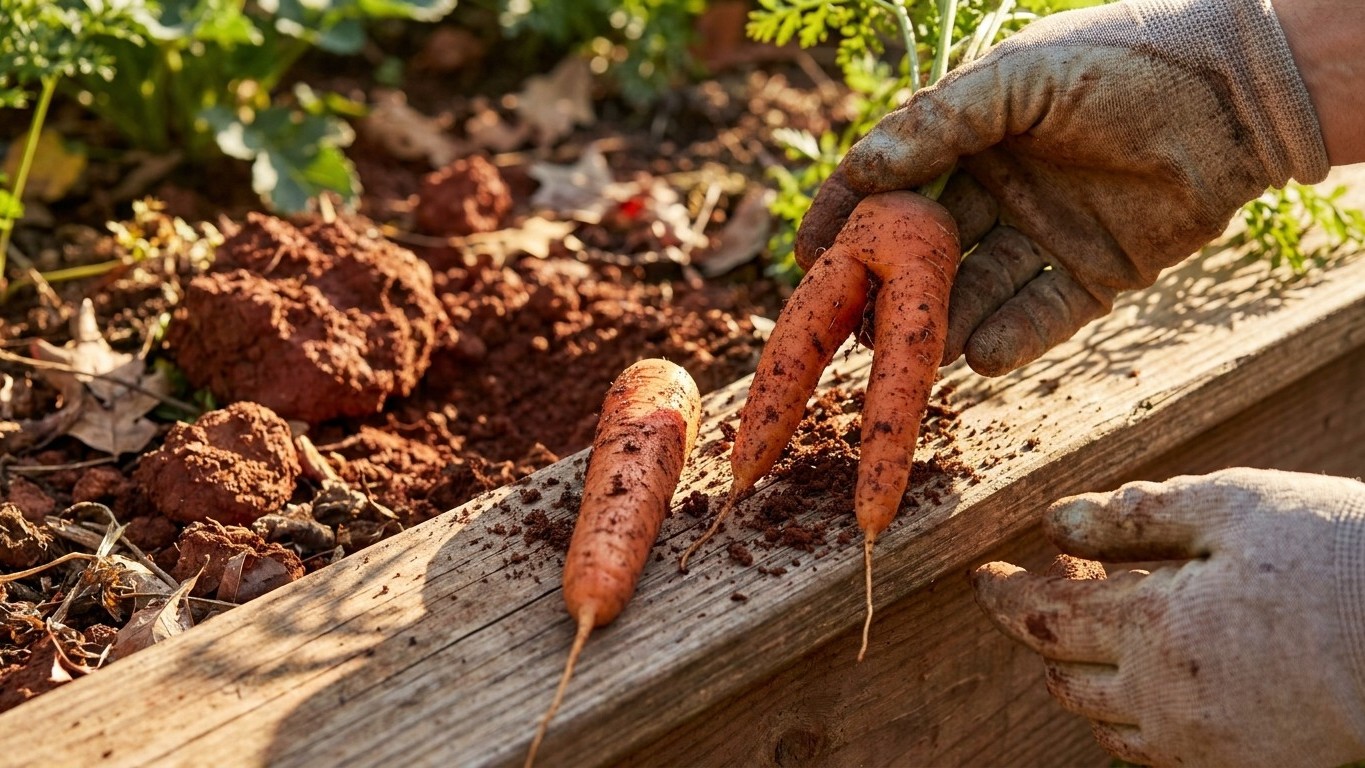

Probably not, and that’s the surprise. The soil USDA lists as representative of Utah is sandy and well drained, the opposite of the dense, rocky ground that twists a carrot root into a fork. But sandy doesn’t mean easy. Low organic matter and high alkalinity bring their own problems, and every Utah garden sits on a different soil series than the one in the state record.
The short answer
The soil USDA records as representative of Utah is the Mivida series, classified as an Aridisol, the dry-climate soil order that tends toward alkaline and often carries salts near the surface. The surface horizon runs 72 percent sand, 9 percent clay and 19 percent silt, with organic matter around 1.5 percent and a drainage class of well drained. Surface pH sits around 8.1, on the alkaline side.
That texture is good news for forking specifically. Utah State University Extension is direct about the mechanism: carrots want deep, sandy, well-drained ground rich in organic matter, and it’s heavy or rocky soil that forces the taproot to split around an obstruction or dense layer. A 9 percent clay figure isn’t heavy soil. A well-drained rating isn’t the compacted, waterlogged profile that stalls a taproot and sends it sideways. On texture and drainage alone, the Mivida series leans toward the conditions Extension describes as carrot-friendly, not the ones that cause forking.
The catch is organic matter. At roughly 1.5 percent, this surface horizon is thin on the material carrots actually feed and root through easily. Extension’s fix for difficult ground, compost worked in generously and double digging to loosen the profile below the topsoil, still applies here even though the failure mode is different. You’re not digging out clay and rock. You’re building depth and food into a sandy base that drains fast but doesn’t hold much for a root to work with. A raised bed filled with a loamy, compost-rich mix sidesteps the whole question and adds the depth a straight taproot needs regardless of what’s underneath.
None of this is a verdict on your yard. Utah spans hundreds of mapped soil series, and the Mivida profile is a statewide reference point drawn from surveyed components, not a measurement of any single dug bed. A river bottom, a foothill lot, or ground a builder scraped and refilled can carry a completely different texture, pH and organic-matter count than the state figures above. Treat this section as the starting line, not the finish. What your own soil does, that requires a look with a shovel.
The test that settles it in your own garden
State soil surveys describe averages across mapped components. Your raised bed, your side yard, and your neighbor’s plot down the block can each behave differently, so the only way to know if your ground will fork a carrot is to check it directly.
- Dig a hole where you plan to plant. Go as deep as your shovel allows and look at what comes up. A carrot needs unobstructed depth to grow straight, so note any hardpan layer, buried rock, or abrupt change in soil color and texture partway down.
- Check for stones and debris. Sift through the dug soil by hand. Pebbles, construction fill, or old root fragments in the root zone are exactly what Utah State University Extension points to as a cause of forking, since the taproot has to grow around anything solid in its path.
- Feel the texture. Squeeze a handful of moist soil. If it holds a sticky, ribbon-like shape, you’re dealing with more clay than the sandy profile described above. If it falls apart and won’t hold any shape at all, you’re on the sandy end, closer to what the state soil record shows.
- Watch how water moves through it. Water the area and observe whether it soaks in steadily or pools on the surface. Standing water signals compacted or clay-heavy ground beneath, the kind of profile that pushes carrot roots to split rather than grow down cleanly.
- Compare what you find to Extension’s guidance. Heavy, rocky, or poorly drained soil calls for compost and double digging, or a raised bed built with a loose, compost-rich mix. Soil that’s loose, deep, and free of obstructions needs less intervention.
What goes wrong here
The failures that show up in Utah gardens trace back to two things: what the ground is made of, and what the climate does to moisture. Neither is fixed by switching seed packets.
- Forking in heavy or compacted ground. Wherever a garden strays from the sandy, well-drained profile toward denser clay or a compacted layer, roots hit resistance and split. Utah State University Extension’s remedy is working in plenty of compost and double digging to break up the profile below the surface, or building a raised bed filled with loose, amended soil so the taproot never meets an obstruction.
- Poor germination during a hot stretch. Carrot seed is sown directly in place and germinates slowly under the best conditions. A dry, hot spell on top of a sandy, fast-draining surface like the Mivida profile can dry out the seed bed before germination finishes. Keeping the top layer of soil consistently moist during germination, rather than letting it dry and rewetting it, keeps more seed alive.
- Splitting from uneven watering. A root that grows through a dry stretch and then gets soaked expands unevenly and cracks along its length. This is a watering-schedule problem, not a soil problem, and it shows up in sandy ground precisely because sandy soil drains fast and dries out between waterings if the schedule isn’t consistent.
Common questions
Does sandy soil mean carrots definitely won’t fork?
It lowers the odds, since Utah State University Extension names heavy and rocky soil as the trigger for forking, and the state’s representative soil profile is sandy rather than heavy. But sand alone doesn’t guarantee a clear path. Buried rock, construction debris, or a compacted layer under the surface can still cause forking in an otherwise sandy bed.
Do I need to test my soil’s pH before planting carrots?
The surface pH recorded for Utah’s representative soil series runs around 8.1, on the alkaline side, but that figure describes a mapped soil series, not any individual garden. A soil test from a local extension office is the only way to know your own bed’s pH, and Utah State University Extension is the authority to consult for interpreting the result and adjusting.
Is low organic matter as big a problem as heavy clay?
It’s a different problem with the same fix. Heavy clay causes forking directly by blocking the root. Low organic matter, like the roughly 1.5 percent figure recorded for Utah’s representative surface soil, doesn’t force a fork on its own, but it starves the bed of the structure and nutrients carrots grow best in. Extension’s answer for both situations is the same: work in compost generously before planting.
Will a raised bed solve forking regardless of what’s underneath?
Largely, yes. A raised bed filled with loose, compost-rich soil gives the taproot a clean, obstruction-free path to grow straight down, which sidesteps whatever the native ground beneath it is doing. It’s the option Utah State University Extension points to for gardens sitting on heavy, rocky, or otherwise difficult soil.