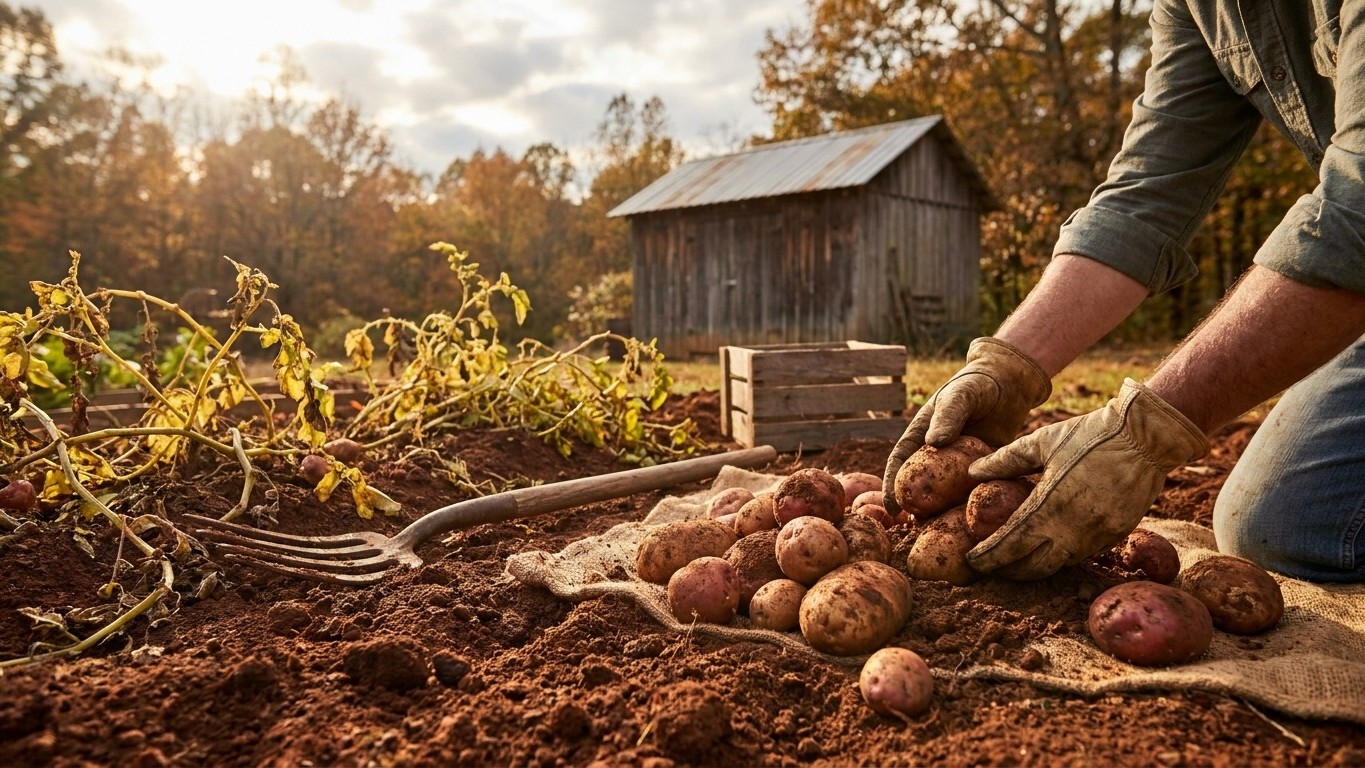

Vermont’s first fall frost lands anywhere from October 3 to October 13 depending on the year, based on the Burlington climate record, so the digging window closes fast once vines start to blacken. An unheated space here will not hold the 40-45 F that stored potatoes need all winter: the coldest month averages a minimum of 12.9 F, cold enough to freeze an uninsulated porch or shed solid. Timing the harvest and picking the right storage spot are two separate problems, and this state makes both of them tight.
The short answer
Frost doesn’t strictly dictate the calendar for digging potatoes, but it forces the issue. Once foliage dies back, whether from disease, dry-down, or an actual frost, the tubers stop gaining size and the clock starts on getting them out of ground that’s about to cool hard. In Vermont, the Burlington station’s climate normals put the first fall frost between October 3 and October 13, which is the mildest window the state offers. That station sits on Lake Champlain, where the lake itself buffers the air on both ends of the season. Move east into the Green Mountains or up into the Northeast Kingdom and the growing season closes earlier, not later. Those areas don’t have their own published NOAA figures cited here, but the direction of the difference is not in question: less lake influence means an earlier frost, which means less margin for a late-planted crop to finish bulking.
That first frost date matters less for the tubers underground, which tolerate a light frost on the foliage without immediate harm, and more as a signal that the ground is losing its summer heat. Soil temperature lags air temperature, so a mid-October frost doesn’t mean the dirt is already cold, but it does mean the season for keeping potatoes in the ground and using it as a free holding bin is closing. Most growers here are done harvesting by the time nights are routinely dropping into the 30s, which in Vermont’s case falls in that same October window or shortly after.
Once the crop is out, the next question is where it lives for the next five or six months, and this is where Vermont’s cold works against convenience. Utah State University Extension recommends a storage temperature of 40-45 F. An unheated garage, three-season porch, or uninsulated shed will not hold that line through a Vermont winter. The coldest month here averages a minimum of 12.9 F, which is a daily average, not an outlier cold snap. That number describes ordinary January nights, and an uninsulated structure will track close to outdoor air on those nights. A space needs either mass (earth contact, an insulated basement wall) or supplemental heat to stay in the 40s when the outside air is sitting near 13 F night after night. Without one of those, the crop freezes, not just risks freezing.
Curing, and where
Before storage temperature is even a question, the crop needs to cure. Utah State University Extension specifies 55-60 F with high humidity for two to three weeks right after digging, a step that toughens the skin and heals small wounds from the fork or the digger. In Vermont, that window falls in the first half of October for most gardens, which is exactly when outdoor air is swinging widely between warm afternoons and near-frost nights. Finding a spot that sits steadily in the 55-60 F band takes some searching, because very few unheated structures hold that range on their own once the calendar turns.
- Dig on a dry day and let the potatoes sit on the soil surface for an hour or two, no longer, to shed loose dirt without exposing them to direct sun.
- Move them immediately out of sunlight. Even brief exposure can turn skins green, and greened potatoes should not go into long-term storage.
- Find a space that’s currently running 55-60 F: an enclosed but unheated porch on the shaded side of the house often lands in that range during early-to-mid October in Vermont, before nighttime temperatures drop hard. A basement corner away from the furnace can also work if it’s not already running cooler than that.
- Raise humidity around the pile if the space is dry. An open basement in fall often runs low-humidity air from a furnace cycling on; a damp burlap cover or a shallow pan of water nearby helps hold moisture near the tubers.
- Hold them there for two to three full weeks, checking periodically that the space hasn’t slid outside the 55-60 F range as outdoor temperatures fall through October.
- Move to permanent winter storage before nights start regularly dropping toward freezing, since an unheated porch that worked for curing in early October will not hold 55-60 F, or even 40-45 F, once the season turns.
Storing through this winter
Once cured, potatoes want a different environment: dark, and either 40-45 F according to Utah State University Extension, or 38 F at 95 percent humidity according to the University of Maine Cooperative Extension. Both figures describe a cold, damp, dark space, and both sit well above what a Vermont winter delivers for free in most structures. The gap between those numbers and the state’s climate is the whole storage problem.
Early in the storage season, an unheated porch or garage that ran too warm for curing in October can suddenly become close to ideal in November, when outdoor lows are dipping into the 30s and 20s but haven’t yet hit the deep cold. That’s a narrow, moving target, and it doesn’t last. By the time the coldest month arrives, with its mean minimum of 12.9 F, that same porch or garage is a freezer, not a root cellar. A space that worked in November can ruin a crop in January if nothing changes.
A basement, particularly one with an earthen or unheated section away from the furnace, is the more dependable option across a full Vermont winter, because the surrounding soil moderates the swings that an aboveground structure can’t resist. An insulated cooler, an old refrigerator run through a thermostat set for cold-not-freezing, or a well-buried root cellar all get closer to the 38-45 F band on the coldest nights than an open shed does. The trade-off is humidity: basements near a furnace tend to run dry, which favors the 40-45 F, lower-humidity USU guidance over the 38 F, 95 percent humidity Maine target, and a dry space needs added moisture (damp sand, a covered container, occasional misting) to avoid shriveling. There isn’t one storage answer for the whole state; there’s a match between how cold and how damp a given space runs during a Vermont winter, and matching that against whichever guidance fits the situation better.
What goes wrong here
- Curing space turns cold mid-cycle. An October cold snap can drop a porch or garage well below the 55-60 F curing range before the two-to-three-week window is up. Move the batch to a warmer interior room, even a spare bedroom, rather than let curing stall in the cold.
- Storage space freezes in the coldest month. A shed or unheated garage that seemed fine in November will not hold 40-45 F, or 38 F, once nights are averaging near 12.9 F. Add insulation around the storage container, move it against an interior basement wall, or bring in a low-wattage heat source with a thermostat.
- Humidity swings with a heated basement. Running a furnace nearby dries the air well below the 95 percent the University of Maine recommends. Cover the bin, add damp sand or slightly moist burlap, and keep the storage container away from heating equipment.
- Digging too late for the frost window. Waiting past the Burlington-area window of October 3 to October 13 risks digging into ground that’s already cooling hard, especially outside the Champlain Valley where the season closes sooner. Plan the harvest date around vine dieback, not the calendar alone, and don’t assume a later frost date than the record supports.
- Green skins from a sunny curing spot. A porch that gets afternoon sun cures at the right temperature but exposes tubers to light. Choose shade over warmth if a trade-off is unavoidable; greening is harder to reverse than a slightly cool cure.
Common questions
Can potatoes stay in the ground past the first frost?
A light frost on the foliage doesn’t damage tubers still underground, since soil temperature lags air temperature. But once frost signals the season is closing, in Vermont that’s the October 3 to October 13 window at the Burlington station, there’s little benefit to waiting, and real risk in areas outside the Champlain Valley where the ground cools faster.
Is a root cellar necessary in Vermont, or will a basement work?
An unheated, earth-contact section of a basement can approach the 40-45 F Utah State University Extension recommends, especially away from furnace heat. A dedicated root cellar isn’t required, but a fully heated basement or an aboveground unheated space usually can’t hold the range through a Vermont winter without help.
Why do stored potatoes sprout even when it’s cold outside?
Sprouting happens when the storage space runs warmer than 40-45 F, not colder. A basement near heating equipment, or a storage container placed too close to a furnace, can sit in the 50s or 60s even while it’s freezing outside, which is warm enough to trigger sprouting.
What’s the difference between the two temperature guidelines given for storage?
Utah State University Extension lists 40-45 F as the storage target; the University of Maine Cooperative Extension lists 38 F at 95 percent humidity. Both describe cold, damp, dark conditions, and either is workable. The more important variable in Vermont is usually humidity control, since dry basement air is a more common problem here than getting the temperature low enough.