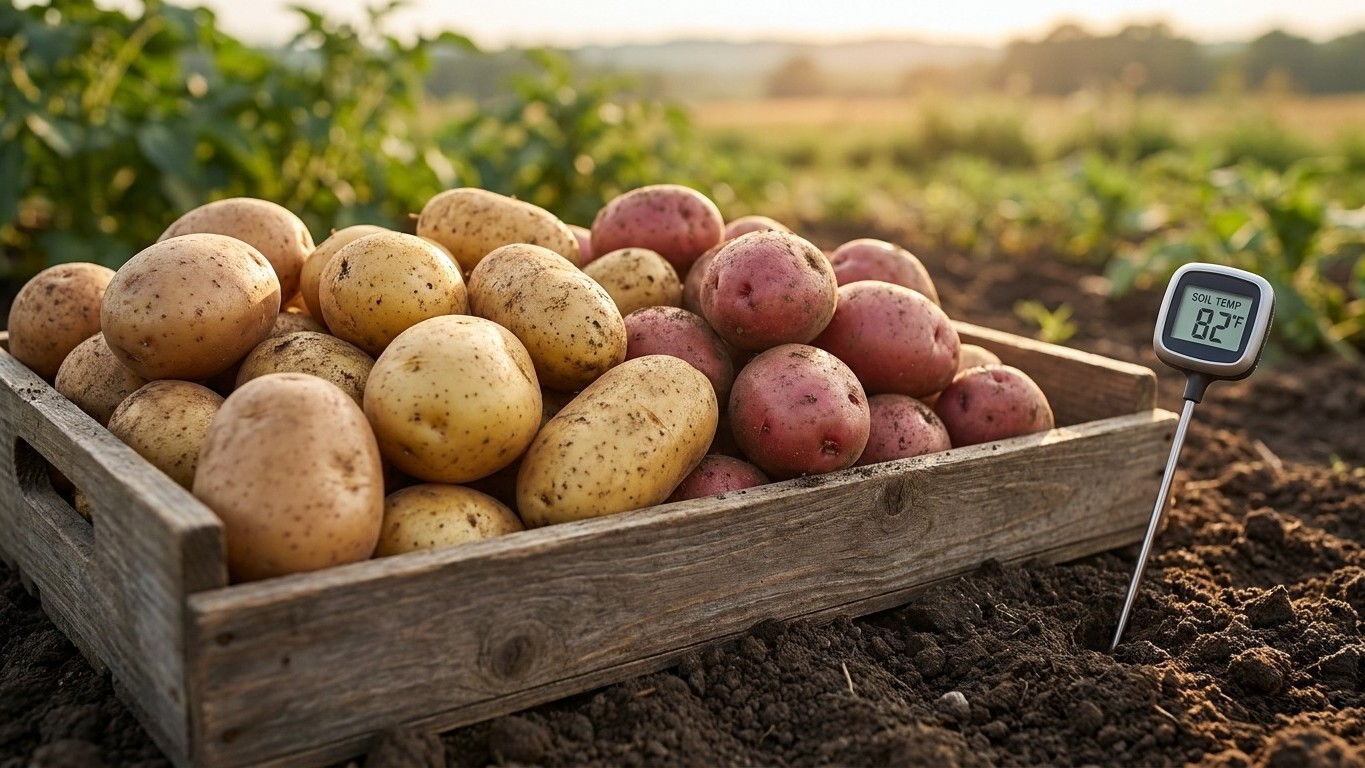

West Virginia gardeners get one real lever with potatoes: season class. In the Charleston area, soil warms to 50°F roughly two to three weeks before the last spring frost, which lands between April 9 and April 23, according to NOAA NCEI’s 1991-2020 Climate Normals for station USW00013866. Early and mid-season potatoes fit that window. Late types ask for more patience than most valley summers offer.
The short answer
Plant early or mid-season potatoes in the lower valleys of West Virginia, and save late-season types for the higher, cooler counties. That’s the whole strategy, and it comes straight from how soil temperature behaves here, not from a brand name on a seed bag.
NOAA NCEI’s Climate Normals for station USW00013866, near Charleston, put the last spring frost between April 9 and April 23. Utah State University Extension’s fact sheet Potatoes in the Garden and the University of Maine Cooperative Extension’s Bulletin #2077 both point to the same planting rule: get potatoes in the ground once soil hits 50°F, which falls 14 to 21 days before that last frost date. For a Charleston-area garden, that means soil is often plantable in late March, well before the calendar says frost is finished.
Why the rush? Because the other end of the season is the real limit. Both extension sources agree that tuber set and fill shut down once soil temperatures climb above 90°F. That’s not a minor slowdown, it’s a stop. Watering more doesn’t restart the process. In a river valley like Charleston, where summer soil can climb well past that mark by midsummer, a potato that needs a long, late season to finish is fighting the thermometer, not the calendar.
This is why the honest answer to “which variety suits West Virginia” isn’t a single name. It’s a season class. Early and mid-season potatoes size up and finish before the worst of the heat sets in across the lowlands. Late-season types can still work, but they belong at higher elevations, where summer soil temperatures don’t spike the same way and the growing window stretches later into cooler air.
Neither Utah State nor the University of Maine publishes a days-to-maturity count for named varieties, and neither will you find one here. What they do publish, consistently, is the season class: early, mid-season, or late. That’s the number that matters for planning, because it tells you whether a variety’s harvest lands before or after your local soil crosses that 90°F ceiling.
What actually decides it
Two mechanisms run this whole decision, and neither one is about the variety’s flavor or skin color. One is about starting the clock. The other is about when the clock runs out.
Soil temperature at planting
Potatoes don’t go by the calendar, they go by the dirt. Utah State University Extension and the University of Maine Cooperative Extension both anchor planting to soil reaching 50°F, not to a fixed date. In a river valley like Charleston, that threshold typically arrives 14 to 21 days ahead of the last spring frost, which itself falls between April 9 and April 23 per NOAA NCEI’s station data. Higher up in the state, cooler soil delays that 50°F mark, which pushes the whole season later, chain-reaction style. A gardener two thousand feet up isn’t behaving cautiously by planting later. The ground is genuinely colder, and rushing it doesn’t help the crop, it just risks rot in cold, wet soil.
The 90°F ceiling that ends the season
This is the mechanism that decides everything else. Once soil temperature climbs above 90°F, tuber set and fill stop. Not slow down: stop. Neither extension source frames this as something irrigation can fix. A well-watered potato in 92°F soil is still a potato that isn’t sizing up. That’s why season class outranks every other trait when you’re picking what to grow. A late-season variety that needs the whole summer to finish is betting that your local soil never crosses that line before harvest. In a low valley with a long run of hot days, that’s a bad bet. At elevation, where summer soil runs cooler for longer, the same variety has a real shot.
Put those two mechanisms together and you get the actual logic of variety selection here: start as early as the soil allows, and finish before the soil turns hostile. Everything else, the shape of the tuber, its skin, what you use it for, is secondary to that timing window. A gardener facing a crop this page never covered, say, a hillside garden at 2,500 feet with rocky, fast-draining soil, can reason it out the same way: cooler soil delays the 50°F planting mark, but it also delays the 90°F ceiling, which buys room for a longer-season type that a valley garden simply doesn’t have.
| Season class | What it means for a West Virginia garden | What it’s generally grown for |
|---|---|---|
| Early | Finishes before peak summer soil heat; safest bet in low valleys | Boiling, salads |
| Mid-season | Needs a longer window; workable in valleys with a cooler microclimate | Boiling, general use |
| Late | Needs the full season; best matched to higher, cooler elevations | Baking, storage |
How to do it
- Check soil temperature directly with a soil thermometer rather than guessing from air temperature, since the two can differ by several degrees in early spring.
- Plant once soil reaches 50°F, which for a Charleston-area garden typically lands 14 to 21 days before the last spring frost window of April 9 to April 23 (NOAA NCEI, station USW00013866).
- Choose certified seed potatoes rather than pieces saved from last year’s crop or grocery-store potatoes. Uncertified seed carries virus that no amount of good soil or timing will undo.
- Match season class to elevation: early or mid-season types for valley gardens, late-season types reserved for higher, cooler ground where summer soil is less likely to cross 90°F before harvest.
- Hill the rows as plants grow, keeping developing tubers covered and shaded, since exposed tubers near hot soil surfaces are the first to feel the heat ceiling.
- Watch soil temperature again as summer builds. If it’s tracking toward 90°F and the crop is an early or mid-season type nearing harvest, dig it rather than let it sit and stall.
- Store harvested tubers in a cool, dark space promptly, since a crop pulled to beat the heat still needs proper storage to hold quality.
What goes wrong
- Planting by the calendar instead of the soil. A gardener who waits for a fixed date instead of testing soil temperature either plants into cold, rot-prone dirt or misses the early window entirely. Fix: use a soil thermometer and go by the 50°F mark, not the date on a seed packet.
- Choosing a late-season variety for a low valley garden. The tubers are still trying to size up when soil crosses 90°F, and growth simply halts. Fix: reserve late-season types for higher elevations, and default to early or mid-season classes in valley locations like Charleston.
- Assuming more water solves heat stress. Neither Utah State University Extension nor the University of Maine Cooperative Extension describes irrigation as a fix for tuber set shutting down above 90°F soil temperature. Fix: mulch to buffer soil temperature, and plan the harvest date around the heat ceiling rather than trying to water through it.
- Saving seed potatoes from the home garden year after year. This is how virus builds up silently in a planting stock, showing up as weaker vigor and smaller yields over time. Fix: start with certified seed potatoes each planting.
- Ignoring elevation differences within the state. A planting and harvest schedule that works in a river valley can be wrong at higher elevation, where both the 50°F planting mark and the 90°F heat ceiling arrive later. Fix: track local soil temperature rather than relying on a single statewide date.
Common questions
Does West Virginia have one best potato variety?
No single variety is named as best in the sources used here. Utah State University Extension and the University of Maine Cooperative Extension both frame the choice around season class, early, mid-season, or late, matched to local soil temperature patterns rather than a single statewide pick.
When should I plant potatoes near Charleston?
Once soil reaches 50°F, which typically falls 14 to 21 days before the last spring frost date. NOAA NCEI’s Climate Normals for station USW00013866 place that frost date between April 9 and April 23.
Can I grow a late-season potato in a hot valley?
It’s a gamble. Late-season types need the full summer to finish, and once soil temperature passes 90°F, tuber set and fill stop according to both extension sources cited here. Valley soils reach that mark sooner than higher, cooler ground.
Why does certified seed matter so much?
Uncertified seed potatoes, including pieces saved from a previous harvest or grocery-store tubers, can carry virus. That virus doesn’t announce itself immediately, it just quietly reduces vigor and yield over successive plantings.