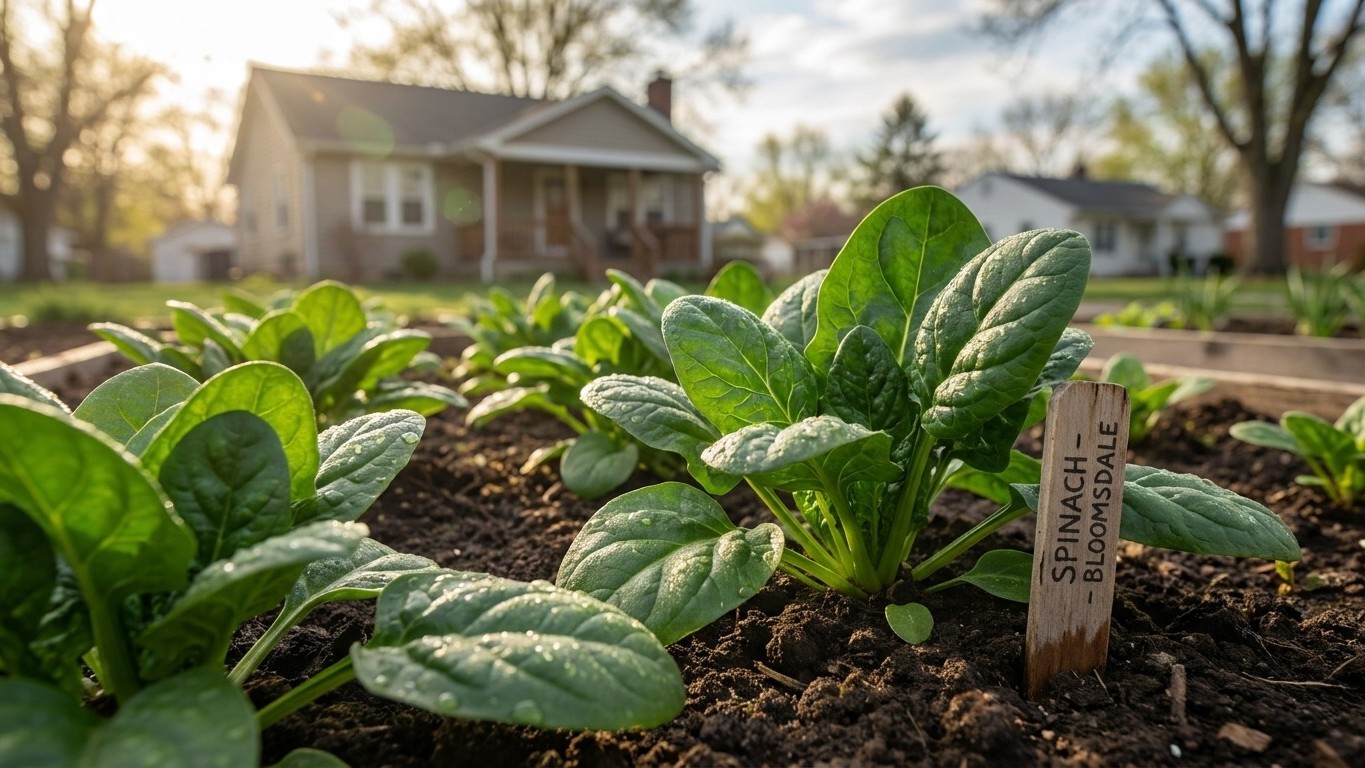

Spinach sown in a Massachusetts garden will typically bolt as late spring pushes past the cool window, somewhere between mid-May and mid-June depending on when you planted and how warm the season runs. The trigger isn’t a single date on a calendar. It’s a combination of lengthening daylight and rising heat working together, which is why the same variety can hold a week longer in a shaded bed than in full sun three yards away.
The short answer
On the longest day of the year, Massachusetts gets 15 hours and 6 minutes of daylight at the reference city used for these calculations. That’s a lot of light, and for spinach, more light during the growing season is not a gift. It’s the countdown clock. Long days trigger flowering in spinach the same way they trigger bulking in a long-day onion, except the outcome is the opposite of welcome: instead of building a crop, the plant switches into reproductive mode, sends up a central stalk, and the leaves turn bitter and thin.
That single fact reshapes how you should think about a Massachusetts summer. A gardener might assume that because Massachusetts summers run milder than, say, the Mid-Atlantic, spinach should hang on longer here. It doesn’t work that way. Day length is driven by latitude, not by weather, and Massachusetts sits far enough north that its daylight hours climb high by late spring regardless of how the thermometer behaves. A cool, cloudy June does not buy extra weeks of harvest if the sun is still up for fifteen-plus hours.
So which is doing the damage here, the day length or the heat? The honest answer is both, stacked on top of each other. Spinach grows best where temperatures stay under 75°F, and Massachusetts averages 10.2 days a year at or above 90°F at the Boston reference station. That’s not an extreme heat load compared to states farther south or west, but it’s more than enough to push soil and air temperatures past the 75°F comfort zone well before the daylight hours even peak. By the time late May and early June arrive, the plant is often getting hit by rising heat and near-maximum daylight in the same stretch of weeks.
The practical takeaway is that Massachusetts spinach growers are working against a compressed spring window, not a generous one. Waiting to see if the season “stays cool enough” is a bet you’ll usually lose, because the daylight portion of the equation doesn’t care about the thermometer at all. If you’re still wondering, Will Spinach Bolt Early in Massachusetts?, the numbers above make the case clearly. Given how tight the spring window really is, many gardeners find better success by shifting focus to When to Sow Autumn Spinach in Massachusetts instead.
How long the spring window really is
Working out how many usable weeks you actually get takes some counting backward and forward from the numbers that matter here. Massachusetts’s average last spring frost, based on 1991-2020 NOAA climate normals, falls between April 1 and April 8 depending on where you sit relative to the coast. Here’s how that translates into a real window:
- Find your sow date. Spinach goes in the ground 2 to 3 weeks before the last frost, which for Massachusetts means sowing somewhere between roughly March 11 and March 25, earlier if you’re closer to the milder coastal zone, later if you’re inland.
- Count the cool early weeks. Germination and early leaf growth happen while soil is still cold and days are still relatively short, giving you a stretch of steady, unhurried growth through most of April.
- Watch the crossover point. As May arrives, daylight hours climb quickly and air temperatures start brushing past that 75°F ceiling on warmer afternoons, even before the season’s true heat sets in.
- Expect bolting pressure by late spring. Once both long daylight and above-75°F stretches show up together, the plant shifts toward flowering, and leaf quality drops even if the plant hasn’t fully bolted yet.
- Total usable window. Counting from a mid-to-late March sowing to the point where daylight and heat converge, Massachusetts gardeners are typically looking at somewhere around eight to nine weeks of good spring spinach growth before quality starts sliding.
That’s a workable harvest window, but it’s tight enough that late sowing, even by a week or two, eats directly into usable production before bolting sets in.
The autumn crop, and when the soil lets you sow
The fall crop is where Massachusetts gardeners often get better, more reliable results, but it comes with its own set of constraints that have nothing to do with day length and everything to do with soil temperature and the calendar running out before frost.
Soil still too warm to germinate
Spinach seed germination drops off once soil temperature climbs above 80°F, according to Utah State University Extension. Massachusetts summers, with that average of 10.2 days a year at or above 90°F, keep soil warm well into late summer, particularly in sunny, unmulched beds. There’s no published soil-temperature calendar specific to Massachusetts in this dataset, but the heat-load figure alone tells you the ground doesn’t cool off overnight. Practically, that means sowing directly into August soil is often a gamble, and most Massachusetts gardeners see better germination once soil starts shedding that summer heat, typically as days shorten and nights cool through late August into September.
The frost that ends the season
Massachusetts’s first fall frost, per the same NOAA climate normals, arrives between November 3 and November 14. Utah State University Extension recommends sowing a fall spinach crop 50 to 75 days before the date you want to harvest. Counting back from a harvest targeted around the earlier end of that frost window, November 3, puts a sow date somewhere between August 20 and September 14. Counting back from the later end, November 14, shifts that sow window to roughly August 31 through September 25. Stack that against the soil-temperature obstacle above, and the workable sowing stretch for most Massachusetts gardens lands in the back half of August through late September, with the exact best week depending on how much summer heat lingered in your particular yard and how close to the coast you’re gardening.
Four spinach varieties commonly show up in seed catalogs for gardeners planning around these windows: Bloomsdale, Melody, Teton, and Olympia. The source used for this article doesn’t publish days-to-maturity or bolt-resistance data for any of them, so no comparison between varieties is offered here. Check seed packet information directly if you want variety-specific guidance.
Checking this against your own county
Frost dates and heat averages in this article come from a single reference station, and Massachusetts is a state where microclimate matters more than its size suggests. Coastal towns run milder and later into fall than inland valleys, and the Berkshires in the west frost earlier in autumn and later in spring than almost anywhere else in the state. If you garden outside the immediate Boston area, treat the dates above as a starting estimate rather than a fixed rule.
For numbers specific to your county, the University of Massachusetts Amherst Extension is the land-grant extension service covering the state and publishes localized planting guidance and frost-date information gardeners can check against their own conditions before committing seed to the ground.
Common questions
Can I stop spinach from bolting by watering more?
Extra water helps with heat stress but doesn’t override the day-length trigger. Once daylight hours climb high enough, the plant moves toward flowering regardless of soil moisture.
Does shade extend the spring harvest?
Partial afternoon shade can keep soil and air temperature below the 75°F ceiling a little longer, which may buy a few extra days, though it won’t offset the daylight-length trigger on its own.
Is fall spinach less likely to bolt than spring spinach?
Yes, because daylight hours are shrinking rather than growing as the fall crop matures, removing the long-day trigger that pushes spring plantings toward flowering.
What happens if I sow fall spinach too early?
Seed sitting in soil above the 80°F germination threshold tends to germinate poorly or unevenly, which is why waiting for soil to cool matters more than rushing to hit an early sow date.