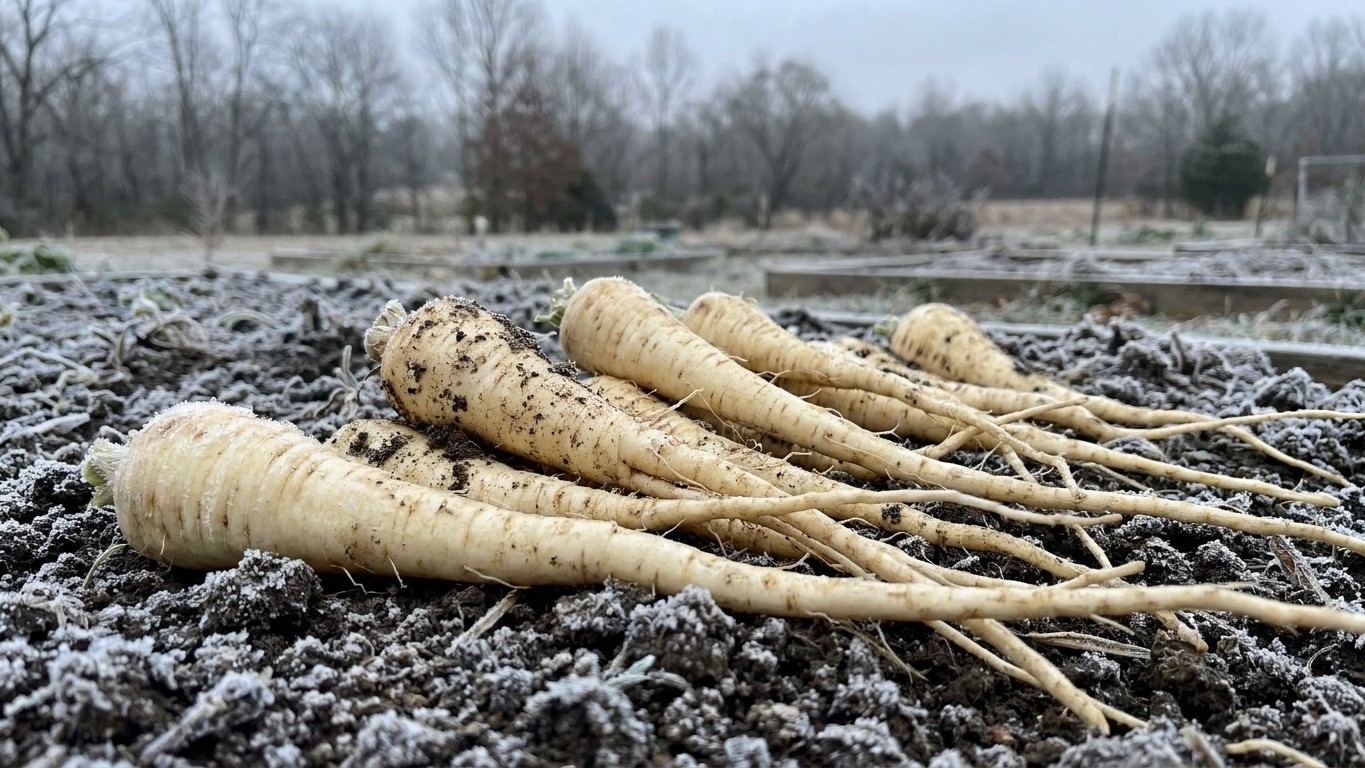

Iowa’s parsnip growers get good news on both fronts. Using Des Moines as the reference point, winters here run cold enough, and long enough, to trigger the starch-to-sugar conversion that turns a bland root into a genuinely sweet one. The growing season leaves room to reach maturity well before the ground locks up, and then some. But the payoff depends on timing you control: when you sow, how you water, and when you finally pull the roots.
The short answer
Everything about parsnip flavor comes down to one question that has nothing to do with a hardiness zone map: does this place deliver several weeks of real, sustained frost, or just an occasional cold night? Hardiness zones tell you whether a plant survives winter. They don’t tell you whether a root sitting in the ground gets enough sustained cold to convert its stored starch into sugar. Those are two different measurements, and mixing them up is the single most common mistake in parsnip advice.
For Iowa, using the Des Moines reference station, the mean daily minimum temperature during the coldest month sits at 13.8°F, based on NOAA NCEI Climate Normals covering 1991-2020. That’s not the record low for the winter, and it’s not a monthly average blending warm afternoons with cold nights. It’s the average low, night after night, across the coldest stretch of the year. A figure that low means the cold isn’t a fluke. It’s the norm, and it holds for weeks at a stretch.
That’s exactly the kind of exposure a parsnip needs. The conversion of starch to sugar isn’t triggered by a single frosty morning. It requires repeated, sustained cold acting on roots that are still in the ground, still alive, still metabolically active enough to respond to the stress. A mean minimum of 13.8°F in the coldest month tells you Iowa isn’t flirting with frost. It’s delivering it in volume.
So the plain answer: yes, parsnips grown in Iowa will sweeten, provided they’re left in the ground long enough after the first fall frost to actually experience that cold. A gardener who digs the whole row the day after the first light frost is skipping the part that matters. The soil itself doesn’t need to freeze solid for the process to work, but the roots need repeated nights well below 32°F, not just one. Given how consistently cold Iowa’s winters run based on the Des Moines figures, that exposure is nearly guaranteed for anyone who resists the urge to harvest early. The bigger risk here isn’t a winter too mild to do the job. It’s a gardener too impatient to wait for it.
Does the season fit?
Parsnips are sown directly in place, never transplanted, and the clock starts the moment seed goes into soil, not when a seedling gets set out. Utah State University Extension puts the full cycle at 100 to 120 days from seeding to maturity. Here’s how that lines up against Iowa’s frost calendar, using the Des Moines-area window as the reference.
- Start with the last spring frost. The NOAA NCEI 1991-2020 normals put the 32°F freeze probability window at April 12 to April 24 for this reference station. Iowa State Extension’s county-level data, drawn from 1950-2021 records, runs roughly 4 days later in spring across much of the state, so treat the airport dates as the early, optimistic edge.
- Back up 2 to 3 weeks for sowing. Utah State’s guidance calls for seeding 2 to 3 weeks before the last frost. That puts a realistic Iowa sowing window somewhere in the last third of March into the first third of April, depending on how closely your ground matches the reference station or runs behind it.
- Add germination time before anything shows. Parsnip seed is slow and unreliable to sprout, typically taking 14 to 21 days to emerge. A bare patch of soil three weeks after sowing is normal, not a failed planting. Digging it up and re-sowing at that point wastes a seed lot that just hasn’t broken ground yet.
- Count 100 to 120 days from the sowing date, not from germination. A late-March sowing reaches maturity somewhere around early July at the low end, and toward late July at the high end. Even a sowing pushed into mid-April still matures by mid-to-late August.
- Compare that to the first fall frost. The same NOAA NCEI normals put the first 32°F freeze at October 14 to October 25 for the reference station, with Iowa State’s county figures running about 10 days earlier in fall in many areas. Either way, a parsnip crop that matures in July or August has weeks, not days, of margin before the first frost even arrives.
That margin matters twice over. It means the crop reaches full size well ahead of any risk from an early frost, and it leaves the roots sitting mature in the ground through the entire frost-exposure window that makes them sweet. In Iowa, the season doesn’t just fit. It fits with slack to spare, which is unusual for a 100-to-120-day crop pushed up against a fall frost date.
What goes wrong here
- Forked roots from heavy or stony ground. A parsnip root pushes straight down, and anything that blocks it, compacted clay, buried rocks, a hardpan a foot down, sends it splitting into two or three legs instead of one clean taproot. Utah State University Extension recommends deep sandy soil for this reason, and says heavy soil needs to be double dug before sowing, working it loose a full spade’s depth beyond normal tilling.
- Forked roots from overwatering. This is a separate cause from soil texture, and it catches gardeners who assume they’ve fixed the problem by loosening the bed. Excess moisture, especially uneven watering that swings from soaked to dry, can cause the same forking in soil that’s otherwise workable. Consistent, moderate watering matters as much as soil prep does.
- A season that runs out. Given Iowa’s frost calendar, this is the least likely failure here, but it still happens to gardeners who sow in late spring or early summer instead of that late-March to early-April window. A parsnip sown in June, for instance, may not reach the 100-day mark before growth slows in the fall cold, leaving undersized roots.
- Pulling the crop before the cold has done its work. Not a mild-winter problem here, since the coldest-month mean minimum of 13.8°F rules that out. The real version of this failure in Iowa is impatience: harvesting right after the first light frost instead of leaving roots in the ground through several more weeks of sustained cold, which is what actually builds the sugar.
The furocoumarin warning nobody puts on a parsnip page
North Carolina Extension Gardener Plant Toolbox states it directly: “All parts of this plant contain furocoumarins which can make skin sensitive to light causing burns so be sure to wear gloves, long sleeves and long pants when dealing with it.” That’s not limited to the leafy tops. It covers the whole plant, roots included, and it’s worth taking seriously precisely because most garden guides skip it entirely.
The mechanism is what makes this catch people off guard. The burn doesn’t come from the sap alone. It comes from sap on the skin combined with sunlight afterward. That’s why a gardener who spends a bright afternoon pulling tops or hauling a harvest basket can walk away feeling fine, only to develop a reactive burn hours later, once the sap-exposed skin has sat in the sun long enough for the reaction to trigger. It’s also why the fix isn’t rinsing off afterward. It’s covering up before you start: gloves, long sleeves, long pants, every time you’re handling the plant on a sunny day.
Checking this against your own county
The Des Moines figures used here are a reference point, not a guarantee for every Iowa address. Frost dates and winter lows shift with elevation, with proximity to the Mississippi or Missouri river valleys, and with how far north or south a given county sits. Iowa State University Extension and Outreach, reachable at extension.iastate.edu, keeps county-level frost data and can point to the numbers that apply to your specific location rather than the airport station cited in the national normals. That’s especially worth checking if you’re near the edges of the state, where frost timing can run noticeably earlier or later than the Des Moines figures suggest.
Common questions
Can I leave parsnips in the ground all winter in Iowa?
Many gardeners do, since the roots are frost-hardy and the sweetening process continues as long as they’re not dug up. The practical limit is whether the ground freezes hard enough to make digging impossible, which varies by how the winter unfolds.
Do parsnips need a specific variety to sweeten in a cold climate?
The sourced guidance here doesn’t name a variety, and no single cultivar is required for the frost-conversion process. The sweetening comes from sustained cold exposure after maturity, not from a particular seed line.
Why hasn’t my parsnip seed sprouted after two weeks?
That’s normal. Germination runs 14 to 21 days, and parsnip seed is notoriously slow and uneven. Resist digging up the row before the three-week mark.
Is the skin reaction from parsnip sap dangerous?
It’s a real photosensitivity reaction tied to furocoumarins in the plant, and the source guidance doesn’t specify severity or treatment. The practical response is prevention: gloves, long sleeves, and long pants whenever you’re handling the plant, especially in direct sun.