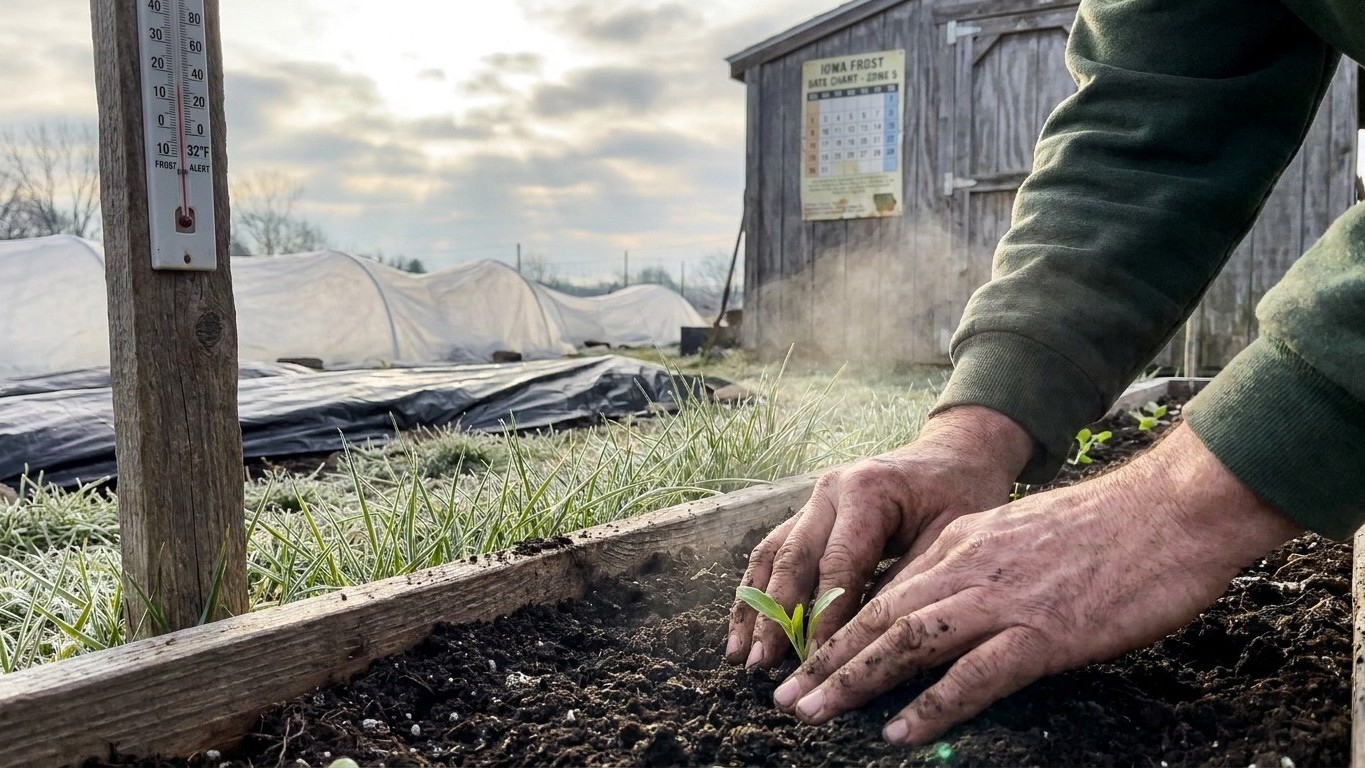

Iowa gardeners work inside a frost-free window that runs roughly five and a half to six months, sitting in USDA Hardiness Zones 4b through 6a. That window, not the calendar month, is what actually decides which crops make sense here and which ones are a bet against the odds.
How long your season really is

Start with three numbers. The USDA Plant Hardiness Zone Map places Iowa across zones 4b to 6a, based on the average annual extreme minimum temperature recorded between 1991 and 2020. NOAA’s climate normals for the same period put the average last spring frost somewhere between April 12 and April 24, and the average first fall frost between October 14 and October 25, the same window that shapes When to Carve a Pumpkin in Iowa if you’re timing your harvest for Halloween.
Do the math on those two dates and you get the number that matters: a frost-free window of somewhere between 173 and 196 days, depending on which end of each range applies to your spot. Call it roughly six months if you’re lucky, closer to five and a half if you’re not. That’s the one figure that governs everything else you plant.
What does a five-and-a-half to six-month window rule out? Anything that needs a genuinely long, hot growing season with no margin for error, think certain long-maturity melons, some dry beans varieties, or okra varieties bred for the Deep South, becomes a gamble rather than a plan. By contrast, a shorter-season crop like Growing Potatoes in Iowa fits comfortably within this window with room to spare, and the same is true for Growing Carrots in Iowa, for Growing Beets in Iowa, for Growing Parsnips in Iowa, and for cool-season greens covered in Growing Spinach in Iowa. Longer-season vines like Growing Pumpkins in Iowa sit closer to the edge of that window. It can still work, but only with transplants started well ahead of the frost date, black plastic mulch to warm the soil, or row cover pulled at both ends of the season. Skip those tricks and a 100-plus day crop started from seed outdoors is racing a clock that isn’t on its side.
One more thing worth saying plainly: these are averages, not guarantees. By definition, half of all years land on the worse side of an average. A last frost date of April 18 means some years it’s April 5, others it’s May 2. Iowa State Extension’s own county-level data, drawn from 1950 to 2021, runs about four days later in spring and ten days earlier in fall than the airport-station normals cited above, which means the NOAA figures represent the optimistic end of the range, not the safe one. Treat the frost dates as a starting point for planning, then watch your actual local forecast before you put tender transplants in the ground.
What the summer does to a garden here
Length of season is only half the story. Des Moines averages 18.4 days a year at or above 90F, and even the coldest month of winter only dips to a mean daily minimum of 13.8F. Both numbers shape what a garden can do here in ways that have nothing to do with how long the season runs.
Heat above roughly 90F isn’t simply “good growing weather” turned up a notch. Tomato flowers stop setting fruit in that range because pollen turns sterile in the heat, and the same fruit-drop problem shows up in Growing Peppers in Iowa once temperatures climb past that threshold. Lettuce, spinach, and other cool-season greens respond to the same stretch by bolting, the plant rushing to flower and turning bitter almost overnight. With 18.4 days a year crossing that threshold, most of them clustered in July and early August, Iowa gardens effectively split into two productive windows with a slow patch in between: a spring push for cool-season crops, a break where heat-lovers like tomatoes and peppers do their real work, and then a fall window where the cool-season crops can come back once temperatures ease.
That coldest-month figure of 13.8F does its own quiet work in the background. It’s not the record low, and it’s not the average temperature for the month, it’s the average nightly minimum during the coldest stretch of winter, and it’s the number that decides whether a perennial, a shrub, or a fruit tree survives the winter at all, independent of anything happening during the growing season. A plant rated hardy to zone 5 should tolerate that kind of cold; one rated for zone 7 or warmer generally won’t, no matter how well it performed all summer.
What tends to go wrong in Iowa
Iowa State University Extension keeps a running record of which pests actually show up in home gardens across the state, and a handful of names account for most of the damage reports. Japanese beetle tops that list, ISU calls it the most destructive insect pest in the state’s landscapes and gardens, and it’s been established here since 1994. It shows up in midsummer, skeletonizing leaves on roses, grapes, and dozens of ornamentals and food crops down to the veins.
Squash vine borer and striped cucumber beetle both target the same family of plants but at different points in the season. Cucumber beetles arrive early, right as squash and cucumber seedlings emerge, feeding on leaves and transmitting bacterial wilt in the process. Squash vine borer works later, boring into stems near the base in early to midsummer, often causing a plant that looked healthy the week before to collapse seemingly overnight.
Common stalk borer rounds out the list of pests worth knowing before you plant, tunneling into the stems of corn, tomatoes, and a wide range of other garden plants, usually in early summer as larvae move from grassy field edges into cultivated beds. None of these problems has a single fix that applies everywhere or every year. What matters here is recognition: knowing that a plant collapsing in July might be squash vine borer, or that skeletonized rose leaves in August point to Japanese beetle, is the first step toward asking your county extension office the right question.
Where to check before you plant
Everything above describes Iowa as a whole, and Iowa isn’t one place. A state that spans zones 4b to 6a, with frost dates that shift by roughly two weeks from one edge to the other, doesn’t have a single planting calendar that fits everyone. A guide built around the state capital can run three weeks off for a garden near the northern border or down along the southern edge, and the gap only grows if you’re gardening near a large body of water or at a noticeably higher elevation than your neighbors.
Statewide averages and a single reference station shape the picture. They’re a starting point for thinking about what’s possible here, not a substitute for local knowledge. Iowa State University Extension and Outreach maintains that local knowledge, with county offices that track frost dates, pest pressure, and soil conditions specific to their own area, often down to the township. Before finalizing a planting date or picking a variety based on days-to-maturity, a call or visit to the county office is worth more than any statewide figure, including the ones cited here.
Where to Go Next Depending on What You’re Growing
Everything above is about the calendar Iowa hands you, not the one on the seed packet — and that calendar plays out differently depending on what’s in the ground. If you’re planning a fall bulb crop, the timing question is really about freeze risk: growing garlic in Iowa walks through why bulbs still soft when the first hard freeze hits are already ruined, and what planting date avoids that. If it’s the lawn you’re worried about rather than the garden bed, Iowa lawn care lays out why warm-season sod that looks great in July can spend half the year dead brown, and what to plant instead. And if tomatoes are the point of the whole exercise, growing tomatoes in Iowa covers the actual last-freeze dates for the Des Moines area and how much later gardeners farther north need to wait before putting transplants in. Each of those pages takes the same question this one just raised — what the season allows — and answers it for one specific thing you’re trying to grow.