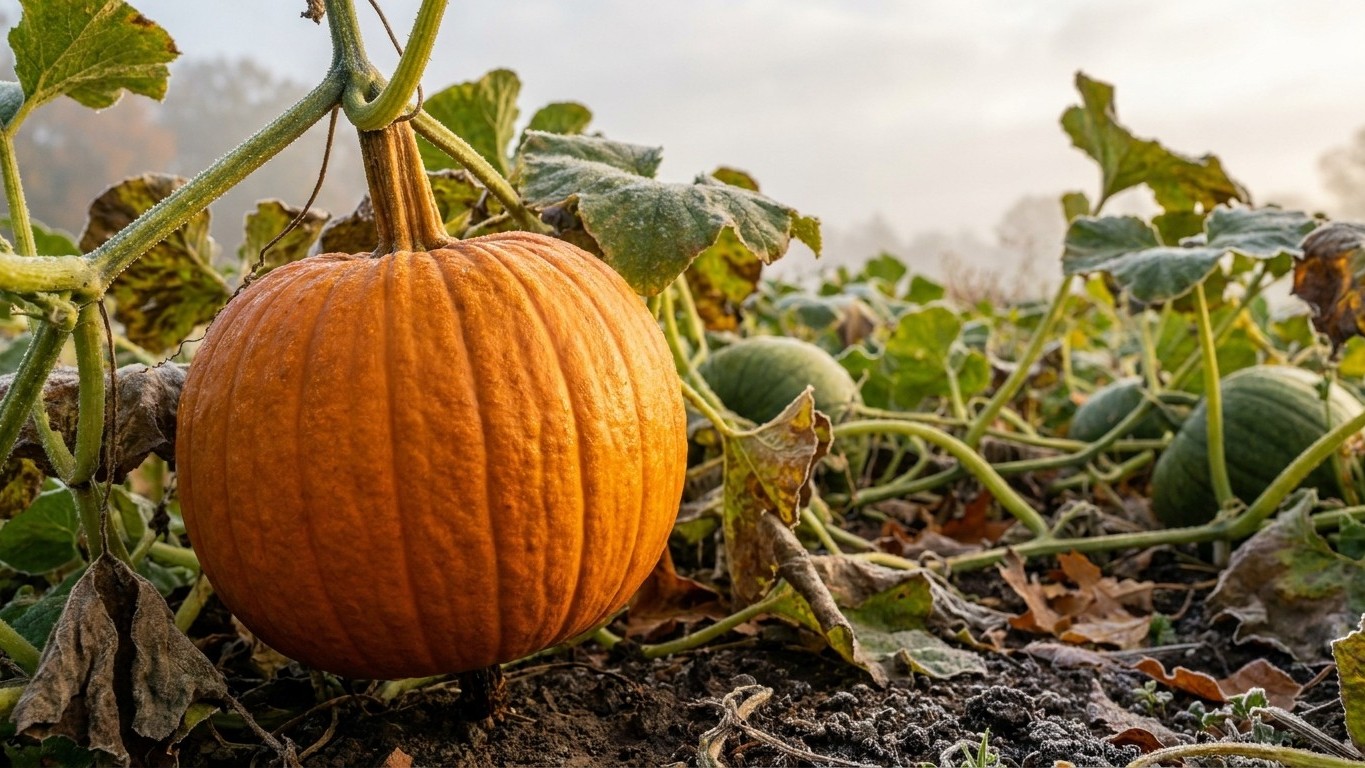

Will Pumpkins Ripen Before Frost in Montana? Yes, pumpkins can ripen in Montana, but the calendar leaves little slack. Count back 45 to 55 days from the state’s first fall frost window of October 1 to October 14, and the flowers that become a ripe pumpkin need to open by roughly the first half of August. Bloom later than that, and the fruit is still green when the cold arrives.
The short answer
Billings, Montana’s most reliable long-term weather record, shows the first fall frost landing somewhere between October 1 and October 14, based on NOAA NCEI’s 1991-2020 Climate Normals for 32 F freeze probability. That’s the wall every pumpkin vine in the region is racing toward, and it shifts depending on elevation and how close a garden sits to a river valley.
Utah State University Extension puts the maturation window for pumpkins at 45 to 55 days, but that clock starts running the moment a female flower opens, not the day the seed goes into the ground. That distinction changes how a Montana gardener should plan late summer.
Run the math against the frost window. If frost arrives on the early side, October 1, and the fruit needs the full 55 days, the flower has to open by August 7. If frost holds off until October 14 and the pumpkin only needs 45 days, a flower opening as late as August 30 still has time. That spread, roughly August 7 to August 20 for anyone who wants a real safety margin, is what decides whether a pumpkin fills out and colors up or stays green on the vine.
Betting on the far end of that range, toward the end of August, only works if two things break the gardener’s way at once: a late frost and a fast-finishing fruit. Neither is guaranteed. A vine that flowers August 25 and then draws a frost on the early side of the window ends the season with green fruit no amount of waiting will fix.
What this means in practice: the seed-starting date matters less than most garden advice suggests. What actually decides the outcome is when the vine puts out its first female flowers, the ones with a small bulge at the base that will become fruit. A gardener who started early but whose vine flowers late from cool soil or stress is in the same trouble as someone who started two weeks behind.
Mountain valleys change this calculation further. The October 1 to October 14 window comes from a Billings station, one of the state’s milder locations. Higher, colder valleys elsewhere in Montana can see a freeze in any month of the growing season, which pushes the safe flowering deadline earlier still, sometimes by weeks.
When to sow here
The planting date that matters isn’t the last frost date. It’s the day the soil itself reaches 65 F, and in Montana those two milestones sit weeks apart. For a full breakdown, see When to Sow Pumpkins in Montana. Warm air moves through in a day; warm soil takes far longer to catch up, especially in clay-heavy valley ground still holding onto winter cold.
- Let the last frost window pass first. NOAA NCEI’s 1991-2020 Climate Normals put Montana’s last spring frost between April 29 and May 10. Seed or transplant before this window closes and a cold night can wipe out young plants outright.
- Don’t assume the soil is ready the same week. Air temperature and soil temperature aren’t the same clock. Soil a few inches down warms slowly, and it commonly takes real time after the last frost date passes before it holds steady at 65 F, the threshold Utah State University Extension gives for direct-seeding pumpkins.
- Check the soil directly instead of guessing from the calendar. A soil thermometer pushed a few inches deep, read in the morning before the sun warms the surface, is the only way to confirm the ground has actually crossed 65 F.
- Use row covers or black plastic to close the gap. Covering the planting area traps daytime heat and can pull that 65 F date roughly two weeks earlier than bare, uncovered soil would reach on its own, which matters directly in a season this short.
- Sow once the soil holds 65 F, not just touches it. A single warm afternoon reading isn’t the same as the ground actually staying there day to day.
The arithmetic that matters most: start from the last spring frost window (April 29 to May 10), add the weeks it takes bare soil to climb into the mid-60s, then subtract roughly two weeks if row covers or plastic are in use. The result is the earliest realistic sowing date. Every week gained here is a week added to the safety margin before the first fall frost, and in a state where that margin is already narrow, a two-week head start from soil warming tricks is not a small thing.
What goes wrong here
- A late flower opens and the fruit never colors. When the first female flowers don’t appear until late August, the pumpkin is still counting through its 45 to 55 days when frost hits, and the shell stays green instead of turning orange. The fix is pushing flowering earlier by warming the soil ahead of schedule with row covers or black plastic, rather than gambling on a slow-starting vine to catch up.
- A nearly-finished fruit gets caught by an early frost. Montana’s fall frost window opens October 1, and a pumpkin that’s colored but hasn’t fully hardened its rind can still be damaged by a hard freeze on the vine. Covering individual fruits with blankets or straw on cold nights, or cutting them with several inches of stem attached once fully orange, keeps a near-ripe pumpkin from turning to mush overnight.
- The vine collapses before the skin hardens. Powdery mildew, vine borer damage, or simple late-season exhaustion can kill the foliage weeks before the fruit is ready, leaving it exposed and stalled. Cutting away only the dead sections while leaving healthy vine intact, and mulching to keep roots cool into September, buys the plant extra weeks to finish the job.
- Pest pressure late in the season slows everything down. Vines already working against a short season lose ground fast when insect feeding is added on top of it. For the specifics on managing pressure in Montana conditions, see this site’s pages on squash bugs in Montana and cucumber beetles in Montana.
- The wrong variety was planted for the season length available. Montana gardeners often lean toward names associated with shorter growing regions, among them Jack Be Little, Baby Boo, Wee-B-Little, Spirit, Autumn Gold, Sugar Pie, New England Pie, Racer, and Cinderella. No days-to-maturity, size, or color figures are attached to any of these here; matching a variety to a given garden’s actual season length takes a look at the seed packet or supplier information, not an assumption based on the name alone.
Checking this against your own county
Everything above is built on frost data from a single Billings weather station, and Montana’s climate doesn’t hold still across the state. A garden in the Bitterroot Valley, up near Kalispell, or out on the high plains near Glasgow can see its first fall frost weeks earlier or later than the October 1 to October 14 window used here, and mountain valleys anywhere in the state carry real risk of frost outside that range entirely.
The most reliable next step is a direct check with Montana State University Extension, which tracks local frost data and growing conditions county by county. A call or visit to the local office can confirm whether the area’s frost window runs earlier or later than the statewide figures used to build the calculation above, which matters directly for deciding how early flowering needs to happen this season.
Local extension staff can also speak to soil warming patterns specific to the area’s soil type, something a statewide average can’t capture, since heavy clay and sandy loam don’t reach 65 F on the same schedule even under identical air temperatures.
Common questions
Can I still plant pumpkins in Montana in July?
The soil is likely warm enough by then, but a vine seeded in July has little chance of flowering by early August, which is the window this calculation depends on. A fast-finishing variety and a hope for a late frost are the only real cushion left at that point.
What happens if a pumpkin freezes on the vine before it turns orange?
It won’t continue ripening once damaged by frost. Utah State University Extension’s guidance covers harvesting with the stem attached before frost and keeping pumpkins where they won’t freeze, but it doesn’t publish a storage temperature or keeping time, so there’s no figure to point to for how a frozen fruit holds up afterward.
Should I remove new flowers appearing late in the season?
Many gardeners do, on the reasoning that a flower with no realistic chance of finishing before frost is pulling energy away from fruit that still has time. No specific figure for the effect is given in the source used here, but the logic follows directly from the 45 to 55 day clock.
How do I know when to harvest before frost hits?
Utah State University Extension’s guidance is to harvest with the stem attached, before frost arrives, once the rind has hardened and colored. Waiting past that point in Montana risks losing the fruit to the state’s October frost window instead of gaining anything from extra time on the vine.