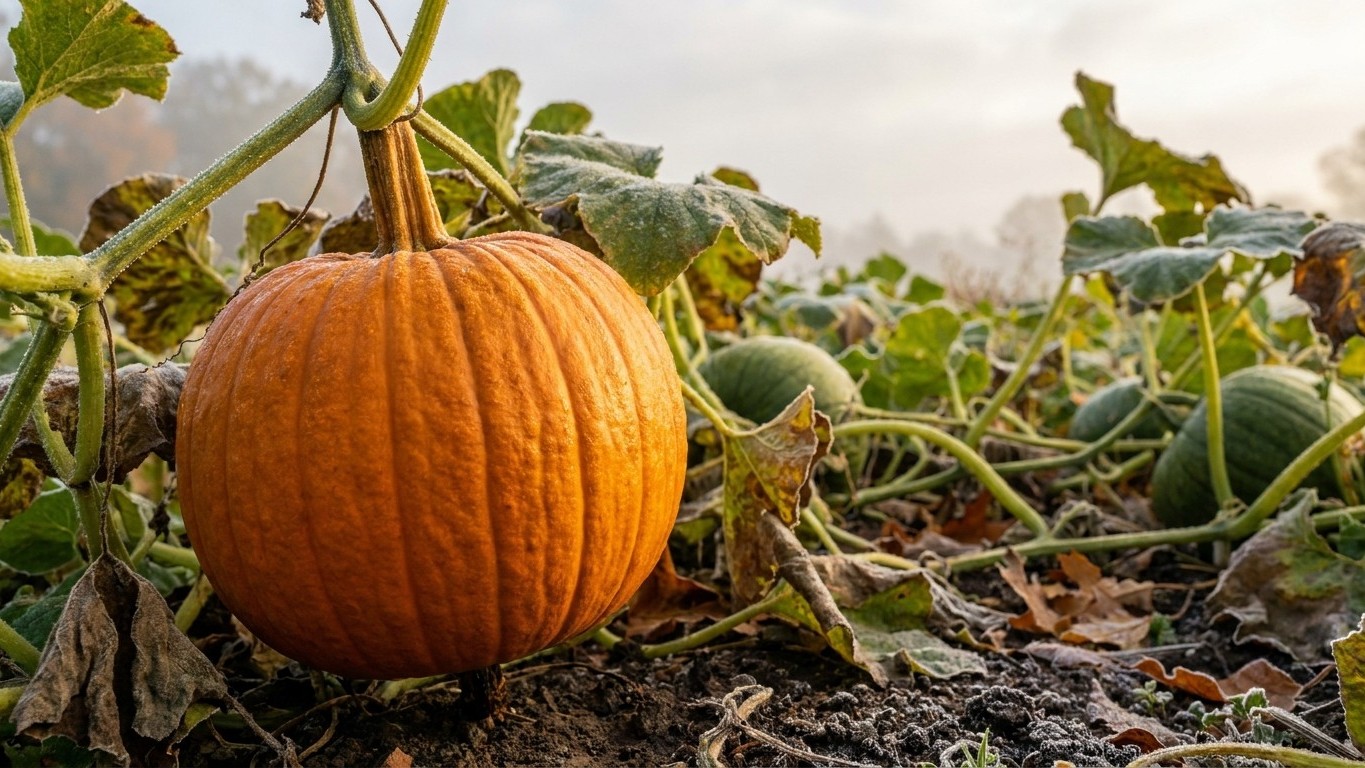

Yes, pumpkins can ripen on the vine in Pennsylvania, but only if their flowers open by roughly mid-September to early October. First fall frost lands between November 5 and November 16 across the state, and a pumpkin needs 45 to 55 days from the moment a flower opens, not from seeding, to finish coloring up. Miss that flowering window and you’re left with a green fruit and a frost warning. For a deeper look at the timing involved, see Will Pumpkins Ripen Before Frost in Pennsylvania?
The short answer
Start with the frost date, because everything else in a pumpkin patch works backward from it. NOAA’s 1991-2020 climate normals put Pennsylvania’s first fall frost, the date when the chance of a 32 F freeze crosses into the 30-70% range, somewhere between November 5 and November 16 depending on where in the state you’re standing. Philadelphia and the southeastern corner sit at the mild end of that window. The northern tier and the Alleghenies run colder, and given how much later those regions thaw out in spring, it’s reasonable to expect their fall frost to arrive at the earlier end of the window too, or before it, even though no separate fall figure for those counties is published here.
Utah State University Extension’s guidance on pumpkins is blunt about the clock: figure 45 to 55 days from flowering to a fully ripe, hard-skinned fruit. That’s the number that decides whether a Pennsylvania pumpkin patch succeeds or fails, and it has nothing to do with when the seed went into the ground.
Do the subtraction and you get a flowering deadline, not a single date but a real window, because the frost date itself is a window. Pair the earliest frost (November 5) with the longer 55-day maturation and the last safe day for a flower to open is around September 11. Pair the latest frost (November 16) with the shorter 45-day maturation and a flower can open as late as October 2 and still finish in time. Most gardeners should treat the earlier end, roughly the second week of September, as the planning target, since it protects against both an early frost and a slow-finishing fruit. The later date, into early October, is the optimistic outer edge, not something to count on.
That means the real question isn’t “when do I plant” so much as “when do my vines actually flower,” and that depends on how early you got seeds or transplants into warm soil back in spring.
When to sow here
The soil, not the calendar, decides when pumpkin seed goes in the ground. Utah State University Extension’s guidance ties sowing to a soil temperature of 65 F, and that threshold has no fixed relationship to the last spring frost date. Pennsylvania’s last spring frost falls between March 29 and April 6, but soil warms far slower than air does, lagging by weeks rather than days. Treating the frost date and the 65 F soil date as the same moment is the single most common planning mistake in a pumpkin patch, because bare, still-cold ground can sit well below 65 F for a good stretch after the air has already cleared frost risk. For a closer look at the specific soil-temperature windows and regional timing across the state, see When to Sow Pumpkins in Pennsylvania.
- Let the last frost window (March 29 to April 6) pass first. In the northern tier and the Alleghenies, where spring runs two to four weeks behind the rest of the state, push that expectation back accordingly before doing anything else.
- Check soil temperature directly with a probe thermometer a few inches down rather than guessing from air temperature. Wait for a consistent 65 F reading, not a single warm afternoon, before sowing.
- If the goal is an earlier flowering date, and therefore more cushion before the fall frost window arrives, lay row covers over the bed ahead of sowing. Row covers trap heat and can effectively buy about two weeks, letting soil reach 65 F sooner than bare, exposed ground would allow.
- Once seed is in, count forward to an expected flowering date and check it against the September flowering deadline worked out above. If the arithmetic is tight, a row cover head start is what closes the gap.
What goes wrong here
- A late flower that never colors. Vines that flower after the safe window simply run out of days. The fruit sizes up but stays pale green or fails to harden its rind before frost. The remedy is upstream: sow earlier using a soil thermometer and row covers rather than the calendar, so flowering happens well inside the September window instead of pushing into late September or October.
- A fruit caught by frost before the skin hardens. Even a fruit that’s colored can still have a soft rind. Utah State University Extension’s advice is to harvest with the stem attached and move fruit to where it will not freeze, ahead of the first fall frost rather than after it. Watching the frost date as a hard deadline, not a suggestion, is the fix.
- A vine that dies back before the rind toughens. Squash bugs and cucumber beetles can weaken and collapse vines well before frost, cutting the maturation period short even when the calendar still allowed time. Rather than re-describe those pests here, see this site’s dedicated pages on squash bugs in Pennsylvania and cucumber beetles in Pennsylvania for how to spot and manage them before they take the vine down early.
- A fruit that colors but stays soft. Color change and rind hardness don’t always arrive together. Give the full 45 to 55 days from flowering rather than pulling fruit as soon as it turns orange, and confirm hardness by pressing a thumbnail into the skin before cutting the stem.
Checking this against your own county
Every figure above is a statewide range, and Pennsylvania’s terrain is varied enough that a statewide range only gets a gardener partway there. A backyard in the Philadelphia suburbs and a hillside garden in the northern tier are not working with the same frost calendar, even though both sit inside the same November 5 to November 16 statewide window.
Penn State Extension (extension.psu.edu) is the named authority for county-level planting advice in Pennsylvania. Their local offices can narrow the frost dates and soil-warming pattern down to the specific county, which matters most for anyone gardening in the colder Alleghenies or the far northern counties where both spring and fall arrive on a different schedule than the statewide average suggests.
Common questions
Can I still get a ripe pumpkin if my vine flowers in early October?
Only at the mild end of the frost window. If the local first fall frost lands closer to November 16 rather than November 5, an early October flower can still finish in the shorter 45-day range. Anywhere the frost typically arrives earlier, that same flower is at real risk.
Does a warm September rescue a late-flowering vine?
Warm weather doesn’t shorten the 45 to 55 day requirement; that window is fixed to the flower’s development, not to how sunny the following weeks are. What warm weather can do is keep the vine healthy long enough to actually reach the fall frost date rather than collapsing early.
Is soil temperature or air temperature the better guide for sowing?
Soil temperature. The 65 F threshold for sowing has no fixed gap from the last frost date, since soil lags air temperature by weeks. A probe thermometer in the bed is more reliable than counting days from the frost date on a calendar.
What if my pumpkin colors up but frost is still weeks away?
Color alone doesn’t confirm readiness. Check for a hardened rind and harvest with the stem attached once both signs line up, then move the fruit somewhere it won’t freeze, rather than leaving it on the vine simply because time remains before frost.