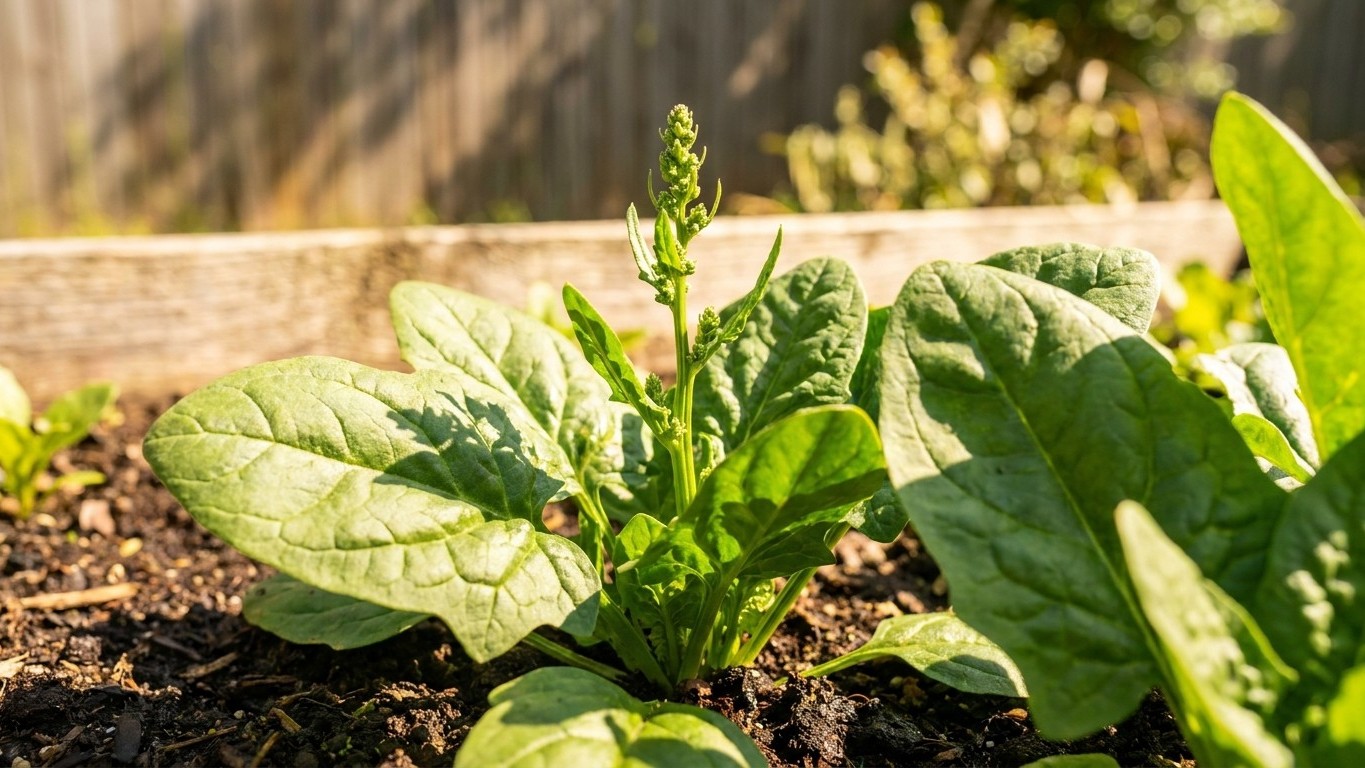

Yes. In British Columbia’s coastal climate, spinach bolts early not because summers get hot, but because the days get long. Near Vancouver, the summer solstice brings 16 hours and 1 minute of daylight, and that alone is enough to push spinach toward flowering. The region rarely sees true summer heat, so the crop’s real enemy here is light, not temperature.
The short answer
Start with the number that matters most: 16 hours and 1 minute of daylight on the longest day at the coastal reference station near Vancouver. That’s an enormous amount of light compared to what spinach tolerates before it starts sending up a flower stalk. Long days, combined with warmth, are what trigger bolting in spinach, and southwestern British Columbia hits that long-day mark whether or not the thermometer cooperates.
Here’s the twist that surprises a lot of gardeners moving to the coast from hotter regions: BC’s mild summers don’t buy extra growing time. The station near Vancouver averages 0.0 days a year at 90 degrees Fahrenheit or higher. That’s about as cool a summer heat load as you’ll find anywhere spinach is grown in North America. If heat were the only trigger, this climate would be close to ideal for spinach clear through July. It isn’t, because day length works independently of temperature, and the days here get plenty long enough to flip the bolting switch on their own.
So which is the real limiter in British Columbia: day length or heat? The answer is day length, decisively. Heat plays almost no role at the reference station, since the region essentially never crosses the 90-degree mark. But that cool summer doesn’t rescue the crop, because spinach doesn’t wait for heat before it bolts. It responds to the calendar’s light, and by the time the solstice arrives, the plant is getting a signal to reproduce regardless of how comfortable the air feels.
This matters for how you plan the season. In a hot inland climate, gardeners fight both day length and heat at the same time, and the two problems arrive together in early summer. In coastal British Columbia, the heat problem barely exists, but the light problem is just as strong as anywhere else at this latitude. That means the fix isn’t about finding shade or watering more to cool the soil. It’s about timing your sowings so the plant finishes its useful growth before the long days take over, and starting a second round only after the days have started shortening again in late summer.
How long the spring window really is
- Frost sets the earliest safe mark. The mean last spring frost at the Vancouver-area reference station lands around March 18. That’s a midpoint, not a guarantee. In roughly half the years on record, frost arrives later than that date, so treat it as the center of a window rather than a green light.
- Sowing happens ahead of that date. Spinach seed goes in the ground 2 to 3 weeks before the last frost, which puts the earliest realistic sowing somewhere around late February to early March for this area, assuming the soil is workable and not waterlogged from coastal winter rain.
- Cool growth continues while temperatures stay reasonable. Spinach grows best where temperatures don’t climb past 75 degrees Fahrenheit. Given that the reference station essentially never sees 90-degree days, the air temperature itself isn’t what shuts the spring crop down here.
- Day length becomes the deciding factor as the solstice approaches. As June nears and daylight stretches toward that 16-hour-and-1-minute peak, the long-day trigger for bolting strengthens regardless of how mild the weather has been.
- The usable spring window works out to roughly ten to twelve weeks. That’s sowing from late February into mid-March, harvesting through April and May, and wrapping up the spring crop by late May or the first days of June before the lengthening daylight pushes the plants to flower.
The autumn crop, and when the soil lets you sow
Soil too warm to germinate
Spinach seed germinates poorly once soil temperatures climb above 80 degrees Fahrenheit, according to Utah State University Extension. That threshold is the real gatekeeper for a late-summer sowing, not the calendar. In a coastal British Columbia climate, where the reference station records zero days a year above 90 degrees Fahrenheit in the air, soil rarely bakes the way it does in continental or interior climates. That’s a practical advantage for gardeners here: the ground is likely to cool below that 80-degree mark earlier in the season than it would in a hotter province or state, which opens the door to an August sowing sooner than gardeners further inland might expect. Exact soil temperature data isn’t published for this reference station, so the safest approach is to sow once the hottest stretch of summer has clearly passed and to avoid sowing into soil that still feels warm to the hand at planting depth.
The frost that ends the season
The mean first fall frost at the Vancouver-area reference station falls around November 10, again a midpoint rather than a fixed date. Utah State University Extension advises sowing a fall spinach crop 50 to 75 days before the date you want to harvest. Working backward from a harvest target just ahead of that mean frost date, say early November, puts the sowing window somewhere between mid-August and mid-September. Sow closer to mid-August for the full 75-day cycle, or wait until early-to-mid September if you’re comfortable cutting it closer to 50 days and accepting a smaller harvest window before frost. Since frost dates run later in half of all years, gardeners who sow on the later end of that range aren’t taking as much of a risk here as they might in a colder inland part of the province.
Four spinach varieties commonly discussed by extension services, Bloomsdale, Melody, Teton, and Olympia, are worth knowing by name if you’re comparing seed catalogs, though no maturity data or performance figures for these varieties appear in the source used for this article.
Common questions
Does a cooler BC summer mean spinach can be grown all season without bolting?
No. The cool summer here removes the heat trigger, but not the day-length trigger. Since the region reaches 16 hours and 1 minute of daylight at the solstice, spinach still receives the long-day signal that pushes it toward flowering, regardless of how mild the temperatures stay.
Should I sow spinach right on the average last frost date?
No. The March 18 mean last frost is a midpoint from Environment and Climate Change Canada’s 1981-2010 normals for the Vancouver Int’l A station, and frost arrives later than that in about half of all years. Sowing 2 to 3 weeks before that date is standard practice, but gardeners in colder inland or upland parts of the province should expect their own local frost dates to run later than this coastal reference figure.
What’s the earliest I can sow spinach for a fall crop in British Columbia?
That depends on when soil temperature drops below 80 degrees Fahrenheit at your planting depth, since germination struggles above that mark. No specific soil temperature record is published for the reference station, so watch your own garden’s soil rather than a calendar date, then count 50 to 75 days back from your intended harvest.
Is heat ever a real problem for spinach in this region?
Based on the reference station’s climate normals, essentially no. The station averages 0.0 days a year reaching 90 degrees Fahrenheit, which makes heat stress a minor concern here compared to interior or prairie climates. Day length remains the dominant factor pushing spinach toward bolting in British Columbia’s coastal areas.