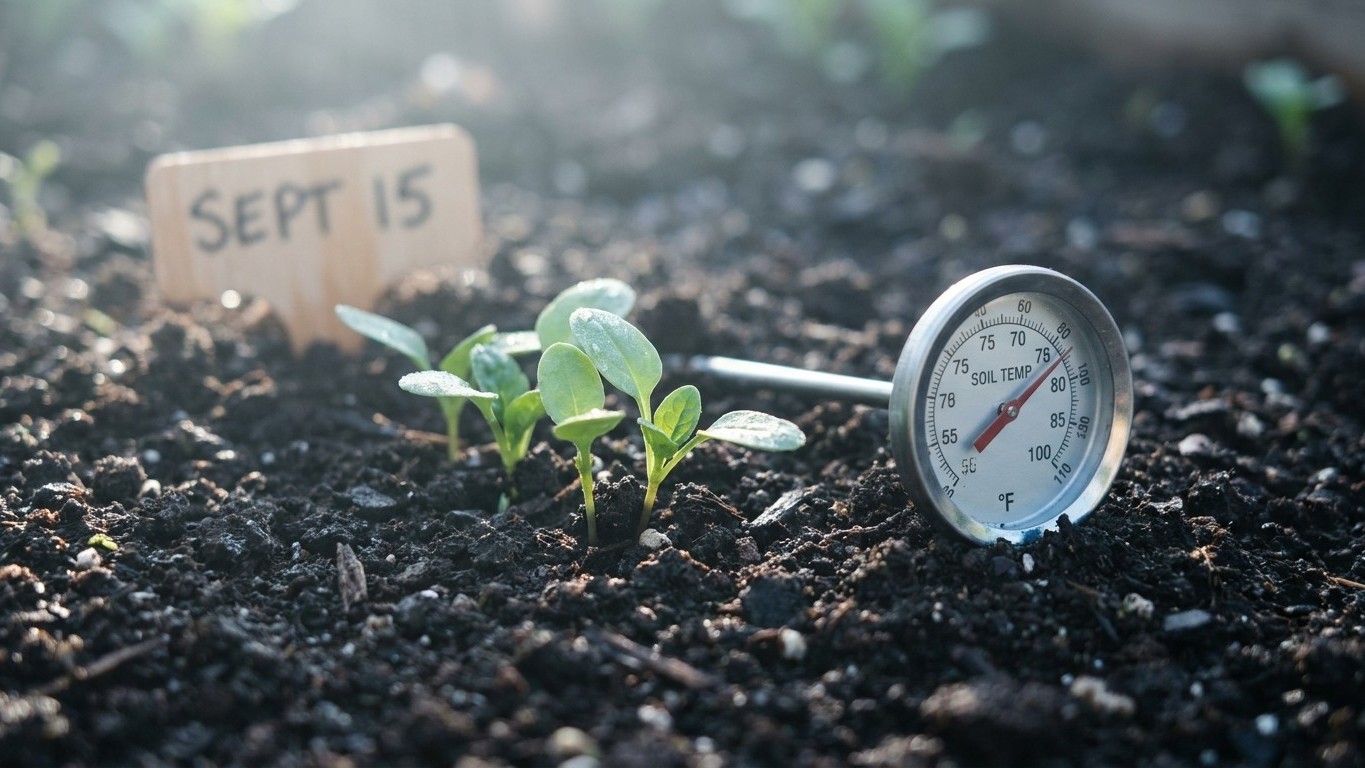

For coastal British Columbia, using Vancouver’s climate normals as the reference point, autumn spinach goes into the ground from mid-August through about September 21. That window comes from counting back 50 to 75 days from the region’s average first fall frost, November 10. Soil temperature matters too: Utah State University Extension notes spinach germinates poorly once soil passes 80°F, but this coastal climate averages zero days a year above 90°F, so warm soil rarely lingers into late summer here.
The short answer
Vancouver sits at a latitude where the longest day of the year delivers 16 hours and 1 minute of daylight. That’s the number that shapes everything else on this page, because spinach doesn’t wait for heat to bolt – long days alone push it toward flowering. A cool summer at this latitude does nothing to buy extra weeks of leaf growth if the days themselves are stretching past whatever length tells the plant to send up a seed stalk.
That’s the first crossing worth getting straight: for spinach, long days work against the gardener, not for the plant’s benefit. Onions run the opposite way at this latitude, with long summer days building the bulb. Spinach only bolts faster because of them. Sixteen hours and change of daylight in June sits well beyond the point where spinach stays vegetative, so the plant tips into reproductive mode no matter how mild the temperature happens to stay that week.
Heat plays a smaller supporting role here than it does further inland or south of the border. The Vancouver reference station averages 0.0 days a year at 90°F or hotter, essentially none. That’s a low heat load, and it means the 75°F growth ceiling Utah State University Extension describes for spinach isn’t crossed by scorching heat waves so much as by ordinary warm summer days stacking up once June arrives.
So which limits the crop here, day length or heat? Day length does the heavy lifting. Even in a summer with no punishing hot stretches, the calendar itself works against spinach as the solstice approaches. Heat adds to the problem at the margins, nudging soil warmer and adding bitterness once that 75°F line is crossed, but it isn’t the dominant force pushing plants to bolt the way it would be in a region logging dozens of 90°F days.
That combination explains why gardeners here grow spinach in two separate windows rather than one long summer run: a spring crop sown while days are still short and temperatures mild, and a fall crop sown once daylight hours are retreating and the mildest of the summer warmth has passed. Trying to carry spinach through the long days of June and July is fighting the plant’s biology, not the local weather.
How long the spring window really is
Working out the spring window means starting from one fixed point and one moving target, then seeing how much room sits between them.
- The fixed point is the last spring frost. Environment and Climate Change Canada puts the average last spring frost at station Vancouver Int’l A at March 18, based on the 1981-2010 climate normals. Spinach seed goes in the ground 2 to 3 weeks before that date, which puts a typical sowing somewhere between February 25 and March 4.
- That frost date is a midpoint, not a guarantee. Because it’s a mean figure, frost arrives later than March 18 in roughly half of all years. Sowing at the early edge of that window means accepting some risk of a late cold snap, and gardeners away from the immediate Vancouver area, especially inland or at higher elevation, should expect the real date to run later still.
- The moving target is the 75°F growth ceiling. Utah State University Extension describes spinach growing best where temperatures stay under 75°F, with quality and flavor both dropping once that line is crossed. Combined with the day-length effect described above, that ceiling typically arrives well before the calendar reaches the June 21 solstice, since rising temperatures and lengthening days work together rather than separately.
- Put together, that leaves a spring window of roughly three months at most. From a late February sowing to a point somewhere in late spring or very early summer, when heat and day length combine to push the crop toward bolting, gardeners here get one solid spring harvest window rather than a long summer-long supply.
No source publishes an exact days-to-maturity figure for spinach, so there’s no way to pin an exact last-harvest date onto that window. The practical approach is to sow as early as the soil can be worked after late February, harvest continuously as leaves size up, and expect the crop to bolt on its own timeline once late-spring warmth and long days catch up with it, not on a date printed on a seed packet.
The autumn crop, and when the soil lets you sow
Fall spinach faces two separate obstacles, and they sit at opposite ends of the calendar. One blocks the seed from sprouting at all; the other cuts the harvest short before the crop finishes growing.
Soil still too warm to germinate
Utah State University Extension is specific on this point: spinach seed germination drops once soil temperature climbs above 80°F. In many parts of the continent, that means fall sowing has to wait for a real cooldown in late summer. Coastal British Columbia has an easier time of it. With an average of 0.0 days a year reaching 90°F at the Vancouver reference station, soil here rarely holds enough heat load to sit above 80°F for long stretches, even in August. That doesn’t mean soil temperature is never a factor. A run of unusually warm, sunny days in late summer can still slow germination for a week or two, but it’s a smaller hurdle in this climate than it would be in a hotter region, where growers have to wait out weeks of baked soil before seed will sprout reliably.
Counting back from the first fall frost
The bigger constraint here is time itself. Environment and Climate Change Canada’s 1981-2010 normals put the average first fall frost at Vancouver Int’l A at November 10. Utah State University Extension recommends sowing a fall spinach crop 50 to 75 days before the date you want to harvest. Counting back from November 10 puts that sowing window between August 27 and September 21.
As with the spring frost date, November 10 is a mean, not a promise. Frost arrives later than that in about half of all years, which gives some cushion on the late end of the sowing window. But treating it as a firm backstop rather than a sure thing is the safer approach, particularly for gardeners outside the immediate Vancouver area, since inland and higher-elevation districts in the province typically see frost arrive earlier than this coastal average. Sowing toward the earlier half of the August 27 to September 21 window, rather than waiting until late September, leaves more room for the crop to finish before the season’s first hard cold shuts it down.
Four spinach varieties turn up repeatedly in extension guidance for fall crops:
- Bloomsdale
- Melody
- Teton
- Olympia
Utah State University Extension names these without publishing days-to-maturity figures or other performance data for any of them, so there’s no verified basis here for recommending one variety over another.
Common questions
Can I sow spinach in July for a fall harvest in British Columbia?
It’s risky. In July, days are still long and soil is at its warmest point of the year, which pushes a young spinach crop toward bolting before it ever fills out. Waiting until the August 27 to September 21 window, once days have started shortening and the soil has eased off its summer peak, is the more reliable approach for this coastal climate.
What happens if I miss the September 21 sowing cutoff?
The crop has less margin to reach a useful size before the average first frost on November 10. Because that frost date is a mean rather than a guarantee, a mild autumn could still allow a late-sown planting to produce something, but there’s no published data here to promise it. Sowing earlier in the window, rather than pushing the cutoff, remains the safer bet.
Does the mild coastal climate mean I can skip the gap between spring and fall crops?
No. The gap exists mainly because of day length, not just heat. Vancouver’s summer solstice brings 16 hours and 1 minute of daylight, which is well beyond what keeps spinach vegetative regardless of how mild the actual temperature stays that week. Even a cool coastal summer doesn’t cancel that effect.
Is the average frost date safe to plan sowing around?
Treat it as a midpoint, not a safe date. Both the March 18 last-frost average and the November 10 first-frost average come from Environment and Climate Change Canada’s 1981-2010 normals at station Vancouver Int’l A, and in roughly half of all years frost arrives later than each of those dates. Gardeners further inland or at higher elevation within the province should expect their own local frost dates to run earlier or later than this single coastal station reflects.