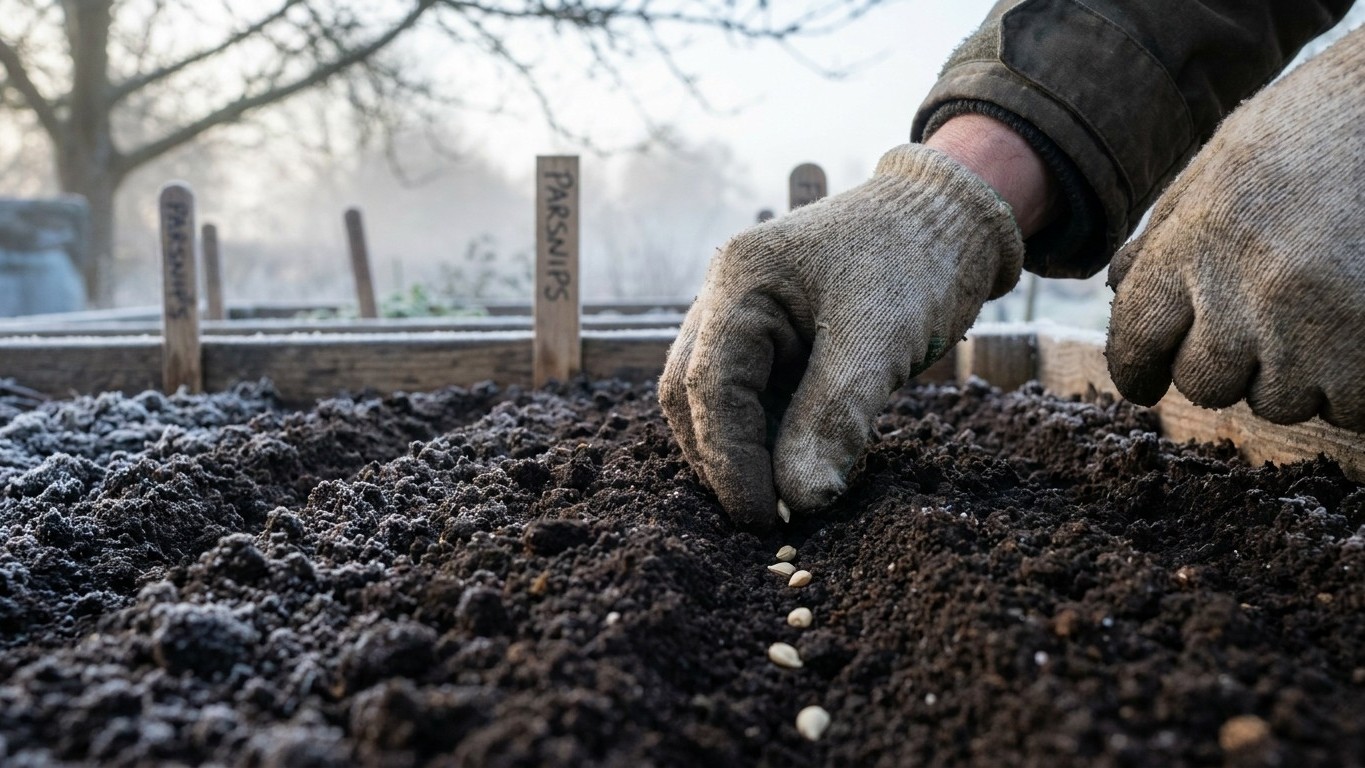

Denver’s frost calendar answers this in one line: sow parsnip seed directly in the ground 2 to 3 weeks before the last spring frost, which falls between May 1 and May 11 on the Front Range plains. That puts the sowing window in mid-to-late April. Mountain towns and the western slope run their own calendars entirely.
The short answer
The number that actually decides this isn’t a hardiness zone label. It’s the mean minimum temperature of the coldest month, and for the Denver reference station that figure is 18.4°F. That’s not a light-frost reading. A mean daily low near 18°F across an entire winter month means the ground and anything left in it are exposed to real, sustained cold for weeks, not for a single overnight dip.
That distinction matters more for parsnips than for almost any other root vegetable. Utah State University Extension notes that parsnips taste best after several weeks of cool, frosty weather, because that exposure converts the starch stored in the root into sugar. A parsnip pulled in September, before frost has had time to work on it, is edible but starchy and flat. The same root left in the ground through a run of freezing nights turns noticeably sweeter.
Denver’s winter delivers exactly that kind of prolonged cold exposure. An 18.4°F average minimum for the coldest month isn’t a marginal, borderline climate where frost shows up once or twice and then backs off. It’s a sustained cold season, which is the specific condition parsnips need to sweeten rather than merely mature. Grow a parsnip here, leave it in the ground into and through the cold months, and the frost exposure that drives sweetening is built into the local winter, not something you have to hope for.
This is worth stating plainly because gardeners sometimes reach for the USDA hardiness zone number as shorthand for “will it get cold enough.” That number describes the coldest temperature a perennial plant can survive over winter. It says nothing about how many frosty weeks a biennial root vegetable sits through before harvest. A location can sit in a mild-sounding zone and still deliver plenty of hard frost, or the reverse. Here, the actual measured figure, the 18.4°F coldest-month minimum, tells you directly: Denver’s plains winter is cold enough, for long enough, to do the sweetening work parsnips depend on.
Does the season fit?
Parsnips need 100 to 120 days from seeding to a harvestable root, according to Utah State University Extension. Sowing happens 2 to 3 weeks before the last spring frost, since the seed tolerates cool soil and the seedlings handle a light frost better than the roots handle late planting. Laying that timeline against Denver’s actual frost dates shows how much room there is to work with.
- Start with the last frost window. NOAA’s 1991-2020 climate normals put the Denver last spring frost between May 1 and May 11.
- Subtract 2 to 3 weeks for sowing. That lands the sowing date somewhere between roughly April 10 and April 27, depending on where in that window the last frost actually falls a given season.
- Account for germination before anything visible happens. Parsnip seed is slow. Expect 14 to 21 days in the ground before sprouts appear, and don’t assume a bare-looking row means a failed sowing. Re-sowing too early just doubles up seedlings later.
- Add the 100 to 120 day growing period from the seeding date. A sowing on April 10 reaches maturity around July 19 at the 100-day mark. A sowing on April 27 reaches the 120-day mark around August 25.
- Compare that to the first fall frost. NOAA’s normals put Denver’s first fall frost between September 30 and October 12.
- Read the gap. Even the latest maturity date, late August, lands a full month or more before the first fall frost arrives. That gap isn’t wasted time. It’s the buffer that lets the roots sit in cooling soil, absorb the first frosty nights, and start converting starch to sugar before you dig them.
The arithmetic works comfortably here. Denver’s frost-free stretch is long enough to grow a full-season parsnip and still leave weeks of cushion on both ends, which is more forgiving than tight coastal or high-mountain windows where the math barely closes.
What goes wrong here
- Forked, split roots from heavy or stony ground. Front Range soil runs heavy in clay in a lot of neighborhoods, and any rock or clod a taproot meets on its way down makes it split around the obstruction. Utah State University Extension recommends deep, sandy soil for parsnips, and where the native ground is heavy, double digging the bed before sowing so the root has loose, stone-free soil to push through.
- Forked roots from overwatering, a separate cause entirely. Even in good soil, roots that sit in consistently soggy ground tend to branch rather than run straight down. This isn’t a soil texture problem, it’s a watering habit problem, and the fix is even, moderate moisture rather than heavy, frequent soakings.
- A season that runs out because sowing got delayed. Denver’s frost-free window is generous, but 100 to 120 days plus a slow 14-to-21-day germination adds up fast. Pushing the sowing date into May instead of mid-to-late April eats into the margin that normally protects this crop, and a wet or late spring can compress that window further.
- Harvesting before the frost has done its work. Denver’s winters are cold enough overall, but a gardener who digs the whole row in early September, right after the roots size up, skips the frosty weeks that build sugar. The fix is patience: let the roots sit through the first fall frost and into the cooling weeks that follow before harvesting, rather than pulling them the moment they look ready.
Common questions
Can I start parsnip seeds indoors and transplant them in Colorado?
No. Parsnips are sown directly in the ground where they’ll grow. The taproot doesn’t handle transplanting well, and disturbing it typically produces a forked or stunted root regardless of how carefully the soil was prepared beforehand.
How long does it take parsnip seed to germinate?
Expect 14 to 21 days before seedlings appear. That’s slow compared with most garden vegetables, and it’s easy to assume a sowing has failed and dig it up prematurely. Give it the full three weeks before deciding to re-sow.
When should I actually pull parsnips from a Colorado garden?
Once the roots reach full size, after the 100-to-120-day mark from seeding, leave them in the ground through the first fall frost and the cooler weeks that follow. That’s the frost exposure that converts starch to sugar. Denver’s coldest-month average minimum of 18.4°F confirms the winter cold is there to do that work if you give it time.
Does Colorado’s clay soil rule out growing parsnips at all?
No, but it does change how you prepare the bed. Utah State University Extension calls for deep, sandy soil, and where the native ground runs heavy, double digging the bed to loosen and de-stone it gives the taproot a straight path down instead of forcing it around obstructions.