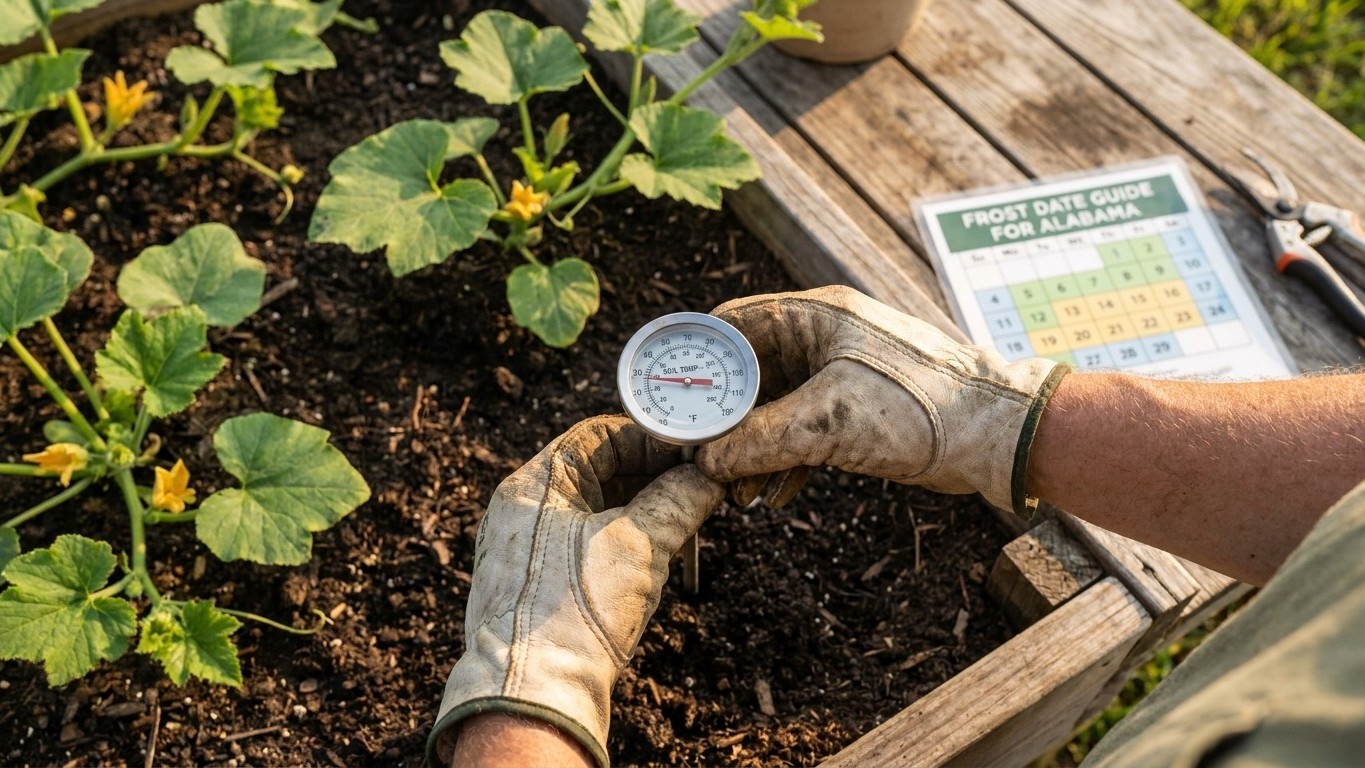

Iowa’s pumpkin calendar starts with soil temperature, not a date on the wall. Seeds go into the ground once soil reaches 65°F, which in most seasons lands sometime in mid-to-late May here. That trigger exists to protect the other end of the calendar: every flower on the vine has to open early enough to ripen a full 45 to 55 days before Iowa’s first fall frost, which arrives somewhere between October 14 and October 25.
The short answer
Iowa’s growing season closes with a first fall frost landing between October 14 and October 25, based on NOAA NCEI’s 1991-2020 climate normals for the 30-70% freeze probability band. That window is the fixed point the whole calendar works backward from, and every pumpkin flower on the vine has to open early enough to finish ripening before it hits.
Utah State University Extension’s guidance puts pumpkin maturation at 45 to 55 days after flowering, not after seeding. That distinction changes the entire backward count for an Iowa garden. Counting 45 days back from the earliest frost date, October 14, lands on August 30. Push it to 55 days and the deadline moves to August 20. Using the later end of the frost window, October 25, gives more room: a 45-day count lands on September 10, a 55-day count on September 1.
So depending on which end of the maturation range a given fruit falls on, and which end of the frost window shows up that particular year, the safe flowering deadline for Iowa sits somewhere between August 20 and September 10. Anything blooming past that line risks a green, unripe pumpkin caught by the season’s first hard freeze.
One caution belongs in that math. Iowa State Extension’s county-level figures, drawn from 1950-2021 records, tend to run about 10 days earlier in fall than the airport station NOAA uses for the statewide normals. A grower relying only on the October 14-25 window may be looking at the optimistic end of things. If frost tends to arrive closer to early October in a given county, the safe flowering deadline should slide back too, closer to mid-August than early September.
None of this touches sowing dates yet. Flowering happens well after seeds go into the ground, and that gap between sowing and blooming is where the next set of decisions comes in.
When to sow here
Soil temperature, not the calendar date of the last frost, decides when pumpkin seeds go into Iowa ground. Utah State University Extension’s guidance calls for waiting until soil reaches 65°F, and that threshold has nothing to do with the air temperature reading that ends frost risk for the season.
Iowa’s last spring frost falls between April 12 and April 24, per NOAA NCEI’s 1991-2020 normals. But bare soil warms far more slowly than the air above it. A gardener who sows the week after the last frost date is very likely sowing into soil that’s nowhere near 65°F yet. That gap between the air clearing and the soil catching up routinely runs into weeks, which is why treating the frost date as a sowing signal leads to seed rot and weak germination in cold, wet ground.
Here’s how the sequence plays out for an Iowa garden:
- Start tracking the last spring frost window, April 12 to April 24, as a floor, not a green light. Frost tapering off doesn’t mean the ground underneath it has caught up.
- Check soil temperature directly at seed depth with a soil thermometer rather than guessing from air temperature. Soil in most Iowa gardens doesn’t reach the 65°F mark until well into May.
- Hold off sowing until that 65°F reading is consistent across several days, not a single warm afternoon. A brief warm spell can spike a one-day reading without the deeper soil catching up with it.
- If the calendar feels tight, row covers buy roughly two weeks of head start by trapping ground heat and blocking wind, letting seeds go in earlier than bare, uncovered soil would allow.
- Once sown, count forward toward the flowering deadline established earlier, mid-August to early September, and treat any planting that pushes flowering past that window as a real risk rather than a routine choice.
Iowa State Extension’s county-level frost data also runs about four days later in spring than the airport-based normals NOAA publishes, which nudges the safe sowing window slightly later than the statewide figure alone would suggest. That’s a small adjustment, but it stacks with the soil-lag effect rather than working against it. The sensible move is waiting for a confirmed soil reading over guessing from a frost-free forecast.
What goes wrong here
Iowa’s flowering deadline, and the slow climb of soil temperature that precedes it, create a handful of predictable failure points each season. Most trace back to timing rather than plant care.
- A late flower that never colors. When pollination happens after the safe flowering deadline (mid-August to early September, depending on how the year’s frost timing plays out), the fruit doesn’t get its full 45 to 55 days before cold weather stops growth. The pumpkin stays green or pale orange, and ripening it on the counter after picking won’t finish the job. The remedy is watching bloom dates through midsummer and pinching off new flowers that open too late to mature, so the plant’s energy goes to fruit already on track.
- A fruit caught by frost before harvest. Even a fruit that colored on schedule can suffer if it’s left on the vine past the first fall frost, somewhere between October 14 and October 25 for most of Iowa, potentially earlier in colder counties. Frost damage on the rind shortens keeping time and invites rot. The fix is harvesting with the stem attached ahead of that window, then storing cured pumpkins somewhere they will not freeze, which is the storage guidance Utah State University Extension actually gives, without a specific temperature or keeping time attached.
- A vine that dies back before the skin hardens. Powdery mildew, borer damage, or simple end-of-season decline can kill foliage before the rind has fully cured. A soft, thin-skinned pumpkin won’t store well even if it looks ripe. Cutting losses early, harvesting once the rind resists a fingernail press rather than waiting on a vine that’s already failing, protects whatever fruit is salvageable.
- Pest pressure compounding a tight calendar. Squash bugs and cucumber beetles both show up on Iowa pumpkin vines and can weaken plants right when the flowering deadline leaves no room for delay. Rather than re-covering identification and control here, see this site’s dedicated pages on squash bugs in Iowa and cucumber beetles in Iowa for management steps specific to those insects.
Common questions
Can I still sow pumpkins in June in Iowa?
It’s tight. A June sowing pushes flowering close to, or past, the safe deadline of mid-August to early September established by counting 45 to 55 days back from the October 14-25 frost window. Some seasons will still work out if frost lands on the later end and pollination happens early in the vine’s growth, but it’s a narrower margin than sowing once soil hits 65°F in May.
What if my pumpkin vine is still flowering in September?
Any flower opening after the safe deadline is unlikely to produce a fully colored fruit before frost, since it needs 45 to 55 days to mature from that bloom. Removing late flowers redirects the plant’s energy to fruit that already has a chance of finishing on time.
How can I tell when my soil has actually reached 65°F?
A soil thermometer pushed to seed depth is the only reliable way. Air temperature and a single warm afternoon can both mislead, since soil warms more slowly than the air above it and needs a consistent reading over several days before it’s safe to sow.
Which pumpkin varieties are commonly grown in Iowa?
Home gardens and patches across the state grow a wide range of named varieties, including Connecticut Field, Howden, Jack Be Little, Cinderella, Big Max, Small Sugar, Autumn Gold, Baby Bear, and Atlantic Giant. Days-to-maturity, size, and color vary by variety and aren’t covered by the sources behind this page, so check the specific seed packet for those figures before planning a sowing date around a particular variety.