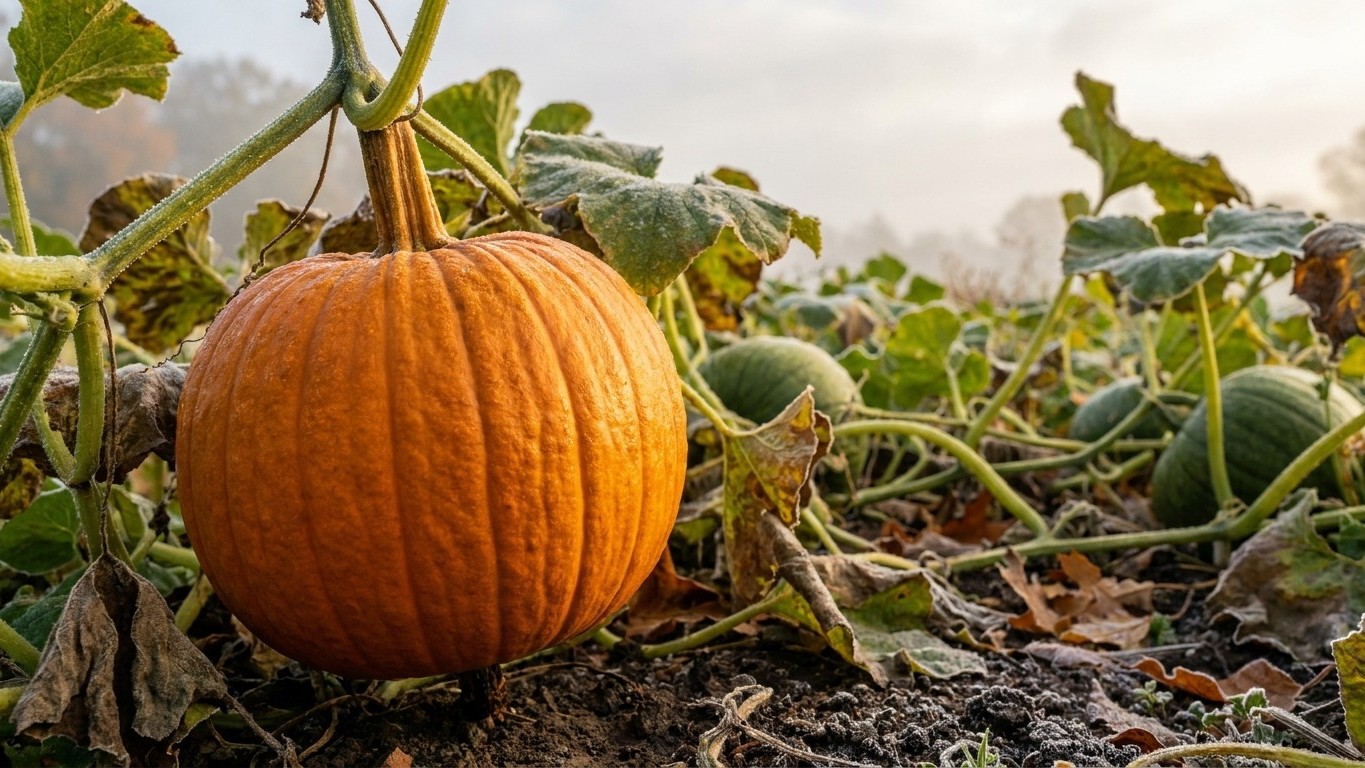

Most Iowa gardeners get a ripe pumpkin by fall, but the margin is thinner than the calendar suggests. What decides the outcome isn’t the sowing date, it’s the day the flower opens, since the fruit has only 45 to 55 days from that point to finish before frost ends the season. Get that flowering window wrong and a healthy vine can still turn out fruit that’s the wrong color, or none at all.
The short answer
Iowa’s first fall frost lands somewhere between October 14 and October 25, based on the 1991-2020 climate normals recorded at the state’s benchmark weather station (NOAA NCEI). That’s the finish line. The pumpkin clock, according to Utah State University Extension, runs 45 to 55 days from the moment a flower opens, not from the day the seed goes into the ground. Confuse those two starting points and every date that follows is wrong.
Working the math backward
Counting back 45 days from the earliest frost date, October 14, lands on August 30. Counting back 55 days from the latest frost date, October 25, lands on September 10. Somewhere between those two figures, roughly the last ten days of August through the first ten days of September, sits the true cutoff. A flower that opens later than that has a real chance of still being green when the first hard freeze blackens the vine.
Why the airport number is the optimistic end
That calculation uses a single benchmark weather station, and it’s the generous version. Iowa State Extension’s county-level data, drawn from measurements taken between 1950 and 2021, run about ten days earlier in fall than the airport-based normal NOAA publishes statewide. Shift the fall frost window ten days earlier and the flowering cutoff moves with it, closer to mid-to-late August in much of the state rather than early September.
None of this says a pumpkin planted on any particular date will or won’t ripen. It says the flowering date, not the planting date, decides the outcome, and that flowering date has to land inside a window that closes around the turn of August into September for most of Iowa, earlier still in counties that run cooler than the benchmark station. For a closer look at Will Pumpkins Ripen Before Frost in Iowa?, watch the vines once flowering starts, not the calendar; a stretch of cloudy, cool weather in July can push the first female flowers back by a week or more without any change to the frost dates themselves.
When to sow here
Working out a When to Sow Pumpkins in Iowa starts with the last spring frost, then adds the lag between air temperature and soil temperature, then subtracts what a row cover can buy back.
The sowing sequence
- Start with the last spring frost. NOAA’s 1991-2020 climate normals put it between April 12 and April 24 for the benchmark station. Iowa State Extension’s county figures run about four days later than that, so gardeners outside the immediate area of the benchmark station should treat the later end of that window, or a few days past it, as the safer marker.
- Don’t sow on that date. Pumpkin seed needs soil at 65°F to germinate reliably, according to Utah State University Extension, and soil doesn’t warm at the same pace as the air. Bare Iowa soil typically lags several weeks behind the last frost before it holds steady at that temperature, since a few warm afternoons don’t undo months of stored winter cold in the ground.
- Test the soil rather than guess it. A soil thermometer pushed four inches down at midmorning gives a more honest reading than counting days on a calendar. Wait for three or four consecutive mornings above 65°F before sowing seed directly.
- Use a row cover to close the gap. A floating row cover laid over the bed traps daytime heat and can let a gardener sow roughly two weeks earlier than bare soil would allow, since the fabric raises soil temperature under it faster than open air alone.
- Add it up. Last frost in mid-to-late April, several weeks of soil warm-up, minus roughly two weeks if a row cover is in play, puts most direct sowing in Iowa somewhere in the second half of May. That timing only matters insofar as it gets the vine to its first female flowers before the late-August to early-September cutoff worked out above.
What goes wrong here
The three failure points
- A late flower that never colors. When the first female flowers don’t open until mid-September, the 45- to 55-day clock runs past the frost window entirely. The fruit sizes up but stays green or pale, because turning orange needs weeks of warm days that aren’t left on the calendar. The fix is upstream: get seed into 65°F soil as early as that threshold allows, and pinch off any new flowers opening after the first week of September so the plant puts its remaining energy into fruit already set rather than starting fruit with no chance of finishing.
- A fruit caught by frost before the vine gives up. A pumpkin can hold decent color and still have soft, thin skin when an early freeze lands inside the October 14-25 window. Frost-killed foliage stops sugar production overnight, and fruit left exposed after that can suffer rind damage. Cut fruit with the stem attached as soon as frost is forecast, and move it somewhere it will not freeze, since Utah State University Extension gives no fixed storage temperature or keeping time for cured pumpkins, only that condition.
- Vines that collapse before the skin hardens. Powdery mildew, drought stress, or a season that simply runs long can kill leaves weeks before the fruit is ready, and a pumpkin without leaves to feed it stops hardening its rind. Deep watering through August and keeping foliage disease in check buys the vine the extra weeks it needs to finish the skin, which matters more for storage than for size.
- Vines weakened by pests before the fruit finishes sizing. Insects already covered elsewhere on this site, including squash bugs and cucumber beetles, drain reserves a late-setting fruit needs to finish. Scout and treat early rather than waiting until the vine is already stressed by the calendar.
Checking this against your own county
The frost dates above come from one benchmark weather station, and Iowa State Extension’s own county-level figures already show why that matters: their 1950-2021 data run about four days later in spring and roughly ten days earlier in fall than the single airport-based record NOAA publishes. A garden in a river valley or a low frost pocket can see numbers further off still.
Iowa State University Extension and Outreach (extension.iastate.edu) publishes county-specific frost data and staffs local offices that track the microclimate variation a statewide average can’t capture. Checking with the office for a specific county is the most direct way to find out whether the flowering cutoff calculated here runs a few days earlier or later on a particular piece of ground, especially near a river, in a valley, or on wind-exposed high ground.
Common questions
Can I still plant pumpkins in July in Iowa?
Not with much margin. A July sowing typically flowers in August, which can still work in a mild year, but it leaves little room for the cool, cloudy stretches that regularly push flowering back a week or two. Anything sown after the Fourth of July is racing the October frost window calculated above.
Do pumpkins ripen after they’re cut from the vine?
Utah State University Extension doesn’t describe a ripening process after harvest, only storage conditions where the fruit “will not freeze.” A pumpkin cut green with the stem attached may hold longer than one left on a dying vine, but it isn’t documented to gain color or sugar once separated from the plant.
Why did my pumpkin flowers fall off without setting fruit?
Early male flowers open before any female flowers appear, and they drop naturally without being expected to set fruit. If female flowers, the ones with a small bulge behind the petals, are opening and still failing to set, the more common culprit is a lack of pollinator visits during the few hours each bloom stays open.
Which pumpkin varieties finish fastest in a short Iowa season?
Seed catalogs list dozens of varieties, including familiar names like Jack O’Lantern, Connecticut Field, Sugar Pie, Baby Boo, Howden, Cinderella, Big Max, Atlantic Giant, and Autumn Gold, but maturity days vary by seed source and aren’t standardized across catalogs. Check the days-to-maturity printed on the specific seed packet, then run it against the flowering window calculated above rather than relying on the variety name alone.